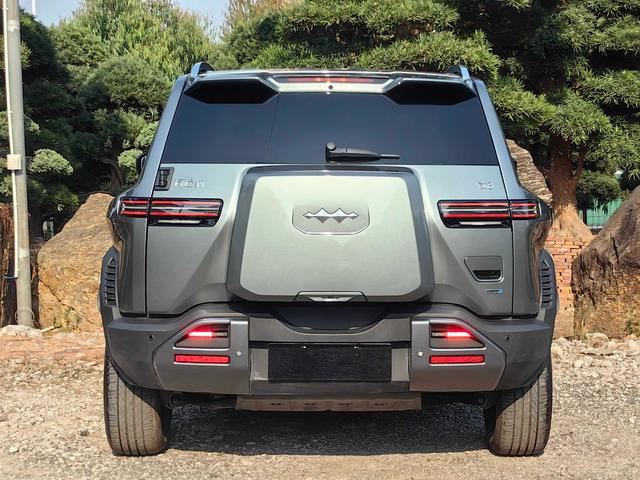
BYD Leopard (Fangchengbao) Titanium 7 2026 300KM AWD Ultra Vehicle Profile: 300km PHEV, Dual-Motor AWD & Full Pros/Cons

1. Verdict: Three Highlights & Three Caveats
Three Highlights:
- 300 km of electric range — a worry-free week of commuting: A large plug-in hybrid battery pack delivers 300 km of CLTC electric-only range, covering most households’ weekly daily commutes. Combined with roughly 1310 km of combined range, you can drive it as an EV every day and use hybrid mode for long trips, keeping refueling pressure low.
- Dual-motor AWD + 4.5s 0–100 km/h — plenty of power: The dual-motor all-wheel-drive layout delivers a combined output of around 360 kW and a claimed 4.5-second 0–100 km/h time. Whether overtaking in the city or cruising on the highway, the power reserve feels generous, and it adds a measure of off-road capability.
- Mid-to-large size + spacious five-seat cabin, family first: With a 4999 mm length and 2920 mm wheelbase in a five-door, five-seat layout, cargo volume ranges from 970 to 1880 L. The boxy silhouette yields a neat, open cabin and load area, making family travel more relaxed.
Three Caveats:
- Boxy styling — more noticeable highway wind noise: Because of the squared-off body, wind noise at highway speeds is more noticeable than in a similarly sized, streamlined SUV, slightly reducing long-distance cruising refinement.
- Large and heavy, less agile in tight urban spaces: At nearly 2 meters wide and about 2530 kg curb weight, it feels big in narrow old-town streets and multi-storey parking garages; parking and squeezing through tight streets requires extra margin.
- A recent launch — long-term reliability still to be proven: As a model launched in August 2026, long-term quality stability and used-car resale value remain to be validated by the market — a factor worth noting with any brand-new model.
2. Model Overview
Fangchengbao (BYD Leopard) is BYD’s sub-brand focused on personalization and “pleasure-first, family-ready” vehicles. The Titanium 7 is the mid-to-large SUV in Leopard’s Titanium series, positioned as a “five-seat ceiling” style of rugged yet family-oriented car — pairing a squared, tough “box” exterior with space, comfort, and family-oriented features at its core.
The Titanium 7 is offered in both plug-in hybrid and pure-electric forms. This profile focuses on the 2026 300KM AWD Ultra trim, which uses hybrid power: a 1.5T turbo engine plus dual-motor AWD, delivering long EV range and long combined range as an “electric for daily, fuel for long trips” solution. Styling-wise, the Titanium 7 uses flat, boxy bodywork with a “Star Ark” interior, giving it strong road presence.
On chassis and intelligence, the Titanium 7 uses a front double-wishbone and rear five-link independent suspension with the YunLian-C intelligent damping system, and it carries BYD’s ShenZhiZhiYan (God’s Eye) driver-assistance suite. Since launch, the Titanium 7 has drawn strong attention in its segment for combining mid-to-large size, advanced features, and a relatively restrained price, with some media describing it as a car that “welds rugged styling to family comfort.”
3. Core Specifications
| Category | Item | Specification |
|---|---|---|
| Model & Powertrain | Brand | Fangchengbao (BYD Leopard) |
| Model | Titanium 7 2026 300KM AWD Ultra | |
| Powertrain | Plug-in hybrid (PHEV) | |
| Body | 5-door, 5-seat SUV | |
| Powertrain Details | Engine | 1.5T turbocharged L4 (156 hp, 115 kW, 225 N·m) |
| Motors | Dual-motor (front + rear) AWD | |
| Combined power | approx. 360 kW (~490 hp) | |
| Transmission | E-CVT | |
| 0–100 km/h | 4.5 s | |
| Top speed | 190 km/h | |
| Range & Charging | CLTC EV range | 300 km (WLTC approx. 210 km) |
| CLTC combined range | approx. 1310 km | |
| Battery | approx. 50 kWh (LFP blade battery) | |
| Fast charge (30%–80%) | approx. 0.23 h | |
| Fuel tank | 60 L | |
| Dimensions & Space | L × W × H | 4999 × 1995 × 1865 mm |
| Wheelbase | 2920 mm | |
| Curb weight | approx. 2530 kg | |
| Cargo volume | 970–1880 L | |
| Chassis & Safety | Suspension | Front double-wishbone + rear five-link independent, YunLian-C intelligent damping |
| Tires | 255/55 R20 | |
| Active safety | ABS, EBD, vehicle stability control, tire pressure monitoring | |
| Passive safety | Multiple airbags, TSC high-speed blowout assist stability control | |
| ADAS & Cockpit | Driver assistance | ShenZhiZhiYan — God’s Eye (DiPilot 300 high-level ADAS) |
| Cockpit | Large central screen + digital cluster + HUD, multi-screen linkage, voice control | |
| Warranty & Service | Vehicle warranty | 6 years or 150,000 km |
| Three-electric warranty | Lifetime warranty for first non-commercial owner (subject to official terms) |
Subsidy Policy (framework per IEA Global EV Policy Explorer):
| Country / Region | Policy Notes |
|---|---|
| China | PHEVs benefit from phased purchase tax exemption (per latest official rules) |
| Some EU countries | Some markets offer purchase subsidies or tax relief for PHEVs; terms vary |
| Parts of North America | Eligible new-energy vehicles may qualify for federal tax credits, depending on model and origin |
Note: Regional subsidy policies change with fiscal cycles — always verify the latest official rules in your target market before purchase.
4. Ownership Costs & Service
- Warranty: The whole vehicle is covered for 6 years or 150,000 km, with a lifetime warranty on the three-electric system for non-commercial first owners. Backed by BYD’s service network, warranty and maintenance coverage is broad and repairs are generally convenient.
- Maintenance cost: PHEVs typically follow a maintenance interval of about 10,000 km, with routine service focused on oil/filter changes and inspection of the three-electric system, keeping costs more contained than a conventional fuel vehicle. Long-term servicing costs stay at a moderate-to-low level within its class (confirm with your local dealer).
- Charging cost: Using an approximate global average residential rate of USD 0.18/kWh: at an energy consumption of roughly 20–26 kWh per 100 km in EV mode, that equals about USD 3.6–4.7 per 100 km — a clear advantage over fuel in most markets. With long combined range and the option of either charging or refueling, cost flexibility for long trips is high.
Subsidies & Policy by Country (source: IEA Global EV Policy Explorer):
| Country / Region | Policy Type | Notes |
|---|---|---|
| China | Purchase tax exemption | PHEVs qualify for phased purchase tax exemption (per latest official rules) |
| Germany | Purchase subsidy (by phase) | Has offered phased subsidies for eligible EVs/PHEVs; amounts tied to vehicle |
| France | Eco-bonus | Purchase subsidy based on CO₂ and vehicle type; PHEV rules change often |
| United States | Federal tax credit | Eligible new-energy vehicles may qualify; amount depends on origin and price |
| Norway | Tax relief | EVs exempt from parts of purchase tax/VAT; PHEV policy tightening yearly |
Note: Policies shift with fiscal cycles and market regulation — always verify the latest official rules in your target market.
5. Competitor Comparison
Competition among plug-in hybrid mid-to-large SUVs in this class is intense. Four key observations:
- Range and refueling strategy differ: The Titanium 7 delivers 300 km of electric range, clearly above most peers, suiting buyers who commute mostly on electricity. The V8X and Hongqi HS6 follow, while the Galaxy M9’s 230 km electric range is more conventional.
- Power delivery differs clearly: Both the Titanium 7 and Hongqi HS6 use dual-motor AWD with 0–100 km/h times in the 4.5–4.8s range, emphasizing performance; the Galaxy M9 is 2WD at 7.3s, leaning toward smooth family driving; the V8X sits in between.
- Space layout strategy differs: The Galaxy M9 offers a 5-door, 6-seat layout and the longest body (5205 mm) — a better fit for larger families; the other three are 5-seaters, with the Titanium 7 and V8X focusing on generous five-seat space.
- Chassis and ADAS each have strengths: The Titanium 7 pairs a front double-wishbone/rear five-link setup with YunLian-C and the high-level God’s Eye ADAS; the V8X uses the Coffee Pilot system; the Hongqi HS6 positions itself as an AWD smart hybrid with a balanced spec sheet.
| Metric | Titanium 7 2026 300KM AWD Ultra | WEY V8X 2026 Sport Max | Galaxy M9 2025 230km 2WD Explorer | Hongqi HS6 PHEV 2026 220 AWD Smart Hybrid |
|---|---|---|---|---|
| Segment / Energy | Mid-large SUV / PHEV | Mid-large SUV / PHEV | Mid-large SUV / PHEV | Mid-large SUV / PHEV |
| Launch | 2026.08 | 2026.08 | 2025.09 | 2025.12 |
| CLTC EV range | 300 km | 261 km | 230 km | 225 km |
| CLTC combined range | approx. 1310 km | approx. 1561 km | approx. 1505 km | approx. 1460 km |
| Battery capacity | approx. 50 kWh | approx. 44.6 kWh | approx. 44.6 kWh | approx. 40 kWh |
| Fast charge (30–80%) | approx. 0.23 h | approx. 0.25 h | approx. 0.25 h | approx. 0.25 h |
| Engine | 1.5T 156 hp L4 | 1.5T 170 hp L4 | 1.5T 163 hp L4 | 1.5T 150 hp L4 |
| Motor config | Dual motor AWD (~490 hp) | Motor (~435 hp) | Motor (~245 hp) | Dual motor AWD (~502 hp) |
| Combined power | approx. 360 kW | approx. 440 kW | approx. 300 kW | approx. 369 kW |
| Combined torque | approx. 620 N·m | approx. 605 N·m | — | approx. 646 N·m |
| Transmission | E-CVT | 4-speed DHT | 3-speed DHT | 1-speed DHT |
| Body | 5-door 5-seat SUV | 5-door 5-seat SUV | 5-door 6-seat SUV | 5-door 5-seat SUV |
| L × W × H (mm) | 4999×1995×1865 | 5040×2025×1808 | 5205×1999×1800 | 4925×1970×1740 |
| Wheelbase (mm) | 2920 | 2968 | 3030 | 2925 |
| Curb weight (kg) | approx. 2530 | approx. 2510 | approx. 2400 | approx. 2285 |
| Cargo volume (L) | 970–1880 | 821–2010 | 359–2171 | 503–1977 |
| Fuel tank (L) | 60 | 65 | 60 | 60 |
| 0–100 km/h | 4.5 s | 5.2 s | 7.3 s | 4.8 s |
| Top speed | 190 km/h | 200 km/h | 200 km/h | 205 km/h |
| WLTC combined fuel | — | 0.64 L/100km | 0.5 L/100km | 0.5 L/100km |
| Depleted-battery fuel | — | 5.8 L/100km | 5.6 L/100km | 5.9 L/100km |
| Drag coefficient (Cd) | — | — | 0.285 | 0.32 |
| Tires | 255/55 R20 | 255/50 R20 / 275/45 R21 | 255/50 R20 | 255/45 R20 |
| ADAS | God’s Eye (DiPilot 300) | Coffee Pilot | — | — |
| Vehicle warranty | 6y / 150,000 km | 6y / 150,000 km | 6y / 150,000 km | 4y / 100,000 km |
Source: user-provided spec comparison screenshots.
Summary: If your core need is the longest electric commuting range plus AWD performance and high-level ADAS, the Titanium 7 is a very balanced choice; if you value body size and a six-seat layout, the Galaxy M9 has the edge; for the strongest combined power figure on paper, the V8X stands out; and the Hongqi HS6 finds its balance as an AWD smart hybrid in a more moderate package. Each of the four has a different focus, so the final pick depends on your use case and budget.
6. Expert Test Drive — Pros & Cons
Compiled from third-party professional media road tests.
Pros:
- Plenty of power, quick acceleration: With dual-motor AWD and a 4.5s 0–100 km/h time, power responds readily whether from standstill or mid-range; the “electric drive feel” is strong, with smooth, continuous output.
- Good chassis quality and effective damping: Combining YunLian-C intelligent damping with front double-wishbone and rear five-link suspension, it suppresses road undulations well, stays stable over speed bumps and potholes, and offers decent cornering support.
- Excellent space: The boxy styling yields open, neatly laid-out rear and cargo areas with high usable space and strong family load capacity.
Cons:
- Noticeable highway wind noise: The squared body produces more wind noise when cruising at speed, slightly less refined than a streamlined SUV.
- Limited agility: At nearly 5 m long and 2 m wide, body following and flexibility are a step behind smaller peers; it’s not as nimble under hard lane changes as a sedan.
- Slight throttle lag: Some reviews note about half a second between pressing the pedal and torque clearly engaging, so hard-acceleration response feels slightly delayed.
Real-World Scenarios (source: professional media real-world figures):
- City EV-mode commuting: In moderate-temperature city traffic running in EV mode, range achievement is reasonable; with climate control on, range drops as expected — a common trait of PHEVs. Daily commuting can typically be “one charge per week.”
- Long-distance depleted-battery scenario: When the battery is depleted, highway fuel consumption lands roughly in the 5–7 L/100 km range; combined with the 60 L tank and over 1300 km of combined range, long road trips need little planning around charging stops.
7. Real Owner Reviews
Positive feedback:
- Space & ride comfort: Most owners appreciate the spacious five-seat cabin, especially the open headroom; the rear floor is nearly flat, so the middle seat isn’t cramped either. “The five-seat layout gives every seat ample room, especially headroom — with such an open body design, you never feel boxed in.”
- Power & driving feel: Owners generally praise the power response and chassis quality, feeling the performance is generous and the car drives steadily. “4.5s to 100, power is always there, and the chassis feels refined — more than enough for family use.”
- Range & efficiency: The combination of long EV range and running on either electricity or fuel feels cost-effective and convenient for many families. “300 km of electric range covers a week of commuting, and combined range of over 1000 km means I don’t plan charging stops on family road trips.”
Negative feedback:
- High cargo floor & simplified cargo cover: Some owners note the cargo floor sits noticeably high, making heavy items harder to load; a few trims omit the covers, reducing convenience. “The cargo floor is clearly high, so loading bulky items takes effort, and they didn’t even leave mounting slots for the cover — that’s a real minus.”
- Highway wind noise & energy use: Some owners mention that the boxy body has more wind noise at highway speed, and energy use climbs when driving enthusiastically. “Wind noise gets pretty clear on the highway, and when I push it harder, consumption can hit about 36 kWh/100 km, which roughly translates to a 10 L/100 km fuel-equivalent level.”
8. References
- Global Petrol Prices (2025). World Average Electricity Prices, USD / kWh. Retrieved from https://www.globalpetrolprices.com/electricity_prices/
- IEA. Global EV Policy Explorer. Retrieved from https://www.iea.org/data-and-statistics/data-tools/global-ev-policy-explorer
- Fangchengbao official website (Titanium 7 specifications): https://www.fangchengbao.com/
- Professional automotive media road tests and real-world reviews of the Fangchengbao Titanium 7
- Genuine owner feedback shared on automotive information platforms
Disclaimer: This profile is for reference only. Actual specifications and configurations are subject to the vehicle sold at local dealerships and the latest official information. Before importing, verify the certification, emissions, and subsidy policies of your target market.