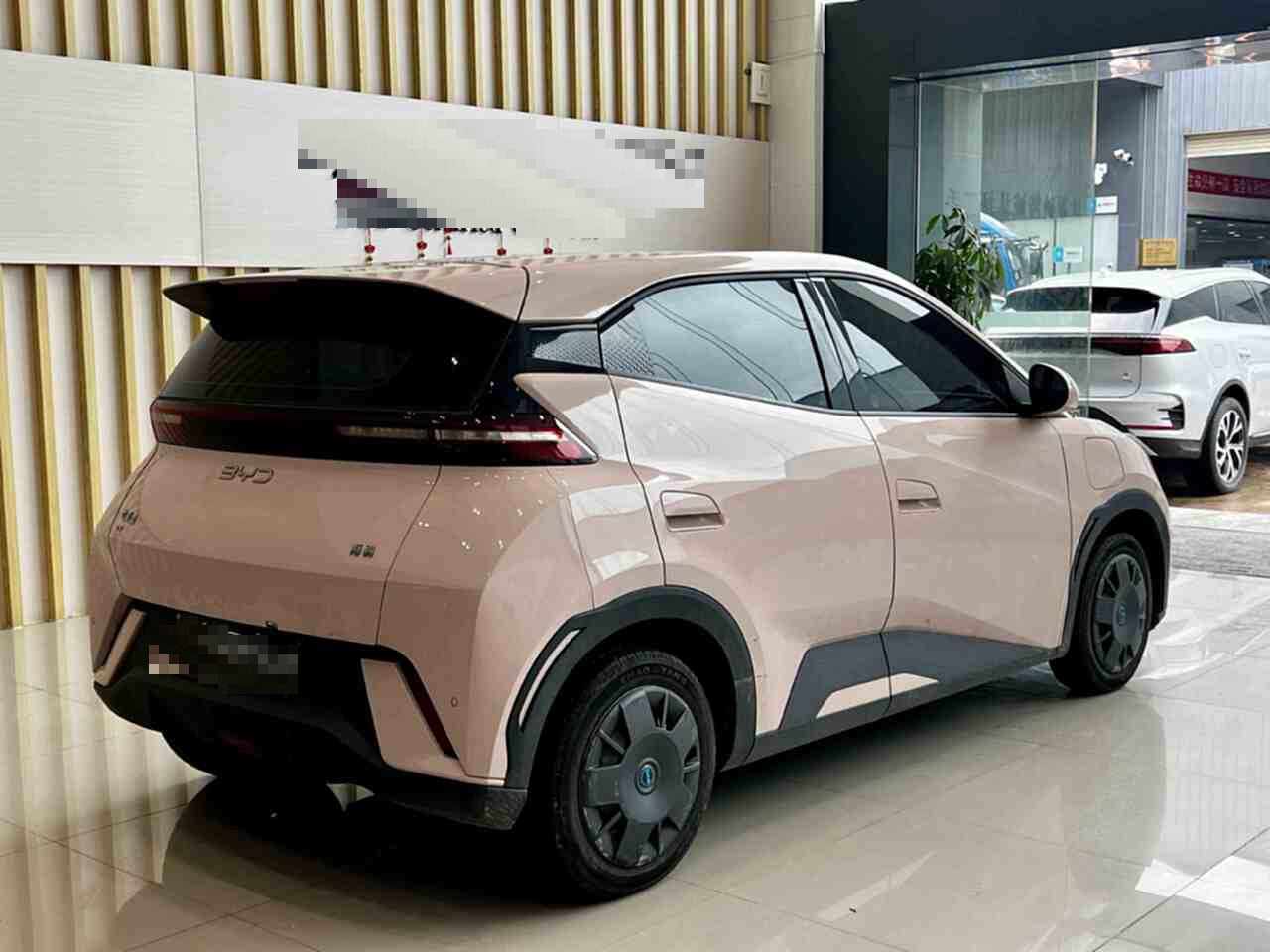
BYD Seagull 2025 305km Smart Driving Version Vehicle Profile: An Affordable EV that offers God's Eye ADAS

Model Overview: Market Position & Credibility
The BYD Seagull is BYD's best-selling pure-electric small car and the sales champion of the global A00 EV segment. Launched in 2023, it quickly took off thanks to its affordable price, solid safety, and class-leading smart features. By June 2025, the Seagull had surpassed 1 million cumulative sales in 27 months—ahead of models like the Tesla Model Y—becoming the fastest EV to reach that milestone globally; it sold 529,500 units in 2025 and was the annual A00 sales champion in both 2023 and 2024.
Built by BYD, the Seagull uses BYD's in-house Blade Battery (LFP) and was among the first entry-level models to feature high-level driver assistance. The 2025 Smart Driving version launched in February 2025, with its core highlight being standard God's Eye C high-level ADAS—an extremely rare fit in an A0 car, breaking the notion that small cars can't have advanced smart driving.
In market positioning, the Seagull targets urban commuters, new drivers, and families adding a second car, championing a "low price, high value" route. Internationally, it enters Europe, Southeast Asia, and elsewhere as the "Seagull"/"Seagull Surf," and is one of the most representative A00 models in BYD's globalization push.
In design, the Seagull is small, refined, and dynamic, offered in bright colors that appeal to younger buyers. Inside, it features a dual-screen layout with a floating central touchscreen and digital instrument cluster, with in-cabin intelligence leading its price point.
You can get a complete look at the vehicle's exterior and interior design through the following video:
Core Specifications
Model: BYD Seagull 2025 Smart Driving 305KM Vitality Version
Powertrain type: Pure electric
Motor: Permanent-magnet synchronous single motor (front)
Max power: 55 kW (75 hp)
Peak torque: 135 N·m
EV range: 305 km (CLTC)
Charging time: Fast charge 30 min (30%-80%); slow charge 4.3 h
Fast-charge power: 30 kW
Power consumption: 9.9 kWh/100km
Battery capacity: 30.08 kWh (LFP Blade Battery)
Top speed: 130 km/h
Official 0-50 km/h: 4.9 seconds
Dimensions (L×W×H): 3,780 × 1,715 × 1,540 mm
Wheelbase: 2,500 mm
Seating: 4 seats
Body type: 5-door 4-seat hatchback (unibody)
Drivetrain: Front-engine, front-wheel drive
Front suspension: MacPherson independent
Rear suspension: Torsion-beam non-independent
Tire size: 165/65 R15
Curb weight: 1,160 kg
Cargo volume: 930 L (with rear seats folded)
Maintenance costs & manufacturer service: Full vehicle warranty is 6 years or 150,000 km, with a lifetime battery warranty for the first owner (subject to official exclusions). Total maintenance cost over 60,000 km is estimated at about USD 162. As a pure EV, it has no engine oil changes and far fewer routine items, keeping maintenance costs well below petrol cars. BYD's after-sales network is broad in China with convenient service.
Subsidy policy: As a pure EV, the Seagull qualifies for China's NEV purchase tax exemption and may enjoy national and local new-energy purchase subsidies (subject to local policy). Overseas, many countries offer purchase tax exemptions, subsidies, or driving privileges for EVs, with amounts and conditions varying. Consult the IEA Global EV Policy Explorer for the differing policies across countries.
Three Highlights & Three Caveats
Highlight 1: The only "God's Eye" high-level ADAS in its class The 2025 Smart Driving version comes standard with the God's Eye C (DiPilot 100) high-level driver assistance system, supporting highway/expressway NOA navigation, automatic parking, valet parking, and 360° camera views. This is extremely rare in an A0-class EV, letting even new drivers handle narrow lanes and crowded lots with ease.
Highlight 2: A price benchmark with global million-sales credibility The Seagull surpassed 1 million cumulative sales within 27 months of launch, becoming the fastest EV globally to hit that milestone, and sold 529,500 units in 2025. As an affordable EV, it sets a value benchmark through solid safety (61% high-strength steel, hot-formed steel) and features beyond its class.
Highlight 3: Extremely low running costs Power consumption of just 9.9 kWh/100km, combined with 305 km of range, keeps daily commuting costs very low—about 0.05 RMB per km in real use. A 30-minute fast charge (30%-80%) plus a nimble 4.95 m turning radius makes it both economical and easy to drive and park.
Caveat 1: Weak high-speed power 0-50 km/h in 4.9 seconds is lively in the city, but acceleration above 100 km/h is limited, so it suits urban commuting rather than long highway hauls.
Caveat 2: No center headrest in the rear, average long-haul comfort Two adults fit fine in the back, but the middle position lacks a headrest, hurting long-trip comfort. The trunk is small—fine for grocery runs or one suitcase, but bulky items require folding the rear seats.
Caveat 3: Noticeable highway noise Owners report audible tire and wind noise at highway speeds, and it has only a single wiper blade, limiting wipe area in rain. Anyone sensitive to cabin quietness should weigh this, which is common among small, affordable cars.
Ownership Costs & Service
Warranty policy: Full vehicle warranty is 6 years or 150,000 km, with a lifetime battery warranty for the first owner. This is highly competitive among affordable EVs and gives strong long-term ownership confidence.
Maintenance costs: Total maintenance cost over 60,000 km is estimated at about USD 162. As a pure EV, routine items are limited (mainly cabin filter, brake fluid, gear oil checks), with no engine oil changes, so maintenance costs are far below comparable petrol cars.
Real ownership cost analysis: The core advantage of a pure EV is extremely low usage cost. At 9.9 kWh/100km and 20,000 km per year, annual consumption is about 1,980 kWh; whether home-charging or using public charging, annual charging costs are far below petrol fuel costs. Combined with the Seagull's small body and agile turning, urban commuting and parking are very convenient, giving it a clear total-cost-of-ownership edge in its class.
Charging cost (based on global average electricity prices): Using the global average residential electricity price published by Global Petrol Prices (approx. USD 0.17/kWh), 20,000 km per year at 9.9 kWh/100km equals about 1,980 kWh, for an annual charging cost of about USD 337. Using China's domestic household electricity price (about USD 0.09/kWh), annual charging cost is about USD 178, or about 0.05 RMB per km—exceptionally economical.
Electricity prices are based on Global Petrol Prices global data for rough estimation only; actual costs vary by region and charging method (home vs public fast charging).
Competitors Comparison
In the affordable EV small-car market, the BYD Seagull's most direct rivals are the Wuling Binguo Pro, Geely Galaxy Xingyuan, and Dongfeng Nammi 01. All four are pure-electric small cars but with different priorities. The following points help you quickly grasp the differences:
-
Range & battery: The Nammi 01 leads with 430 km and the largest 42.3 kWh battery; the Binguo Pro follows (403 km, 37.9 kWh); the Seagull (305 km, 30.08 kWh) and Xingyuan (310 km, 30.12 kWh) sit in the shorter-range group. The Seagull and Xingyuan use self-developed Blade/Shendun batteries (own safety route), the Binguo Pro uses a Shenlian battery, and the Nammi 01 uses a CATL battery.
-
Power & drivetrain: The Nammi 01 is strongest (95 hp/70 kW); the Seagull is weakest (75 hp/55 kW) but lightest (1,160 kg); the Xingyuan is rear-motor rear-drive (rare in small cars), while the others are front-drive.
-
ADAS & cabin: The Seagull is the only one with standard high-level ADAS (God's Eye C), leading in smart driving; the Xingyuan runs Flyme Auto for an excellent smart cockpit; the Binguo Pro and Nammi 01 focus on practical features.
-
Space & size: The Xingyuan (4,135 mm) and Nammi 01 (4,020 mm) are larger and both 5-seat; the Binguo Pro (4,050 mm) is 5-seat; the Seagull (3,780 mm) is smallest and 4-seat—ideal for individual commuting and small families, and the most maneuverable.
|
Comparison Item
|
Seagull 2025 Smart Driving 305KM Vitality
|
Binguo Pro 2026 403km Flagship
|
Xingyuan 2026 310km Chengfeng
|
Nammi 01 2026 Chuxin 430Air
|
|
Manufacturer
|
BYD
|
SGMW Wuling
|
Geely Galaxy
|
Dongfeng Passenger
|
|
Class
|
Small car
|
Small car
|
Small car
|
Small car
|
|
Powertrain
|
Pure electric
|
Pure electric
|
Pure electric
|
Pure electric
|
|
Motor
|
75 hp
|
88 hp
|
79 hp
|
95 hp
|
|
Max power (kW)
|
55
|
65
|
58
|
70
|
|
Peak torque (N·m)
|
135
|
110
|
130
|
160
|
|
EV range (km, CLTC)
|
305
|
403
|
310
|
430
|
|
Battery capacity (kWh)
|
30.08
|
37.9
|
30.12
|
42.3
|
|
Battery type
|
LFP (Blade)
|
LFP (Shenlian)
|
LFP (Shendun)
|
LFP (CATL)
|
|
Fast charge (30%-80%)
|
30 min
|
15 min
|
21 min
|
30 min
|
|
Slow charge (hours)
|
4.3
|
5.9
|
8.94
|
—
|
|
Power consumption (kWh/100km)
|
9.9
|
10.8
|
10.7
|
10.7
|
|
Transmission
|
Single-speed
|
Single-speed
|
Single-speed
|
Single-speed
|
|
Dimensions (L×W×H, mm)
|
3,780×1,715×1,540
|
4,050×1,758×1,580
|
4,135×1,805×1,570
|
4,020×1,810×1,570
|
|
Wheelbase (mm)
|
2,500
|
2,560
|
2,650
|
2,663
|
|
Body type
|
5-door 4-seat hatchback
|
5-door 5-seat hatchback
|
5-door 5-seat hatchback
|
5-door 5-seat hatchback
|
|
Top speed (km/h)
|
130
|
130
|
130
|
140
|
|
Drivetrain
|
Front-drive
|
Front-drive
|
Rear-drive
|
Front-drive
|
|
Front suspension
|
MacPherson independent
|
MacPherson independent
|
MacPherson independent
|
MacPherson independent
|
|
Rear suspension
|
Torsion-beam non-independent
|
Torsion-beam non-independent
|
Torsion-beam non-independent
|
Torsion-beam non-independent
|
|
Tire size
|
165/65 R15
|
165/65 R15
|
165/65 R15
|
165/65 R15
|
|
Curb weight (kg)
|
1,160
|
1,270
|
1,215
|
1,312
|
|
Cargo volume (L)
|
930
|
1,370
|
375-1,320
|
326-945
|
|
Full vehicle warranty
|
6 yrs / 150,000 km
|
4 yrs / 150,000 km
|
4 yrs / 150,000 km
|
3 yrs / 100,000 km
|
|
High-level ADAS
|
Standard (God's Eye C)
|
—
|
—
|
—
|
|
Reversing camera
|
Standard
|
Standard
|
Standard
|
Standard
|
|
Cruise control
|
Standard
|
Standard
|
Standard
|
Standard
|
|
Voice control
|
Standard (Hello XIAODI)
|
Standard
|
Standard (Flyme Auto)
|
Standard
|
|
Central touchscreen
|
Floating touchscreen Pad
|
Central screen
|
Central screen
|
Central screen
|
Summary: The choice among these four EV small cars is clear. The Seagull's core selling points are its "God's Eye" high-level ADAS and the credibility of global million-sales, making it outstanding value—the top pick for new drivers and urban commuters—but you must accept the smallest body (4 seats) and shorter range.
The Nammi 01 offers the longest range (430 km) and strongest power (95 hp), suiting those who want more range and performance. The Binguo Pro offers balanced range (403 km) and the largest cargo space (1,370 L), strong for practicality. The Xingyuan is larger with the longest wheelbase, rear-drive layout plus Flyme Auto cockpit, ideal for space- and tech-focused buyers. Each has strengths; the final decision depends on your weighting of smart driving, range, space, and smart cockpit.
Expert Test Drive — Pros & Cons
Pros:
-
Fun and agile in the city: Light body, light steering, a smooth, unintrusive regenerative braking system, and great brake feel make it very nimble in narrow lanes and crowded lots—among the most refined affordable EVs in its class.
-
Class-above cabin features: Faux-leather sport seats are comfortable and supportive, the floating touchscreen infotainment is fluid, and unexpected touches like wireless charging and rear disc brakes lift perceived quality beyond its price.
-
Strong ADAS and safety: God's Eye C high-level ADAS supports highway NOA and auto parking, with standard AEB, ESP, and other active safety, plus a 61% high-strength-steel body for solid passive safety.
Could be improved:
-
Weak high-speed acceleration: Power reserve above 100 km/h is limited, favoring city use over extended highway driving.
-
Limited trunk and storage: The trunk handles daily shopping or one suitcase; bulky items need the rear seats folded, and cabin storage is sparse.
-
Noticeable highway noise: Tire and wind noise are evident at speed, and the single wiper blade limits rainy-day visibility.
Test scenarios:
-
City commuting and launches: Brisk launches at red lights, 0-50 km/h in 4.9 seconds, and light overtaking in the city; real-world range is strong relative to the CLTC 305 km figure, measured at about 320 km (Source: professional media test, measured range 319.6 km).
-
Fast-charge efficiency: 30%-80% in just 30 minutes (30 kW fast charge), and with 305 km of range, weekly charging for city use is basically worry-free (Source: official figures, 9.9 kWh/100km).
Real Owner Reviews
Positive feedback:
Power & launch response: Summary: Owners approve of the responsive motor and brisk city launches; power is instant and overtaking is easy.
"Power is instant, red-light launches are quick, overtaking is easy; the 0-50 acceleration is more than enough."
Running cost & efficiency: Summary: Low consumption, convenient charging, and extremely low running cost are the most satisfying points.
"Consumption is about 11.8 kWh/100km; at 0.6 RMB/kWh home charging, monthly commuting costs under 200 RMB—way cheaper than a petrol car."
Smart driving & assist functions: Summary: God's Eye C's auto parking and 360° camera greatly ease the pressure on new drivers—the most praised feature.
"Auto parking saves me a lot of hassle, the 360° camera is clear, parking is much more efficient, and tight-lot parking no longer scares me."
Negative feedback:
Small trunk: Summary: Limited trunk volume is enough for daily shopping, but bulky items or multi-person trips need the rear seats folded—a common complaint.
"The trunk is too small; a stroller basically fills it, and for bulky items I have to fold the rear seats all the way down."
Highway noise & insulation: Summary: Audible tire and wind noise at speed and average sound insulation are clearly felt by owners.
"Tire and wind noise are quite noticeable at highway speeds; it's better with music on, but quietness is average."
References
-
Global Petrol Prices (2025). World Average Electricity Prices, USD / kWh. Retrieved from https://www.globalpetrolprices.com/electricity_prices/
-
IEA. Global EV Policy Explorer. Retrieved from https://www.iea.org/data-and-statistics/data-tools/global-ev-policy-explorer
-
BYD. Seagull Specifications. Retrieved from https://www.byd.com/
-
Bitauto. BYD Seagull Model Overview. Retrieved from https://www.bitauto.my/zh/wiki/比亚迪海鸥