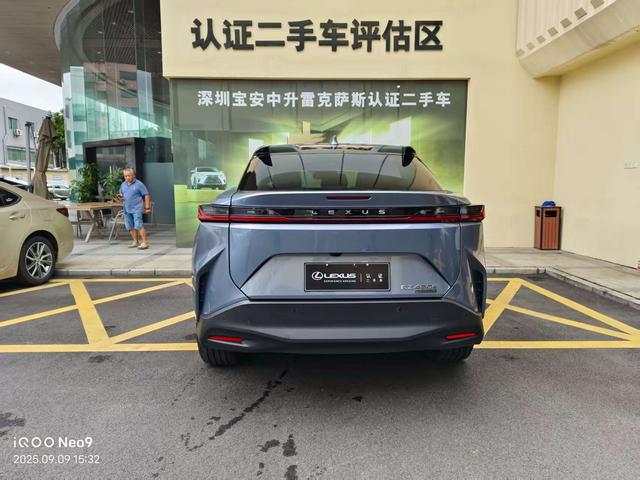
2024 Lexus RZ 300e Long Range Vehicle Profile: 614km Range, 10-Year Battery Warranty, and Lexus Quiet Luxury in a Compact Electric SUV

1. Verdict: Three Highlights and Three Caveats
Highlights
- Lexus-grade refinement and build quality are this car's solid foundation. The RZ sits on the e-TNGA dedicated EV platform, removing the vibration and noise sources of an engine entirely. Combined with Lexus's long-standing sealing and sound absorption work, low-speed refinement reaches the level a luxury badge should deliver. Materials are substantial and assembly is tight; the weight of the doors and the feel of the interior continue the brand's traditions. This is the hardest part of the RZ to criticise.
- A single-motor front-drive layout brings longer range and a lower entry point. The 300e uses a front-mounted single motor with front-wheel drive, dropping the rear motor and associated hardware of the 450e. That cuts kerb weight and energy consumption, delivering 614km of CLTC range — the longest-range and most affordable version of the RZ line-up. For buyers focused on urban commuting, that trade-off makes complete sense.
- Comfort-biased chassis tuning makes everyday driving relaxed. Suspension settings prioritise comfort, filtering high-frequency vibration well, with light steering and gentle body responses. It performs quietly and smoothly in both city and highway cruising. This is not a car chasing handling thrills, but as a daily luxury electric SUV it is thoroughly resolved.
Caveats
- Modest performance is the clearest product shortfall. A single 150kW (204PS) motor moving a mid-size SUV weighing around 1,935kg returns roughly 7.8 seconds to 100km/h — mid-to-lower pack among electric SUVs at the price. Most overseas reviews describe the RZ 300e's power delivery conservatively, noting a lack of the instant shove an EV should provide when overtaking or merging.
- The 614km CLTC figure shrinks noticeably in real use. CLTC is optimistic, and overseas media consistently report significant range loss at highway speeds across the RZ line, with a further drop in cold winter conditions. For buyers who travel long distances regularly without dependable charging, range anxiety remains a genuine decision factor.
- Pricing sits noticeably apart from domestic rivals in this class. An official guide price of RMB 206,000 is not an easy position in today's market. The NIO ES6 offers 490PS dual-motor performance and a battery-swap ecosystem at RMB 350,000; the Audi Q6L Sportback e-tron delivers 279PS and 800V fast charging at RMB 359,800; the AION LX PLUS 80D counters with 490PS and longer range at RMB 339,600. The RZ 300e's core competitiveness rests on brand and refinement, not on specifications.
2. Model Overview
The Lexus RZ is the brand's first global strategic model built on the e-TNGA dedicated electric platform, positioned as a mid-size luxury electric SUV and the flagship product of Lexus's full electrification transition. The 2024 RZ 300e Long Range is the entry long-range version of the line-up, known as the RZ 300e in overseas markets, using a single-motor front-wheel-drive layout.
Outside, the RZ continues Lexus's signature spindle design language, but as an EV it adopts a closed-off front end, with L-shaped daytime running lights at each side echoing a full-width light bar. The overall look is cleaner than the combustion models. The flanks flow smoothly, and the sweeping roofline gives this mid-size SUV a coupe-like character; flush door handles and low-drag wheels further optimise aerodynamics, with a drag coefficient of 0.28Cd. The full-width tail lamp is a signature Lexus element in recent years.
Dimensionally, the RZ measures 4,205 × 1,895 × 1,635mm with a 2,520mm wheelbase. It is worth noting that while the wheelbase figure is compact in the specification sheet, the body width of 1,895mm gives good lateral space, so three rear passengers will not feel cramped. Boot volume is 522L, entirely adequate day to day, and the rear seats fold in a split for further load expansion.
In the market, the RZ targets buyers who want luxury-brand refinement, primarily commute in the city, and have no strong need for extreme performance or maximum range. Its rivals include new-energy products like the NIO ES6 that emphasise performance and a service ecosystem, electrified efforts from legacy luxury brands like the Audi Q6L Sportback e-tron, and value-and-range-focused domestic models like the AION LX PLUS. The RZ's differentiation lies in Lexus brand heritage, build quality and refinement; its shortfalls lie in performance figures, range, and competitiveness at the current price.
You can explore the exterior and interior design in detail in the following video:
3. Basic Information
Core Specifications
| Item | Detail |
|---|---|
| Model | Lexus RZ 2024 300e Long Range |
| Manufacturer | Lexus |
| Class | Mid-size SUV |
| Energy type | Battery electric |
| Launch date | 2023.12 |
| Motor type | Permanent magnet/synchronous |
| Number of drive motors | Single |
| Motor layout | Front |
| Motor max power | 150kW (204PS) |
| Motor max torque | 266.3N·m |
| Transmission | Single-speed fixed ratio |
| Drive layout | Front-engine, front-wheel drive |
| Battery type | Ternary lithium |
| Battery energy | 67.5kWh |
| CLTC electric range | 614km |
| Fast charging | 30-80% in about 28 minutes |
| Slow charging | About 10 hours |
| Dimensions | 4,205 × 1,895 × 1,635mm |
| Wheelbase | 2,520mm |
| Body style | 5-door, 5-seat SUV |
| Kerb weight | 1,935kg |
| Gross weight | 2,520kg |
| Boot volume | 522L |
| Top speed | 160km/h |
| Official 0-100km/h | 7.8s |
| Energy consumption | 11.7kWh/100km |
| Drag coefficient | 0.28Cd |
| Seating | 5 |
Maintenance and Manufacturer Service
In the Chinese market the RZ carries a 6-year or 150,000km vehicle warranty, with a separate 10-year or 200,000km term for the drive battery — a leading commitment among luxury brands and a reflection of the Toyota group's confidence in battery durability. As an EV there are no routine oil or filter consumables; servicing centres on the cabin filter, brake fluid, coolant checks and inspections, putting single-service costs well below combustion models. Note that regenerative braking reduces actual brake wear versus a combustion car, but the 12V battery deserves attention after long periods parked.
Incentive Policies
Policy support for battery-electric vehicles varies considerably by market. The table below summarises the main directions as a reference:
| Country/Region | Policy Direction | Practical Impact for Electric SUV Buyers |
|---|---|---|
| Thailand | Substantial consumption tax concession for EVs | Purchase tax far below combustion cars |
| Philippines | Excise tax banded by powertrain | Most favourable rate band for EVs |
| Canada | Federal and provincial purchase incentives | Some provinces offer purchase subsidies |
| UAE | Low import duty, heavy charging investment | Contained purchase cost, low running cost |
Source: IEA Global EV Policy Explorer
4. Ownership Costs and Service
Warranty
The Chinese market offers a 6-year or 150,000km vehicle warranty plus a 10-year or 200,000km battery warranty. North America typically provides longer battery coverage, while Middle East and Southeast Asian markets generally follow terms matching local regulation. Cross-border buyers should refer to the terms published by the dealer in the ordering market.
Service Cost Analysis
Servicing an EV works entirely differently from a combustion car. The RZ 300e has no oil, oil filter or spark plug replacements; the main items are the cabin filter (around every 20,000km), brake fluid (about every two years), coolant checks, and routine chassis and powertrain inspections. Based on 20,000km per year, routine servicing over six years comes to roughly USD 500-800 — significantly below a petrol or hybrid at the same price.
Charging and Energy Costs
The RZ 300e consumes 11.7kWh/100km. Against a global average residential electricity price of about 0.170 USD/kWh (Global Petrol Prices, Q4 2025), that is roughly USD 0.020 per kilometre, or about USD 400 per year at 20,000km annually — the most immediate advantage an EV holds over a combustion car. Using public fast chargers, where tariffs typically run two to three times residential rates, annual spend rises to USD 800-1,200 but still sits below the fuel bill of a comparable combustion SUV.
Source: Global Petrol Prices
Incentives and Policy Comparison
| Country/Region | Main Policy | Support Available to EV Buyers |
|---|---|---|
| Thailand | Substantial EV consumption tax concession | Purchase cost significantly reduced |
| Philippines | Excise tax banded by powertrain | Lowest tax band for EVs |
| Canada | Federal and provincial incentives | Some provinces subsidise purchase and home chargers |
| UAE | Low import duty | Purchase cost relatively contained |
Source: IEA Global EV Policy Explorer
5. Competitor Comparison
The mid-size electric SUV segment is among the most fiercely contested anywhere, and the RZ takes a differentiated route: trading specification for brand refinement. Three direct rivals are compared below: the NIO ES6 2026 100kWh Natural Wonder Edition, the Audi Q6L Sportback e-tron 2026 Long Range, and the AION LX 2022 PLUS 80D Flagship.
- Performance. The RZ 300e uses a single 150kW (204PS) motor with 266.3N·m, the only front-drive single-motor car of the four. The NIO ES6 and AION LX are both dual-motor all-wheel drive, each with 360kW (490PS) combined and up to 700N·m of torque. The Audi Q6L Sportback e-tron runs a single 205kW (279PS) motor with 460N·m. The RZ trails clearly on acceleration, but gains lower consumption and longer range as a result.
- Range and charging. The RZ 300e offers 614km CLTC from a 67.5kWh pack; the NIO ES6 pairs a 100kWh battery with 630km CLTC and battery-swap support; the Audi Q6L Sportback e-tron achieves 715km from a 107kWh pack on an 800V architecture, giving it the fastest charging of the group; the AION LX 80D carries a 93.3kWh battery for 650km. On charging convenience, NIO's swap network is the most distinctive proposition of the four, while Audi's 800V platform shines on long-distance fast charging.
- Size and space. At 4,205mm long with a 2,520mm wheelbase, the RZ is the most compact of the four; the NIO ES6 measures 4,854mm with a 2,843mm wheelbase, the Audi Q6L Sportback e-tron 4,884mm with 2,832mm, and the AION LX 4,835mm with 2,720mm. All three rivals are more than 600mm longer than the RZ, with corresponding advantages in rear legroom and boot space — the NIO ES6 offers 582-1,496L, the AION LX 410-1,400L, and the RZ 522L.
- Equipment and intelligence. All four offer L2 driving assistance, 360-degree cameras and adaptive cruise as mainstream features. The RZ holds its brand advantage in luxury feel and build, with a 13.1-inch central screen and the Lexus connected services; the NIO ES6 leads on smart cabin and swap-service ecosystem; the Audi Q6L has traditional strengths in lighting technology and chassis feel; the AION LX is the most aggressive on feature content for the money.
5.1 Model Identity
| Item | Lexus RZ 2024 300e Long Range | NIO ES6 2026 100kWh Natural Wonder Edition | Audi Q6L Sportback e-tron 2026 Long Range | AION LX 2022 PLUS 80D Flagship |
|---|---|---|---|---|
| Manufacturer | Lexus | NIO | Audi (FAW) | GAC Aion New Energy |
| Class | Mid-size SUV | Mid-size SUV | Mid-size SUV | Mid-size SUV |
| Energy type | Battery electric | Battery electric | Battery electric | Battery electric |
| Launch date | 2023.12 | 2026.04 | 2026.04 | 2022.01 |
5.2 Powertrain, Battery and Performance
| Item | Lexus RZ 300e | NIO ES6 100kWh | Audi Q6L Sportback e-tron | AION LX PLUS 80D |
|---|---|---|---|---|
| Motor max power | 150kW (204PS) | 360kW (490PS) | 205kW (279PS) | 360kW (490PS) |
| Motor max torque | 266.3N·m | 700N·m | 460N·m | 700N·m |
| Number of motors | Single | Dual | Single | Dual |
| Motor layout | Front | Front + rear | Rear | Front + rear |
| Transmission | Single-speed fixed ratio | Single-speed fixed ratio | Single-speed fixed ratio | Single-speed fixed ratio |
| Drive layout | Front-engine FWD | Dual-motor AWD | Rear-motor RWD | Dual-motor AWD |
| Battery type | Ternary lithium | Ternary lithium (swappable) | Ternary lithium | Ternary lithium |
| Battery energy | 67.5kWh | 100kWh | 107kWh | 93.3kWh |
| CLTC electric range | 614km | 630km | 715km | 650km |
| Energy consumption | 11.7kWh/100km | 16.6kWh/100km | 15.7kWh/100km | 16kWh/100km |
| Top speed | 160km/h | 200km/h | 200km/h | 180km/h |
| Official 0-100km/h | 7.8s | 4.5s | 6.3s | 3.9s |
5.3 Dimensions, Space and Chassis
| Item | Lexus RZ 300e | NIO ES6 100kWh | Audi Q6L Sportback e-tron | AION LX PLUS 80D |
|---|---|---|---|---|
| Dimensions (mm) | 4,205×1,895×1,635 | 4,854×1,995×1,703 | 4,884×1,965×1,656 | 4,835×1,935×1,685 |
| Wheelbase (mm) | 2,520 | 2,843 | 2,832 | 2,720 |
| Body style | 5-door 5-seat SUV | 5-door 5-seat SUV | 5-door 5-seat SUV | 5-door 5-seat SUV |
| Door type | Conventional swing doors | Conventional swing doors | Conventional swing doors | Conventional swing doors |
| Seats | 5 | 5 | 5 | 5 |
| Kerb weight (kg) | 1,935 | 2,353 | 2,373 | 2,220 |
| Gross weight (kg) | 2,520 | 2,843 | 2,832 | 2,720 |
| Boot volume (L) | 522 | 582-1,496 | 511 | 410-1,400 |
| Drag coefficient | 0.28Cd | — | 0.25Cd | — |
| Min. turning radius | 5.6m | — | 6.2m | — |
| Front suspension | MacPherson independent | Multi-link independent | Five-link independent | MacPherson independent |
| Rear suspension | Multi-link independent | Multi-link independent | Five-link independent | Multi-link independent |
| Steering assistance | Electric | Electric | Electric | Electric |
| Front/rear brakes | Ventilated disc/ventilated disc | Ventilated disc/ventilated disc | Ventilated disc/ventilated disc | Ventilated disc/ventilated disc |
| Parking brake | Electronic | Electronic | Electronic | Electronic |
| Front/rear tyres | 235/60 R18 | 265/45 R21 | 255/45 R21 | 245/50 R20 |
5.4 Safety and Driver Assistance
| Item | Lexus RZ 300e | NIO ES6 100kWh | Audi Q6L Sportback e-tron | AION LX PLUS 80D |
|---|---|---|---|---|
| ABS/EBD/EBA | Standard | Standard | Standard | Standard |
| TCS/ESP | Standard | Standard | Standard | Standard |
| Lane departure warning | Standard | Standard | Standard | Standard |
| Lane keep assist | Standard | Standard | Standard | Standard |
| Active braking | Standard | Standard | Standard | Standard |
| Forward collision warning | Standard | Standard | Standard | Standard |
| Rear collision warning | Standard | Standard | Standard | Standard |
| DOW door-open warning | Standard | Standard | Standard | — |
| Reverse camera | Standard | Standard | Standard | Standard |
| 360-degree camera | Standard | Standard | Standard | Standard |
| Transparent chassis view | Standard | Standard | Standard | Standard |
| Cruise control | Standard | Standard | Standard | Standard |
| Adaptive cruise control | Standard | Standard | Standard | Standard |
| Full-speed adaptive cruise | Standard | Standard | Standard | Standard |
| Driving assistance level | L2 | L2 | L2 | L2 |
| Auto parking | Optional | Standard | Optional | Optional |
| Auto hold | Standard | Standard | Standard | Standard |
| Hill-start assist | Standard | Standard | Standard | Standard |
5.5 Cockpit and Controls
| Item | Lexus RZ 300e | NIO ES6 100kWh | Audi Q6L Sportback e-tron | AION LX PLUS 80D |
|---|---|---|---|---|
| Central screen | 13.1-inch | — | — | — |
| Full digital cluster | Standard | Standard | Standard | Standard |
| Head-up display | Optional | Optional | Optional | Optional |
| Leather steering wheel | Standard | Standard | Standard | Standard |
| Heated steering wheel | Standard | Optional | Standard | Optional |
| Steering memory | Standard | Standard | Optional | Optional |
| Steering adjustment | Tilt + reach | Tilt + reach | Tilt + reach | Tilt + reach |
| Shifter type | Button | Button | Button | Button |
| Front wireless charging | Standard (50W front row) | Standard | Standard | Standard |
| Keyless entry | Standard | Standard | Standard | Standard |
| Keyless start | Standard | Standard | Standard | Standard |
| Smart remote key | Standard | Standard | Standard | Standard |
| Bluetooth phone key | Standard | Standard | Standard | Standard |
5.6 Seats and Comfort
| Item | Lexus RZ 300e | NIO ES6 100kWh | Audi Q6L Sportback e-tron | AION LX PLUS 80D |
|---|---|---|---|---|
| Seat material | Leatherette | Leatherette (Nappa optional) | Leatherette | Leatherette + Nappa |
| Seat layout | 2+3 | 2+3 | 2+3 | 2+3 |
| Driver's seat power adjustment | Standard | Standard | Standard | Standard |
| Front passenger power adjustment | Standard | Standard | Standard | Standard |
| Front seat heating | Standard | Standard | Standard | Standard |
| Front seat ventilation | Standard | Standard | Standard | Standard |
| Second-row recline | Standard | Standard | Standard | Standard |
| Second-row seat heating | Standard | Standard | Standard | Standard |
| Sunroof | Opening panoramic | Opening panoramic | Opening panoramic | Opening panoramic |
Summary
These four cars represent four different electric value systems. The RZ 300e opts for "compact size and gentle power in exchange for brand refinement and low consumption", its real cards being Lexus build quality, refinement and a 10-year/200,000km battery warranty — at the cost of both performance and space. The NIO ES6 builds dual advantages in performance and charging with 490PS dual motors, a 100kWh battery and battery swapping; its 4.5-second sprint is a height the RZ cannot reach. The Audi Q6L Sportback e-tron sets the benchmark for long-distance range and charging speed with 107kWh, 715km and an 800V platform. The AION LX 80D counters with a 3.9-second sprint and longer range, offering the strongest specification value. If you value brand heritage, everyday urban refinement and resale, and have no long-distance anxiety, the RZ 300e deserves serious consideration. If performance, range or charging convenience matter more, all three rivals merit a priority test drive.
6. Expert Test Drive
Strengths
- Refinement is excellent. Electric drive removes engine vibration and noise, and Lexus's insulation work keeps the cabin at mainstream luxury-brand quietness in low-speed and city conditions, with low fatigue over long distances.
- Cabin quality and assembly are solid. Interior materials continue Lexus tradition, with tactile finishes and panel gaps that bear close inspection. The substantial feel of the doors and overall tightness of the cabin are widely praised, with few rattle complaints.
- Energy consumption is well controlled. At 11.7kWh/100km the RZ sits low in its class, and with a 67.5kWh pack delivering 614km CLTC, daily charging stops are infrequent.
Areas for Improvement
- Performance is modest. A 150kW single motor moving a car of nearly two tonnes accelerates in a leisurely manner, and several overseas outlets express reservations about the RZ 300e's responses, finding it lacks the punch an EV should deliver.
- Real range falls short of the claimed figure. CLTC is optimistic, highway range loss is pronounced, and usable range shrinks further in cold weather — long trips need planned charging stops.
- Value for money at the price is questioned. In the RMB 200,000-350,000 electric SUV market the RZ 300e holds no advantage on performance, range or size, leaving buyers to judge whether the brand premium is worth it.
Test Scenarios
- Scenario one: urban consumption test. Across mixed congested and free-flowing city conditions, measured consumption was close to the claimed 11.7kWh/100km, drifting modestly higher with air conditioning on. Data source: third-party media real-world testing.
- Scenario two: highway range test. At steady highway speeds, real range falls noticeably against the CLTC claim; overseas media testing shows highway running is the main range drain across the RZ line. Planning long trips on 70-80% of the claimed figure is advisable. Data source: overseas media real-world range test (Lexus RZ 300e real-world range test).
7. Real Owner Reviews
Positive Feedback
Luxury feel and driving refinement draw the most consistent praise, particularly the brand's trademark quietness and build.
"It's a good close-range luxury car. Fewer parts, fewer squeaks. The build continues the Lexus tradition." (Overseas owner review)
Comfort is well regarded, making city driving easy.
"The suspension is comfortable and the seats are supportive — very easy for everyday driving." (Overseas owner review)
Negative Feedback
Performance is the most concentrated complaint, falling short of most owners' expectations.
"You will be a little disappointed in overall performance unfortunately." (Reddit owner review)
Range and price are seen as uncompetitive.
"Pros: Typically solid Lexus luxury and build. Cons: Weak performance; so-so range; too expensive; lots of alternative EVs." (Overseas media review)
8. References
- Global Petrol Prices (2025). World Average Electricity Prices, USD / kWh. Retrieved from globalpetrolprices.com
- IEA. Global EV Policy Explorer. Retrieved from iea.org
- The Road Beat. 2024 Lexus RZ 300e Review. Retrieved from theroadbeat.com
- Lexus RZ 300e Review. Retrieved from youtu.be/6pJv_ZUJUJo
- Car and Driver. 2026 Lexus RZ Review, Pricing, and Specs. Retrieved from caranddriver.com
- Reddit r/Lexus. My RZ 300e Review. Retrieved from reddit.com