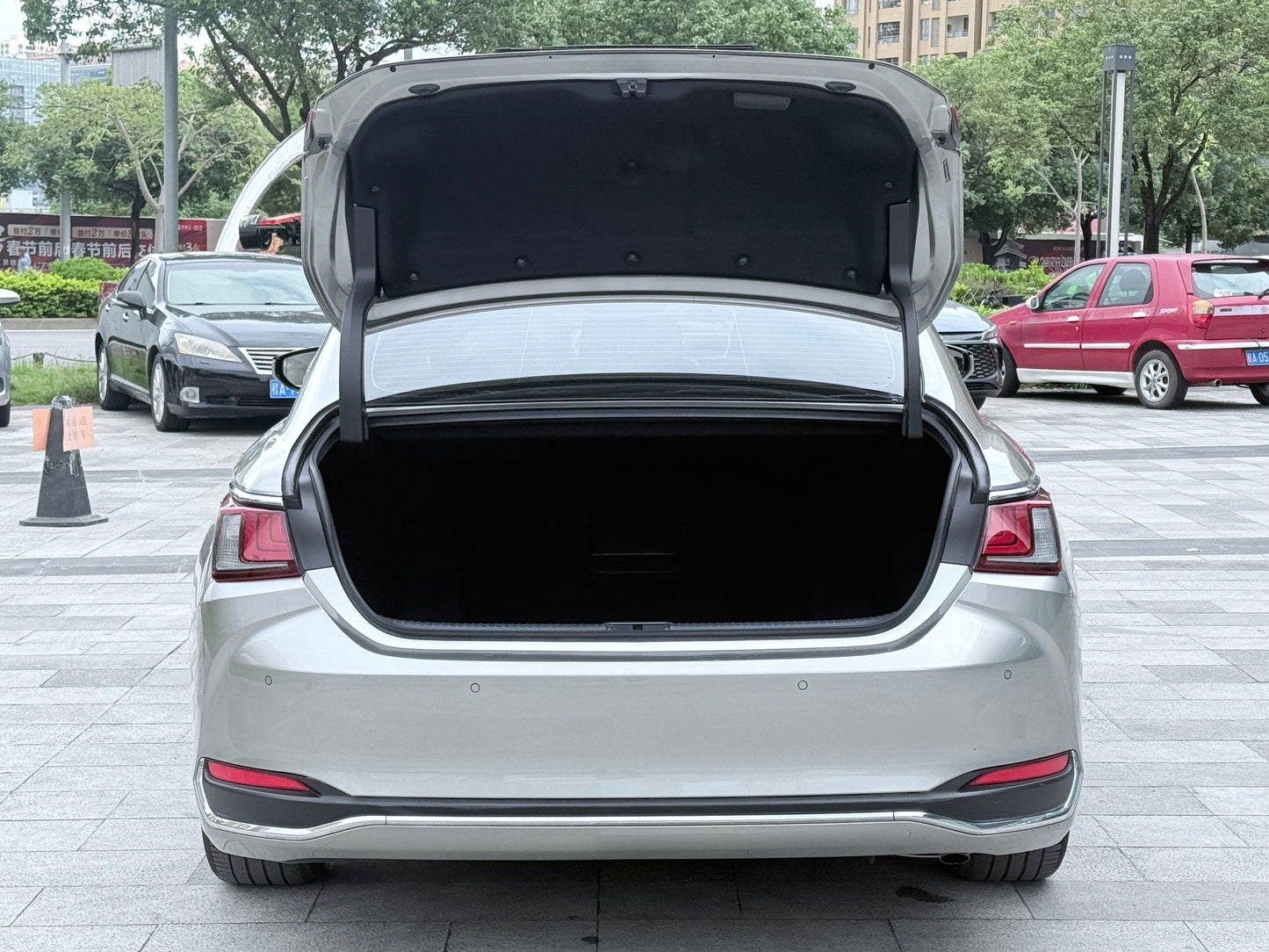
2026 Lexus ES 300h Vehicle Profile: Best Luxury Hybrid Sedan with 4.39L/100km and 2950mm Wheelbase

1. Verdict: Three Highlights and Three Caveats
Highlights
- Fuel economy is this generation's sharpest weapon. The new fifth-generation hybrid system swaps in a 2.0-litre Atkinson-cycle engine and returns a WLTC combined figure of just 4.39L/100km — in real-world testing on free-flowing roads, owners have seen around 3.8L/100km. For a luxury sedan over 5.1 metres long, that means a single tank easily covers more than 1,000 kilometres and long-distance anxiety largely disappears.
- Refinement and chassis quality remain Lexus hallmarks. The new ES uses acoustic glass and a redesigned glass sealing structure, which Lexus says cuts noise intrusion into the cabin by roughly 27% and rear-seat noise by about 18%. A stiffer GA-K platform body paired with swing-valve dampers delivers finely judged bump absorption, giving a sense of composure at this price point that few rivals match.
- Space and cabin experience have taken a genuine step up a class. Versus the previous generation, length grows by 165mm, width by 55mm, height by 110mm and wheelbase by 80mm, markedly improving rear legroom and ease of access. The cabin follows the new Tazuna cockpit concept with large dual screens and a full-colour Slope-HUD, while retaining physical controls where they matter.
Caveats
- The powertrain character is relaxed — do not expect driving thrills. Engine output drops from 178PS to 152PS, the motor contributes 113PS, and combined system output is 197PS, giving a 0-100km/h time of about 9.4 seconds. This is not a car built for hard driving, and the engine note becomes noticeably coarse under hard acceleration.
- Infotainment stability remains a weak point. Despite upgraded dual screens with 5G connectivity and OTA support, real-world use still sees occasional dropped connections and laggy responses — a clear gap against the smart cockpits now offered by domestic EV brands.
- Highway re-acceleration is limited, with thin power reserves at speed. City commuting is effortless, but asking for a quick overtake above 80km/h exposes a languid response that requires forward planning. This is the unavoidable trade-off of a hybrid tuned for economy first.
2. Model Overview
The Lexus ES is the brand's core product in the mid-large luxury executive sedan segment, and 2026 brings a complete generation change. The key structural shift is a simplified line-up: the pure petrol variant is gone, leaving only the hybrid (300h) and the battery-electric (500e) — a clear marker of Lexus's electrification strategy.
Outside, the new car draws inspiration from the LF-ZC concept, adopting a SPINDLE BODY silhouette and abandoning the traditional oversized grille — the 300h keeps a central intake aperture, with a spindle-style graduated lower grille and black trim details. Headlights move to the new L-Signature twin-arrow design, an L-shaped trim piece and e-Latch electronic door handles appear on the front doors, and the tail features a full-width LEXUS lettering light bar. The 300h records a 0.28Cd drag coefficient.
The dimensional change is the most tangible improvement of this generation: 5,140 × 1,920 × 1,555mm with a 2,950mm wheelbase, up across the board and delivering real gains in rear space and boot usability.
Positioned for the "rational luxury" buyer — someone who values long-term reliability, low hybrid running costs and Lexus's trademark quietness and comfort over outright performance or badge theatre — the ES competes with German mid-large sedans at a similar price and with comfort-focused executive products. It has a stable following across North America, the Middle East, Southeast Asia and China, and the hybrid is especially popular in fuel-price-sensitive markets such as Australia and Southeast Asia.
You can explore the exterior and interior design in detail in the following video:
3. Basic Information
Core Specifications
| Item | Detail |
|---|---|
| Model | Lexus ES 2026 300h |
| Powertrain type | Petrol-electric hybrid |
| Engine | 2.0L naturally aspirated inline-4 (M20A-FXS), Atkinson cycle |
| Engine max power | 112kW (152PS) |
| Engine peak torque | 188N·m (4,400-5,200rpm) |
| Motor max power | 83kW (113PS) |
| Combined system output | 145kW (197PS) |
| Transmission | E-CVT |
| Drive layout | Front-engine, front-wheel drive |
| Combined fuel consumption | WLTC 4.39L/100km |
| Dimensions | 5,140 × 1,920 × 1,555mm |
| Wheelbase | 2,950mm |
| Body style | 4-door, 5-seat sedan |
| Kerb weight | 1,654kg |
| Boot volume | 487L |
| Top speed | 180km/h |
| Official 0-100km/h | 9.4s |
| Seating | 5 |
Maintenance and Manufacturer Service
The ES 300h carries a 6-year or 150,000km vehicle warranty, with a separate, longer term for hybrid system components including the drive battery — one of the stronger commitments among luxury brands. Servicing centres on oil, oil filter and cabin filter, and the simple E-CVT has few wear items, giving notably lower long-term maintenance costs than turbocharged dual-clutch equivalents. Note that while hybrid batteries have an excellent reliability record, replacement outside warranty is costly, so used buyers should check battery health.
Incentive Policies
Hybrid vehicle policy varies widely by market. The table below summarises the main directions as a reference:
| Country/Region | Policy Direction | Practical Impact for Hybrid Buyers |
|---|---|---|
| Thailand | Consumption tax concessions for hybrids | HEV taxed below conventional petrol cars |
| Philippines | Excise tax banded by price and powertrain | Relatively moderate burden for hybrids |
| UAE | Low import duty, no displacement surcharge | Purchase cost driven mainly by price and duty |
| Australia | No federal hybrid subsidy; state registration fees vary | Long-term fuel savings are the main benefit |
Source: IEA Global EV Policy Explorer
4. Ownership Costs and Service
Warranty
In the Chinese market, the ES 300h offers a 6-year or 150,000km vehicle warranty — above the 3-year or 100,000km standard of most German rivals in the class. Overseas terms differ: North America typically provides a longer powertrain warranty, while Middle East and Southeast Asian markets generally offer five years or more, or terms matching local regulation. Cross-border buyers should refer to the terms published by the dealer in the ordering market.
Service Cost Analysis
Based on 20,000km per year, servicing focuses on oil and filter (every 10,000km) and air/cabin filters (every 20,000km). The hybrid E-CVT requires no scheduled transmission fluid change — only mileage-based inspection — which substantially reduces long-term outlay. Estimating from the typical level for luxury hybrid sedans in this class, routine servicing over six years comes to roughly USD 1,200-1,500, a restrained figure for a luxury brand.
Fuel Running Costs
Using the WLTC combined figure of 4.39L/100km as a baseline and 20,000km per year, annual fuel consumption is about 878L. The engine accepts 92-octane petrol; assuming RMB 7.5/L, annual fuel spend is roughly RMB 6,585, or about USD 930 per year — approximately USD 0.046 per kilometre. That figure stands out in the luxury class: a 5.1-metre luxury sedan costing about the same to fuel as a compact family car.
Charging Cost Note
This article covers a petrol-electric hybrid, so external charging does not apply. As a reference, the global average residential electricity price is about 0.170 USD/kWh (Global Petrol Prices, Q4 2025); a pure-electric vehicle consuming 15kWh/100km would cost roughly USD 0.026 per kilometre. For buyers without reliable home charging, the hybrid's ability to cut fuel bills without changing any habits is precisely its core value.
Incentives and Policy Comparison
| Country/Region | Main Policy | Support Available to Hybrid Buyers |
|---|---|---|
| Thailand | Consumption tax concession for hybrids | Lower tax at purchase |
| Philippines | Excise tax banded by powertrain | Relatively friendly rate for hybrids |
| UAE | Low import duty | Purchase cost relatively contained |
| Australia | State-level registration and road charges vary | No direct subsidy; fuel savings deliver long-term return |
Source: IEA Global EV Policy Explorer
5. Competitor Comparison
In the executive sedan market around the thirty-thousand-dollar mark, the meaning of "luxury" is being redistributed. Three direct rivals are compared below alongside the ES 300h: the Audi A6L 2026 2.0T quattro Prestige, the Crown (imported) 2024 Sedan 2.5L HEV Prestige, and the Audi A5L 2026 2.0T Full-Domain Hybrid quattro.
- Powertrain architecture. The ES 300h and the Crown both use naturally aspirated engines with electric motors on a hybrid path, at 145kW and 131kW combined respectively, pursuing smoothness and economy. Both Audis use 2.0T turbocharging with 48V mild hybrid, at 200kW and 400N·m, hitting 100km/h in 5.8 and 5.5 seconds respectively — clearly quicker. Choosing a side here is really choosing between "effortless economy" and "ample performance".
- Drive layout. The ES 300h and Crown are front-wheel drive, simple in structure and efficient in packaging; both Audis feature quattro all-wheel drive (the A6L a part-time system with a multi-plate clutch centre differential), offering more margin on slippery surfaces and at speed.
- Size and positioning. The ES 300h is 5,140mm long with a 2,950mm wheelbase — the longest of the group. The A6L measures 5,142mm with a 3,066mm wheelbase, giving it the best rear legroom. The A5L takes a more compact route at 4,908mm and 2,969mm, while the A6L's 1,874mm width and 1,464mm height create the widest, flattest stance. The Crown sits in the middle, at 5,030mm, 3,000mm and 1,480mm tall.
- Energy consumption and running costs. This is where the ES 300h dominates. Its 4.39L/100km WLTC figure is well below the A6L's 6.99L, the Crown's 6.21L and the A5L's 6.39L. In high-fuel-price markets, that gap compounds into a substantial sum over a five-year ownership period.
5.1 Model Identity
| Item | Lexus ES 2026 300h | Audi A6L 2026 2.0T quattro Prestige | Crown (imported) 2024 Sedan 2.5L HEV Prestige | Audi A5L 2026 2.0T Full-Domain Hybrid quattro |
|---|---|---|---|---|
| Manufacturer | Lexus | FAW Audi | Toyota (imported) | FAW Audi |
| Class | Mid-large sedan | Mid-large sedan | Mid-large sedan | Mid-size sedan |
| Energy type | Petrol-electric hybrid | Petrol + 48V mild hybrid | Petrol-electric hybrid | Petrol-electric hybrid |
| Launch date | 2026.04 | 2026.03 | 2024.04 | 2026.03 |
5.2 Powertrain and Performance
| Item | Lexus ES 300h | Audi A6L 2.0T quattro | Crown 2.5L HEV | Audi A5L 2.0T quattro |
|---|---|---|---|---|
| Engine | 2.0L 152hp L4 | 2.0T 272hp L4 | 2.5L 185hp L4 | 2.0T 272hp L4 |
| Engine code | M20A-FXS | DXG | A25B-FXS | DXG |
| Displacement (mL) | 1,987 | 1,984 | 2,487 | 1,984 |
| Displacement (L) | 2.0 | 2.0 | 2.5 | 2.0 |
| Induction | Naturally aspirated | Turbocharged | Naturally aspirated | Turbocharged |
| Engine layout | Transverse | Longitudinal | Transverse | Longitudinal |
| Cylinder layout | L4 | L4 | L4 | L4 |
| Valves per cylinder | 4 | 4 | 4 | 4 |
| Valvetrain | DOHC | DOHC | DOHC | DOHC |
| Engine max power | 112kW (152PS) | 200kW (272PS) | 136kW (185PS) | 200kW (272PS) |
| Engine max torque | 188N·m | 400N·m | 225N·m | 400N·m |
| Motor max power | 83kW (113PS) | 18kW (24PS) | 131kW (179PS) | 18kW (24PS) |
| Motor max torque | 206N·m | 230N·m | 300N·m | 230N·m |
| Combined system output | 145kW | 200kW | 131kW | 200kW |
| Motor type | Permanent magnet/synchronous | Permanent magnet/synchronous | Permanent magnet/synchronous | Permanent magnet/synchronous |
| Battery type | Ternary lithium | Ternary lithium | NMC ternary lithium | LFP |
| Battery capacity (kWh) | 1.7 | — | 1.7 | — |
| Battery warranty | 10 years or 250,000km | — | 8 years or 200,000km | — |
| Transmission | E-CVT | 7-speed DCT | E-CVT + AT | 7-speed DCT |
| Drive layout | Front-engine FWD | Front-engine AWD (part-time) | Front-engine FWD | Front-engine AWD (part-time) |
| Top speed | 180km/h | 250km/h | 180km/h | 250km/h |
| Official 0-100km/h | 9.4s | 5.8s | 8.6s | 5.5s |
| WLTC combined fuel | 4.39L/100km | 6.99L/100km | 6.21L/100km | 6.39L/100km |
| Fuel grade | 92-octane | 95-octane | 92-octane | 95-octane |
| Fuel delivery | Direct injection | Direct injection | Direct injection | Direct injection |
| Head/block material | Aluminium/Aluminium | Aluminium/Cast iron | Aluminium/Aluminium | Aluminium/Aluminium |
| Emissions standard | China VI | China VI | China VI | China VI |
5.3 Dimensions, Space and Chassis
| Item | Lexus ES 300h | Audi A6L 2.0T quattro | Crown 2.5L HEV | Audi A5L 2.0T quattro |
|---|---|---|---|---|
| Dimensions (mm) | 5,140×1,920×1,555 | 5,142×1,874×1,464 | 5,030×1,890×1,480 | 4,908×1,860×1,448 |
| Wheelbase (mm) | 2,950 | 3,066 | 3,000 | 2,969 |
| Front/rear track (mm) | 1,654/1,677 | 1,625/1,610 | 1,620/1,630 | 1,624/1,609 |
| Body style | 4-door 5-seat sedan | 4-door 5-seat sedan | 4-door 5-seat sedan | 4-door 5-seat sedan |
| Door type | Conventional swing doors | Conventional swing doors | Conventional swing doors | Conventional swing doors |
| Seats | 5 | 5 | 5 | 5 |
| Kerb weight (kg) | 1,654 | — | — | — |
| Gross weight (kg) | 1,810 | 2,060 | 2,045 | 1,955 |
| Fuel tank (L) | 55.0 | 61.0 | 84.0 | 60.0 |
| Boot volume (L) | 487 | 409 | — | 403 |
| Min. turning radius | 5.9m | 6.05m | 5.7m | 5.9m |
| Drag coefficient | — | — | 0.23 | — |
| Front suspension | MacPherson independent | Multi-link independent | Multi-link independent | Multi-link independent |
| Rear suspension | Multi-link independent | Multi-link independent | Multi-link independent | Multi-link independent |
| Steering assistance | Electric | Electric | Electric | Electric |
| Front/rear brakes | Ventilated disc/solid disc | Ventilated disc/ventilated disc | Ventilated disc/ventilated disc | Ventilated disc/ventilated disc |
| Parking brake | Electronic | Electronic | Electronic | Electronic |
| Front/rear tyres | 235/60 R18 | 255/40 R20 | 235/55 R19 | 245/35 R20 |
5.4 Safety and Driver Assistance
| Item | Lexus ES 300h | Audi A6L 2.0T quattro | Crown 2.5L HEV | Audi A5L 2.0T quattro |
|---|---|---|---|---|
| ABS/EBD/EBA | Standard | Standard | Standard | Standard |
| TCS/ESP | Standard | Standard | Standard | Standard |
| Blind spot assist | Standard | Standard | Standard | Standard |
| Lane departure warning | Standard | Standard | Standard | Standard |
| Lane keep assist | Standard | Standard | Standard | Standard |
| Active braking | Standard | Standard | Standard | Standard |
| Forward collision warning | Standard | Standard | Standard | Standard |
| Rear collision warning | Standard | Standard | Standard | Standard |
| DOW door-open warning | Standard | Standard | Standard | Standard |
| Front cross-traffic alert | Standard | Standard | Standard | Standard |
| Driver fatigue alert | Standard | Standard | Standard | Standard |
| Adaptive cruise control | Standard | Standard | Standard | Standard |
| Driving assistance level | L2 | L2 | L2 | L2 |
| Auto parking | — | Optional | — | Optional |
| Auto hold | Standard | Standard | Standard | Standard |
| Hill-start assist | Standard | Standard | Standard | Standard |
5.5 Cockpit and Connectivity
| Item | Lexus ES 300h | Audi A6L 2.0T quattro | Crown 2.5L HEV | Audi A5L 2.0T quattro |
|---|---|---|---|---|
| Central screen | 12.3-inch | 11.9-inch | 12.3-inch | 11.9-inch |
| Full digital cluster | Standard | Standard | Standard | Standard |
| Head-up display | Standard | Optional | Standard | Optional |
| Leather steering wheel | Standard | Standard | Standard | Standard |
| Steering adjustment | Tilt + reach | Tilt + reach | Tilt + reach | Tilt + reach |
| Steering memory | Standard | Optional | Standard | Optional |
| Steering functions | Multi-function | Multi-function | Multi-function | Multi-function |
| Shifter type | Electronic | Electronic | Electronic | Electronic |
| Smart remote key | Standard | Standard | Standard | Standard |
| NFC/RFID key | Standard | Standard | Standard | Standard |
| UWB digital key | Standard | — | — | — |
| Bluetooth phone key | Standard | Standard | Standard | Standard |
| Phone wireless charging | Standard | Standard | Standard | Standard |
| Front wireless charging | Standard | Standard | Standard | Standard |
| Wireless charging power | 40W front row | — | 40W front row | — |
5.6 Comfort and Convenience
| Item | Lexus ES 300h | Audi A6L 2.0T quattro | Crown 2.5L HEV | Audi A5L 2.0T quattro |
|---|---|---|---|---|
| Seat material | Leatherette | Leatherette | Leather | Leatherette |
| Driver's seat power adjustment | Standard | Standard | Standard | Standard |
| Front passenger power adjustment | Standard | Standard | Standard | Standard |
| Front seat heating | Standard | Standard | Standard | Standard |
| Front seat ventilation | Standard | Optional | Standard | Optional |
| Second-row seat heating | Standard | Optional | Standard | Optional |
| Second-row recline | Standard | Standard | Standard | Standard |
| Sunroof | Single | Segmented non-opening | Panoramic | Panoramic |
| Keyless entry | Standard | Standard | Standard | Standard |
| Keyless start | Standard | Standard | Standard | Standard |
| Cabin air purifier | Standard | Standard | Standard | Standard |
Summary
These four cars represent two very different ideas of luxury. The ES 300h and Crown take the "hybrid efficiency and composure" path, with the ES leading on fuel consumption (4.39L) and overall length (5,140mm), while the Crown counters with an 84L tank and a 0.23Cd drag coefficient for long-distance range and aerodynamics. Both Audis establish an advantage in performance and stability through 2.0T power and quattro all-wheel drive — 0-100km/h in 5.5-5.8 seconds is a height the hybrids cannot reach — at the cost of roughly 50% higher fuel consumption and a 95-octane requirement. If your use case is mostly urban commuting and long-distance cruising, with an emphasis on ten-year reliability and low running costs, the ES 300h is the most internally consistent choice here. If you want more power in reserve, stronger all-weather capability or a sharper brand character, the two Audis deserve a priority test drive.
6. Expert Test Drive
Strengths
- Refinement improved again. Acoustic glass and a new sealing structure cut in-cabin noise by around 27% (18% for rear seats) per Lexus. In practice, apart from the engine note under hard acceleration, wind and road noise remain at the level expected of a Lexus.
- Fuel economy that belies a 5.1-metre car. A 4.39L/100km WLTC figure — and around 3.8L/100km measured in free-flowing conditions — on 92-octane fuel gives more than 1,000km of range per tank, upending the assumption that big luxury cars must be thirsty.
- Seat comfort and ride quality remain class benchmarks. The multi-link rear suspension with swing-valve dampers absorbs fine surface imperfections brilliantly, and revised seat shaping keeps fatigue lower than German rivals on long journeys.
Areas for Improvement
- Gentle power delivery with little driver engagement. At 197PS combined and roughly 9.4 seconds to 100km/h, it is adequate but never quick, and highway re-acceleration needs extra margin. Reviews consistently describe it as offering little driving enjoyment — a family or executive runabout rather than a driver's car.
- Infotainment intelligence lags. Despite large dual screens and 5G connectivity, real-world use brings dropped connections and lag, and voice recognition trails domestic EV-brand systems by a clear margin.
- The sense of interior luxury is debatable. Some reviews note that this generation's cabin looks plain in daylight; materials are soft but the leather quality no longer matches the traditional Lexus impression, and visual richness leans heavily on ambient lighting at night.
Test Scenarios
- Scenario one: long-distance combined fuel test. Over a mix of city and highway conditions (about 60% highway), measured combined consumption was approximately 4.4L/100km — closely matching the official WLTC figure. Data source: third-party media long-distance test (all-new Lexus ES 300h in-depth experience).
- Scenario two: urban refinement test. At a steady 50-80km/h in the city, cabin noise remained at a low level, rising noticeably only under hard acceleration when the engine revs high. Data source: third-party media test (Lexus ES 300h road test).
7. Real Owner Reviews
Positive Feedback
Fuel economy draws the most consistent praise, with real-world results even exceeding expectations.
"Measured fuel consumption as low as 3.8L/100km, and one tank ran 1,200km." (2026 ES 300h owner, measured)
Seat comfort and overall refinement come up repeatedly, with noticeably lower fatigue than rivals on long trips.
"Seats are comfortable and refinement is excellent." (2026 ES 300h owner)
Noise control in city conditions is widely acknowledged, with only hard acceleration intruding.
"You can completely relax about refinement in the city. Apart from the engine being a little louder under hard acceleration, wind and road noise stay at a good level." (Media in-depth experience)
Negative Feedback
Infotainment stability is the most concentrated complaint, with dropped connections and lag affecting daily use.
"The infotainment frequently loses connection, and the power is too relaxed — clear weak points." (2026 ES 300h owner)
Conservative tuning means limited highway re-acceleration and little driving excitement.
"Not enough pull for re-acceleration at highway speed, and driving feels short on excitement. It has strengths, and it has weaknesses." (Lexus ES owner)
Some noise still enters at high speed — acceptable, but not perfect.
"Above 120km/h there is a little noise at highway speed, which is acceptable. Almost no new-car smell." (Lexus ES owner)
8. References
- Global Petrol Prices (2025). World Average Electricity Prices, USD / kWh. Retrieved from globalpetrolprices.com
- IEA. Global EV Policy Explorer. Retrieved from iea.org
- Lexus China. All-New Generation ES Specifications and Configurations. Retrieved from lexus.com.cn
- 2026 Lexus ES 300h Review. Retrieved from youtu.be/roIScIbBXLg
- Lexus ES 300h Hybrid Review. Retrieved from justinpritchard.ca