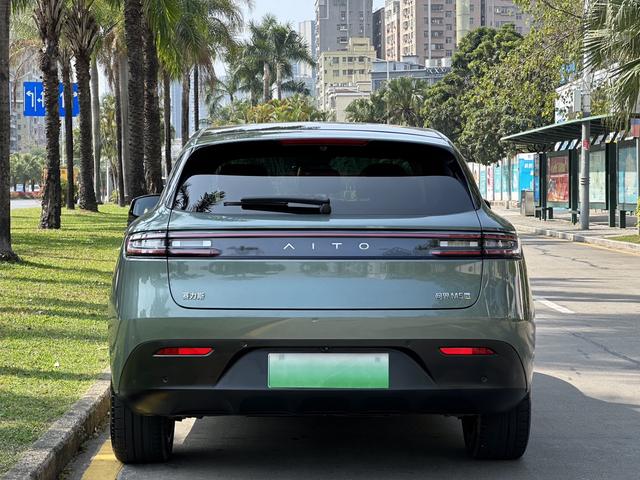
AITO Wenjie M5 2025 EREV Ultra AWD Vehicle Profile: Huawei ADAS, Dual-Motor AWD & Full Pros/Cons

1. Vehicle Overview: What Is This Car?
The AITO Wenjie (Seres) M5 is a premium smart SUV co-developed by Seres and Huawei. The 2025 EREV (Extended-Range Electric) Ultra AWD variant is a midsize extended-range SUV launched in March 2025 with a guide price of 249,800 RMB. Its biggest selling points are Huawei’s ADS smart-driving system and HarmonyOS cockpit, positioning it as a tech-luxury car focused on agile handling. Compared to rivals, its core edge is seamless Huawei ecosystem integration plus a punchy dual-motor AWD drivetrain — making it one of the closest blends of “intelligence” and “driving dynamics” in the Chinese EREV SUV segment.
2. Key Specs at a Glance (vs. 3 Midsize EREV SUVs)
| Item | Wenjie M5 EREV Ultra AWD | Avatr 07 Max+ RWD EREV | XPeng G7 1704Max Flagship | Shangjie H5 EREV Max+ |
|---|---|---|---|---|
| Guide price (RMB) | 249,800 | 229,900 | 205,800 | 179,800 |
| Segment | Midsize SUV | Midsize SUV | Midsize SUV | Midsize SUV |
| Drivetrain | EREV (496 hp) | EREV (314 hp) | EREV (296 hp) | EREV (204 hp) |
| EV range (CLTC) | 230 km | 245 km | 430 km | 235 km |
| Combined range (CLTC) | 1,275 km | — | 1,704 km | 1,360 km |
| Max motor power | 365 kW (496 hp) | 231 kW (314 hp) | 218 kW (296 hp) | 150 kW (204 hp) |
| Max motor torque | 675 N·m | 333 N·m | 450 N·m | 350 N·m |
| 0–100 km/h | 4.3 s | 6.6 s | 6.9 s | 7.8 s |
| L×W×H (mm) | 4785×1930×1625 | 4825×1980×1605 | 4918×1925×1655 | 4780×1910×1657 |
| Wheelbase (mm) | 2880 | 2940 | 2890 | 2840 |
| Battery | 42 kWh (NMC) | 39.05 kWh (LFP) | 55.8 kWh | 32.6 kWh |
| Drive motors | F: induction / R: PMSM | Rear single motor | Rear single motor | Rear single motor |
| Fuel tank | 56 L | 45 L | 60 L | 50 L |
Source: compiled from configuration comparison screenshots (OCR).
3. Exterior & Space: Agile Midsize, Cargo Is the Weak Point
The Wenjie M5 uses a fastback SUV silhouette at 4785×1930×1625 mm — the more compact option among the four, noticeably shorter than the XPeng G7 (4918 mm), making it more agile in the city with a 6 m turning radius for easier parking and U-turns. The trade-off: rear space and cargo trail its rivals. Trunk volume of 369–776 L is the smallest of the four (Avatr 500–1325 L, XPeng 779–2237 L, Shangjie 593–1629 L). Some owners report that at 178 cm tall, their hair brushes the headliner in the rear — rear headroom is tight for taller passengers. Best suited to buyers who value looks and handling over maximum space.
4. Performance & Range: AWD Power Benchmark, Plenty of City EV Range
This is the M5’s standout strength. The Ultra AWD pairs a 1.5T four-cylinder range extender (H15RT, 41% thermal efficiency) with a 165 kW front induction async motor plus 200 kW rear permanent-magnet motor for dual-motor AWD — 365 kW (496 hp) combined and 675 N·m, hitting 0–100 km/h in just 4.3 s. It’s the only AWD model here and the most powerful of the four. EV range is 230 km (CLTC) and combined range 1,275 km, with a 56 L tank — electric for daily driving, fuel for long trips. DC fast charge from 20%–80% takes about 30 min (max ~73 kW), plus 3.5 kW V2L vehicle-to-load for camping. By comparison, the Avatr 07 is a RWD single-motor at 6.6 s best, the XPeng G7 leads on EV range (430 km) but does 6.9 s, and the Shangjie H5 is slowest at 7.8 s.
5. Smart Driving & Cockpit: Huawei ADS + HarmonyOS, the Real Killer Feature
The M5’s soul is the Huawei ecosystem. It runs HarmonyOS cockpit with Huawei ADS smart driving and L2 driver assistance — adaptive cruise, lane keep, front cross-traffic warning/braking, door-open warning (DOW), transparent chassis / 360° camera, and auto parking. Voice assistant (XiaoYi) recognizes speech accurately, even dialects, and flows seamlessly between phone, watch, and car. Cabin kit includes a 10.25-inch instrument cluster, head-up display (HUD), electronic gear stalk, heated/ventilated seats, wireless charging, and UWB digital key. For Huawei users, the “car as phone extension” experience is hard for rivals to match.
6. Safety & Quality: Good Reputation, but Worth Noting
Owner reviews are positive overall (Autohome 4.29/5, Sohu 4.77/5) with a 112 faults-per-100-cars figure — mid-to-upper tier for the segment. Active safety is comprehensive: ABS, stability control, tire pressure monitoring, 360° camera, lane-departure warning, front/rear collision warning, and AEB are all standard. Two things to keep in mind: a few owners reported a disputed formaldehyde-level complaint case (individual dispute with conflicting factory vs. third-party tests, no official conclusion), and some owners find passive assists (auto high beam, auto wipers) mediocre. Overall reliability reputation is positive.
7. Real Owner Feedback: Praised for ADAS & Power, Criticized for Space
Across Sohu and Autohome feedback: owners most appreciate the great ADAS, punchy performance, quiet cabin, and smooth HarmonyOS. Range performance is rated above 88% of peers. Most complaints center on: tight rear headroom for taller passengers, small trunk, and some mediocre auto assist features. The trade-off is clear — buyers willing to pay for Huawei ADAS and AWD performance accept a more agile, space-compromised package.
8. Buying Advice & Summary: Who Should Buy It? What to Check?
The Wenjie M5 EREV Ultra AWD suits city-dwelling buyers who value smart driving, want the Huawei ecosystem, and enjoy dual-motor AWD performance — especially Huawei phone/watch owners.
Three things to check before buying:
- Space trade-off: smallest rear and trunk of the four — test rear headroom and cargo with family before committing.
- Range positioning: 230 km EV suits daily commuting plus occasional long trips (1,275 km combined is worry-free). If daily EV mileage is large, the XPeng G7’s 430 km EV range is longer but lacks AWD.
- Price vs. performance: at 249,800 RMB it’s pricier than the Avatr 07 (229,900), XPeng G7 (205,800), and Shangjie H5 (179,800) — you pay for the Huawei ADAS stack and AWD. Budget-conscious buyers could consider the RWD version.
Bottom line: for the strongest ADAS, punchiest AWD, and most agile drive in the midsize EREV segment, the Wenjie M5 is a top pick. But if it’s the family’s only car with hard space requirements, test the rear seats first. From a resale standpoint, the M5 holds value well and carries strong Huawei brand backing, making it a solid used-car choice.
Compiled from configuration comparison screenshots and public sources; specs subject to official delivery.