Ford Explorer 2024 Vehicle Profile: Rear-Drive Midsize SUV with 7 Seats and 2.3T Power

Model Overview: Market Position & Brand Background
The Ford Explorer is one of North America's best-selling SUVs and has been a mainstay of the US large-SUV market for nearly 35 years. The China-built version, produced by Changan Ford, is defined by "longitudinal rear-drive platform + high-output 2.3T + true 7 seats," standing apart in the 300,000-CNY midsize-and-up petrol SUV class — while most rivals use transverse front/four-wheel drive, the Explorer sticks with a rear-drive-first architecture built for segment-topping driving dynamics.
The 2024 model refined the 2023 offering: the 2.3T EcoBoost delivers 289 hp / 445 N·m via a 10-speed automatic, with the rear-drive Fengshang 7-seat version positioned as a high-value entry point. Against the Teramont X, Palisade and Navigator rivals, the Explorer differentiates through the driving fun of its rear-drive platform, a larger body, and richer standard smart-safety equipment.
Design follows a tough, imposing line: an over-5-meter body, a through-flow light bar and a squared-off front grille, continuing the muscular full-size American SUV look with high recognition. Inside, the SYNC Max infotainment pairs a 12.3-inch full-digital cluster with a 27-inch 4K center screen, with half-aniline leather seats and B&O audio (on higher trims) balancing luxury and tech.
You can get a full look at the car's exterior and interior in the following video:
Core Specifications
|
Item
|
Specification
|
|
Model
|
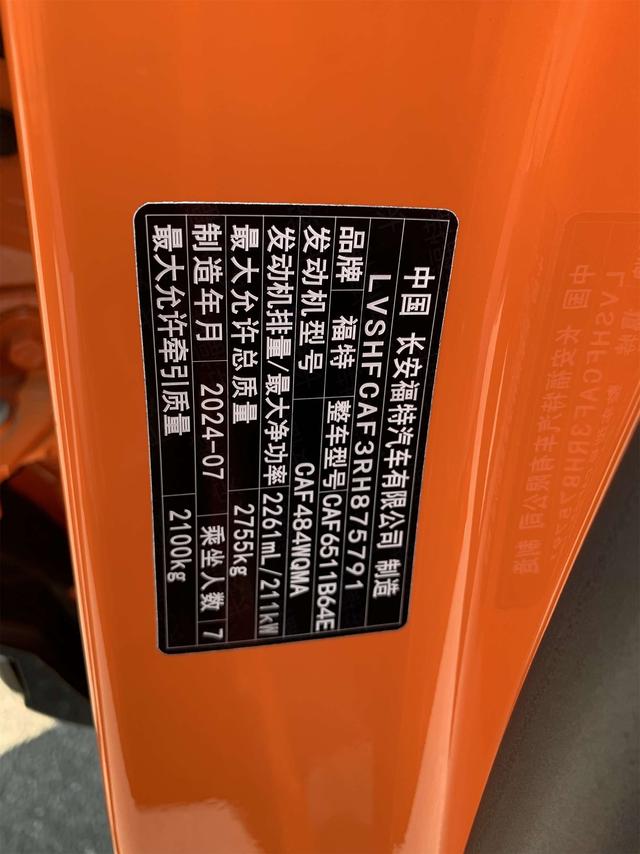
Changan Ford Explorer 2024 2.3T EcoBoost Rear-Drive Fengshang 7-Seat
|
|
Powertrain
|
Petrol (front-engine, rear-wheel drive)
|
|
Engine
|
2.3T EcoBoost turbo I4, 289 hp, 445 N·m
|
|
Transmission
|
10-speed automatic (10AT)
|
|
Top speed
|
200 km/h
|
|
0–100 km/h
|
approx. 7.6 s
|
|
Combined fuel consumption
|
WLTC 8.86 L/100km
|
|
Dimensions
|
5063 × 2004 × 1778 mm
|
|
Wheelbase
|
3025 mm
|
|
Seating
|
5-door, 7-seat SUV
|
|
Fuel tank
|
81 L
|
|
Cargo volume
|
2487 L (2nd & 3rd rows folded)
|
|
Min. turning radius
|
5.9 m
|
|
Curb weight
|
2009 kg
|
|
Vehicle warranty
|
3 years or 100,000 km
|
Maintenance cost & service: Estimated 6-year/60,000-km total maintenance cost is roughly 456 USD, with routine services (oil, filters, brakes); backed by Changan Ford's nationwide service network with broad coverage.
Incentives: As a petrol vehicle it is not eligible for NEV purchase subsidies; tax treatment for large SUVs varies by country/region — refer to local policy (see: IEA Global EV Policy Explorer and local vehicle regulations).
Three Highlights & Three Caveats
Highlight 1: A rare rear-driven layout + punchy 2.3T, driving feel is outstanding The Explorer is built on the CD6 longitudinal rear-wheel-drive platform with a 50:50 weight balance, short front overhang, a 2.3T EcoBoost (289 hp / 445 N·m) and a 10-speed automatic, sprinting to 100 km/h in about 7.6 seconds with a minimum turning radius of just 5.9 meters. Unlike most rivals with transverse front/four-wheel drive, it drives with a rear-drive sedan's agility — highway lane changes and mountain-road runs feel more confident.
Highlight 2: True 7-seat space with impressive hauling capacity Measuring 5063 × 2004 × 1778 mm with a 3025 mm wheelbase, it offers a 5-door, 7-seat layout; folding the second and third rows frees up 2487L of cargo space. A nearly 6-square-meter cabin and a 1.1-square-meter panoramic sunroof make full-family commuting and long road trips effortless.
Highlight 3: Generous smart and safety equipment, solid materials The whole line comes standard with L2 Ford Co-Pilot 360 (0-180 km/h adaptive cruise with lane centering), a 540° surround-view camera, the SYNC Max 27-inch 4K center screen and active noise cancellation; critical body areas use 1700 MPa high-strength steel with up to 33 active and passive safety features. In its segment, its tech and safety kit sit in the top tier for a petrol midsize SUV.
Caveat 1: City fuel consumption runs high Between the punchy 2.3T and a two-tonne curb weight, the Xiaoxiong Youhao crowd-sourced average is about 11 L/100km, with city congestion tests reaching 14–17 L/100km or more; highway is around 9 L. If you mostly drive in city traffic, the fuel bill is a real everyday cost.
Caveat 2: Wide body, parking takes care At over two meters wide (2004 mm), it needs more care in older neighborhoods and narrow parking bays; while the turning circle is tight, the sheer body width means an adjustment period for parking.
Caveat 3: Infotainment details still need polish Owners report voice recognition struggles with homophones, no handwriting input for navigation, and mediocre surround-camera resolution; some trims lack a dashcam and the battery is on the small side. The smart experience is good, but details trail newer EV natives.
Ownership Costs & Service
Warranty policy: 3 years or 100,000 km vehicle warranty; confirm final terms in your purchase contract.
Fuel cost: At a Xiaoxiong Youhao crowd-sourced average of about 11 L/100km and Global Petrol Prices' global average petrol price of about 1.1 USD/L, each 100km costs roughly 12 USD; in city congestion (14–17 L/100km) that rises to about 15–19 USD per 100km.
Maintenance cost: Estimated total maintenance over 60,000 km is about 456 USD, covering routine oil, filter and brake services; follow the manufacturer's recommended intervals for the 10AT and turbo.
Ownership cost analysis: As a two-tonne midsize-and-up petrol SUV, fuel and maintenance are the main running costs; resale value and insurance are comparable to peers in the segment, suiting families who value driving dynamics and need serious space.
Subsidy policy comparison:
|
Country/Region
|
Key measures (summary)
|
|
China
|
Petrol vehicles get no NEV subsidy; consider purchase/registration limits in some cities
|
|
United States
|
Large SUVs generally fall outside most states' EV tax credits; standard fuel-vehicle rates apply
|
|
EU (multiple)
|
Higher carbon/registration tax for large petrol vehicles; some cities impose emission restrictions
|
|
Southeast Asia / emerging markets
|
Imported large SUVs face high tariffs; local production can enjoy tariff relief
|
Competitors Comparison
A 4-strong comparison of high-value midsize-and-up SUVs: These four 300,000-CNY-class SUVs take very different approaches. Ford Explorer uses a punchy 2.3T plus longitudinal rear-drive to target "driving feel and true 7 seats"; the VW Teramont X uses a 2.0T with AWD and German space to win family buyers; the Hyundai Palisade offers a smooth big-displacement 3.5L V6; and the Lincoln Navigator focuses on plush comfort and a hushed cabin. None is outright "better" — it comes down to your preferences.
-
Power & drivetrain: Explorer's 2.3T / 289 hp is the strongest and is rear-drive; Teramont X is 2.0T / 220 hp with AWD; Palisade is a 3.5L V6 / 272 hp with FWD; Navigator is 2.0T / 261 hp with AWD.
-
Space & seating: Explorer (5063mm / 7 seats) and Palisade (4995mm / 7 seats) offer true 7 seats; Teramont X and Navigator are 5-seaters tuned more for comfort.
-
Drivetrain & handling: Explorer's longitudinal rear-drive with a 5.9m turning radius is the most agile; Teramont X / Navigator AWD offer better all-weather traction.
-
Equipment & smart driving: Explorer comes standard with L2 + 540° camera; Teramont X offers L1/L2 with auto-park; Navigator has L2 with a Qualcomm 8155 chip; Palisade is more basic.
|
Dimension
|
Explorer 2024 2.3T Rear-Drive 7-Seat
|
Teramont X 2024 380TSI AWD Luxury
|
Palisade 2023 3.5L FWD GL
|
Navigator 2023 2.0T AWD Exclusive
|
|
Engine
|
2.3T I4 turbo
|
2.0T I4 turbo
|
3.5L V6 NA
|
2.0T I4 turbo
|
|
Max power
|
213 kW (289 hp)
|
162 kW (220 hp)
|
200 kW (272 hp)
|
192 kW (261 hp)
|
|
Peak torque
|
445 N·m
|
350 N·m
|
336 N·m
|
390 N·m
|
|
Transmission
|
10-speed auto
|
7-speed DCT
|
8-speed auto
|
8-speed auto
|
|
Drivetrain
|
Rear-wheel drive
|
AWD (on-demand)
|
Front-wheel drive
|
AWD (on-demand)
|
|
Top speed
|
200 km/h
|
200 km/h
|
210 km/h
|
200 km/h
|
|
Combined economy (WLTC)
|
8.86 L/100km
|
8.64 L/100km
|
10.4 L/100km (NEDC)
|
8.66 L/100km
|
|
Dimensions (mm)
|
5063×2004×1778
|
4917×1989×1729
|
4995×1975×1775
|
4908×1952×1717
|
|
Wheelbase (mm)
|
3025
|
2980
|
2900
|
2900
|
|
Seating
|
5-door 7-seat
|
5-door 5-seat
|
5-door 7-seat
|
5-door 5-seat
|
|
Cargo volume
|
2487 L (folded)
|
540–1719 L
|
—
|
822–2463 L
|
|
Curb weight
|
2009 kg
|
2040 kg
|
1881 kg
|
1986 kg
|
|
Fuel tank
|
81 L
|
70 L
|
71 L
|
75 L
|
|
Front suspension
|
MacPherson
|
MacPherson
|
MacPherson
|
MacPherson
|
|
Rear suspension
|
Multi-link
|
Multi-link
|
Multi-link
|
Multi-link
|
|
Front/Rear brakes
|
Ventilated disc/Solid disc
|
Ventilated/Ventilated
|
Ventilated/Solid
|
Ventilated/Solid
|
|
Tire spec
|
255/55 R20
|
245/60 R18
|
245/60 R18
|
255/60 R19
|
|
Autonomous braking
|
Standard
|
Standard
|
Standard
|
Standard
|
|
Lane keeping
|
Standard
|
Standard
|
Standard
|
Standard
|
|
Driver fatigue alert
|
Standard
|
Standard
|
Standard
|
Standard
|
|
Driver-assist level
|
L2
|
L1
|
L1
|
L2
|
|
Adaptive cruise
|
Full-speed ACC
|
Full-speed ACC
|
Full-speed ACC
|
Full-speed ACC
|
|
Auto parking
|
—
|
Standard
|
—
|
Standard
|
|
Panoramic sunroof
|
Opening panoramic
|
Opening panoramic
|
Opening panoramic
|
Opening panoramic
|
|
Power tailgate
|
Standard
|
Standard
|
Standard
|
Standard
|
|
Keyless entry
|
Front
|
All doors
|
Front
|
Front
|
|
Wireless charging
|
Standard
|
—
|
—
|
—
|
|
Center screen
|
27-inch
|
12-inch
|
12.3-inch
|
11.4-inch
|
|
Digital cluster
|
12.3-inch
|
10.25-inch
|
Non-fully digital
|
Fully digital
|
|
Infotainment
|
SYNC Max
|
VW IQ.Drive
|
Hyundai
|
SYNC (Qualcomm 8155)
|
|
Voice wake word
|
Hello Ford
|
Hello VW
|
Xiao Du
|
Hello Lincoln
|
|
Speaker count
|
6
|
8
|
6
|
9
|
|
Millimeter-wave radars
|
3
|
1
|
1
|
5
|
|
Forward collision alert
|
Standard
|
Standard
|
Standard
|
Standard
|
|
Camera
|
Reversing camera
|
Reversing camera
|
Reversing camera
|
360° surround view
|
If you value "driving feel + true 7 seats + smart equipment" most, the Explorer rear-drive Fengshang is the strongest pick of the four — the 2.3T power reserve and longitudinal rear-drive handling are its unique edge; for German solidity, AWD and a more spacious 5-seat cabin, the Teramont X / Navigator are stronger; if you prefer a big-displacement V6's smoothness and true 7-seat layout, the Palisade is worth a look. For families who prize driving pleasure and space, the Explorer is the one to recommend.
Expert Test Drive: Pros & Cons
Pros
-
Strong power and excellent driving dynamics: The 2.3T (289 hp / 445 N·m) with 10AT does 0–100 km/h in about 7.6 s; the longitudinal rear-drive platform delivers a 50:50 balance and 5.9m turning radius, officially "rare rear-drive in its class," and tests show better highway stability and more precise lane changes (source: Ford China official site and professional media tests).
-
Outstanding space and hauling: At 5063mm long with a 3025mm wheelbase and true 7-seat layout, folding the second/third rows yields 2487L of cargo; the official site touts a "nearly 6-square-meter cabin and 1.1-square-meter panoramic sunroof," making family trips effortless (source: Ford China official site).
-
Generous smart-safety kit: Standard L2 Co-Pilot 360 (0–180 km/h full-speed ACC with lane centering), 540° surround-view camera, SYNC Max 27-inch 4K center screen, active noise cancellation, 1700 MPa high-strength steel and 33 safety features (source: Ford China official site).
Cons
-
High city fuel consumption: Owners report 14–17 L/100km or more in city congestion, about 9 L on the highway, and a Xiaoxiong Youhao combined average of about 11 L/100km — a real daily cost for pure city commutes (source: Xiaoxiong Youhao crowd-sourced data).
-
Wide body makes parking tricky: Over 2 meters wide, owners find parking in older neighborhoods and narrow bays inconvenient; the turning circle is tight but the sheer width adds difficulty (source: owner reviews).
-
Infotainment details need polish: Voice recognition struggles with homophones, no handwriting input for navigation, average surround-camera quality, no dashcam on some trims, and a small battery (source: owner reviews).
Real-world scenarios
-
Mixed routes (highway + city + suburbs): Xiaoxiong Youhao combined average of about 11 L/100km; about 9 L on the highway; 14–17 L in pure city congestion (source: Xiaoxiong Youhao crowd-sourced report).
-
Driving dynamics test: ample 2.3T power, smooth 10AT, sporty 5.9m turning circle and agile handling, stable highway cruising (source: professional "2024 Ford Explorer" tests and owner feedback).
Real Owner Reviews
Positive feedback
Owners rate three dimensions most highly — spacious, ample power reserve, agile handling — with the imposing exterior and value also widely praised (Sohu Auto overall 4.65; space 4.84, exterior 4.88, ahead of most peers).
"It drives very steadily, the chassis and handling need no praise, the turning radius is small — a flexible heavy man, with enough equipment."
"Pros: big space, good handling, strong power, nice looks, and it's very comfortable on the highway."
"Handling, chassis and sound insulation are all good, very stable at speed. For a petrol car in this price range, the ST's equipment is already pretty full."
Negative feedback
Owners most often complain about high city fuel consumption, the wide body making parking awkward, infotainment details (voice recognition / handwriting input / camera quality), and a small battery.
"City fuel consumption is high, and highway wind noise is a bit strong."
"The car is too wide; some parking lots are hard to park in."
"Navigation lacks handwriting input, voice can't distinguish homophones well, the 360 camera quality isn't great, and cabin headroom isn't tall enough."
"The Titanium trim has no dashcam, a small battery, and the 360 isn't as smart as other cars'."
References
-
Global Petrol Prices (2025). World Average Petrol Prices, USD / L. Retrieved from https://www.globalpetrolprices.com/gasoline_prices/
-
IEA. Global EV Policy Explorer. Retrieved from https://www.iea.org/data-and-statistics/data-tools/global-ev-policy-explorer
-
Ford China official website (Explorer specifications and features)
-
Autohome (Ford Explorer 2024 specs and owner reviews)
-
Xiaoxiong Youhao (Ford Explorer fuel-consumption crowd-sourced report)
-
Sohu Auto (Ford Explorer owner ratings)