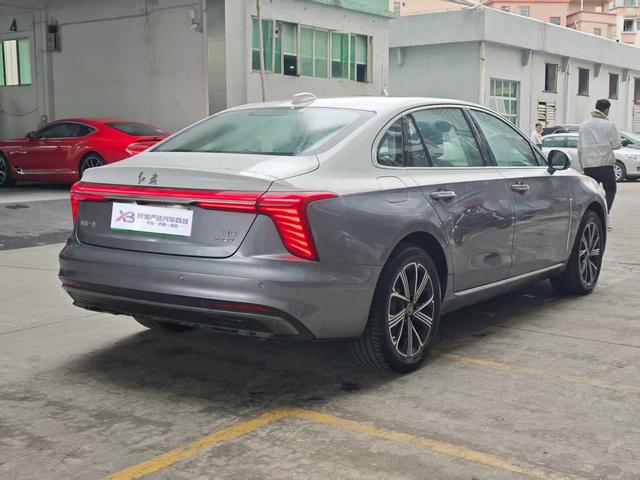
Hongqi H5 PHEV 2025 130 Super Hybrid Vehicle Profile: 130km EV Range, 1560km Combined, 3.75L/100km

1. Verdict: Three Highlights and Three Caveats
Highlights
- Highlight 1 — 130km of EV range plus 1,560km combined, covering two very different use patterns. With 130km of CLTC electric range, daily commuting can run almost entirely on electricity, keeping running costs very low. With a full tank and a full charge, CLTC combined range reaches 1,560km, so long trips need no careful charging planning — the most practical advantage a plug-in hybrid holds over a pure EV.
- Highlight 2 — Discharged-state fuel consumption stays controlled. The CLTC minimum charge-sustaining figure is 3.75L/100km, with 0.89L/100km WLTC combined. Even driven purely as a combustion car with no charging at all, real-world discharged fuel consumption clusters around 4.5-5L/100km, and it runs on 92 octane, keeping long-term costs manageable.
- Highlight 3 — A five-metre body bringing space and presence. At 4,988mm long, 1,875mm wide with a 2,920mm wheelbase, this is the most complete package of the four, with rear space and a 500L boot among the class leaders and a stance that leans toward upper-mid-size sedan territory.
Caveats
- Caveat 1 — Motor and system output sit at the entry end of this group. With a 168kW (228PS) motor and 340N·m of system torque, acceleration reserves fall clearly behind the Lync & Co 07GT's dual-motor all-wheel drive (390kW system output, 765N·m) and the Seal 07DM's 200kW motor. Its official 7.6-second 0-100km/h is also the only quoted figure in the group.
- Caveat 2 — DC fast charging peaks at only 60kW. A 30%-80% fast charge takes 14 minutes, which is not long in itself, but a 60kW peak means high-power charging is hard to achieve on public DC posts, so the experience depends on the actual charger available.
- Caveat 3 — EV range and battery capacity are on the small side here. An 18.4kWh pack corresponds to 106km of WLTC electric range; against the Seal 07DM's 230km and the 07GT's 170km, daily electric commuting has a tighter margin and requires more frequent charging.
2. Model Overview
- Background. The Hongqi H5 PHEV is the brand's first plug-in hybrid sedan, launched in April 2025 and developed from the combustion H5 platform. The 130 Super Hybrid reviewed here is the entry range version; the lineup also offers a 170 Super Hybrid with a larger 23.9kWh battery and 170km of electric range.
- Product logic. Keep the near-five-metre body and the brand's symbolic presence, then layer on a plug-in hybrid system that combines electric commuting with combustion long-distance travel to remove range anxiety. Drag coefficient is optimised to around 0.26Cd, lower than the combustion version, specifically to cut energy use at highway speed.
- Powertrain. A 1.5T turbocharged engine paired with an electric motor and a 1-speed DHT hybrid transmission. The engine produces 110kW (150PS) and 225N·m with 45.21% thermal efficiency; the motor produces 168kW (228PS) and 340N·m.
- Market logic. The H5 PHEV's direct rivals are plug-in hybrid mid-size sedans at a similar price. Its core cards are body dimensions, the dual electric-plus-combustion range capability, and the brand's recognition and service network in its home market.
- Full look at the car's exterior and interior design: https://youtu.be/OfQC-lebyNE
3. Basic Information
| Item | Specification |
|---|---|
| Model | Hongqi H5 PHEV 2025 130 Super Hybrid |
| Powertrain | Plug-in hybrid electric vehicle |
| Engine | 1.5T turbocharged L4, 1,498mL, model CA4GB15TDH-33 |
| Engine output | 110kW (150PS) / 225N·m, 45.21% thermal efficiency |
| Motor | Single motor, 168kW (228PS), 340N·m |
| Transmission | 1-speed DHT hybrid transmission |
| Electric range | 130km (CLTC), 106km (WLTC) |
| Combined range | 1,560km (CLTC) |
| Charging | 14 minutes for 30%-80% DC fast charge, 60kW peak |
| Energy consumption | 14.2kWh/100km |
| Minimum charge-sustaining consumption | 3.75L/100km (CLTC) |
| WLTC combined consumption | 0.89L/100km |
| Fuel grade | 92 octane |
| Dimensions | 4,988×1,875×1,500mm, wheelbase 2,920mm |
| Seating | 5 seats, 4-door three-box sedan |
| Kerb weight | 1,870kg |
| Top speed | 180km/h |
| Official 0-100km/h | 7.6 seconds |
| Fuel tank | 55.0L |
| Luggage capacity | 500L |
| Front/rear track | 1,615/1,622mm |
| Minimum turning radius | 5.9m |
| Vehicle warranty | 4 years or 100,000km, with lifetime electric drive warranty for the first owner (exclusions per official terms) |
| Estimated 60,000km servicing cost | CNY 1,892 |
Maintenance costs and manufacturer service
- Servicing for a plug-in hybrid covers both the engine and the electric drive system, centring on oil and filter, air filter and hybrid system checks.
- The vehicle warranty is 4 years or 100,000km, with lifetime electric drive warranty for the first owner.
- There are more service items than a pure EV, but because the engine runs far less in city conditions than a combustion car, oil and wear parts are consumed more slowly.
Government incentives by country
| Country/Region | Subsidy and incentive policy |
|---|---|
| China | Purchase tax exemption for new energy vehicles; plug-in hybrids qualify for green plates and local subsidies in some cities |
| United States | Plug-in hybrids may claim the federal clean vehicle tax credit, with additional state purchase or charging incentives |
| Germany | Tax benefits and favourable company-car taxation, subject to a minimum electric range threshold |
| France | Purchase subsidies tiered by electric range and emissions |
| Norway | Partial tax relief, at a lower level than battery electric vehicles |
Source: IEA Global EV Policy Explorer (https://www.iea.org/data-and-statistics/data-tools/global-ev-policy-explorer)
4. Ownership Costs and Service
Warranty and servicing
- Four years or 100,000km for the vehicle, with lifetime electric drive warranty for the first owner.
- The estimated 60,000km servicing cost of CNY 1,892 is the lowest in this group, because city commuting runs mostly on electricity and the engine's actual operating mileage is sharply reduced.
- Service items cover oil and filter, air filter, cabin filter and hybrid system checks.
Electricity and fuel costs (ownership costs need to be split)
- Electric mode: at 14.2kWh/100km and a global average residential price of about USD 0.16/kWh, electricity costs about USD 2.27 per 100km.
- Discharged mode: at 3.75L/100km and a global average petrol price of about USD 1.30 per litre, fuel costs about USD 4.88 per 100km.
- If daily commuting stays within 130km and home charging is available, the vast majority of mileage can be covered on electricity, making annual energy costs significantly lower than a combustion sedan of the same size.
Incentive comparison
| Country/Region | Main policy instruments |
|---|---|
| China | Purchase tax exemption, green plates and local subsidies |
| United States | Federal tax credit, state-level purchase and charging incentives |
| Germany | Tax benefits and favourable company-car rates (subject to electric range threshold) |
| France | Purchase subsidy tiered by electric range and emissions |
| Norway | Partial tax relief, at a lower level than battery electric vehicles |
Source: IEA Global EV Policy Explorer (https://www.iea.org/data-and-statistics/data-tools/global-ev-policy-explorer)
5. Competitor Comparison
- Introduction. Placing four plug-in hybrid mid-size sedans together, the differences come down to three things — whether the electric range is enough, how aggressive the performance orientation is, and the strategy chosen for battery and charging.
- Electric range forms a clear ladder. The Seal 07DM's 230km and the 07GT's 170km beat the Hongqi H5 PHEV's 130km, and that margin shows up directly in charging frequency.
- Performance orientation differs most. The Lync & Co 07GT uses dual front and rear motors with electric all-wheel drive, 390kW of system output and 765N·m of system torque, the only AWD car here. The H5 PHEV, Seal 07DM and 07 EM-P are all single-motor front-drive, a full tier apart in reserves.
- Engine thermal efficiency is the new battleground. The H5 PHEV's 45.21% and the 47.26% of both Lync & Co models are all high, and thermal efficiency feeds directly into discharged-state fuel consumption.
- Body size and space diverge. The H5 PHEV has the longest body at 4,988mm and the longest wheelbase at 2,920mm with a 500L boot; the Seal 07DM is close at 4,995mm and 2,900mm, while the two Lync & Co cars are shorter but 1,900mm wide.
Note: The comparison tables below are compiled from the vehicle configuration screenshots provided, and are intended only as a cross-reference on specifications and equipment.
Specification Table (Part 1)
| Item | Hongqi H5 PHEV 2025 130 Super Hybrid | Lync & Co 07GT 2027 AWD Performance Ultra | BYD Seal 07DM 2026 DM-i 230KM Flagship | Lync & Co 07 EM-P 2026 200 Long Range Ultra |
|---|---|---|---|---|
| Class | Mid-size sedan | Mid-size sedan | Mid-size sedan | Mid-size sedan |
| Energy type | Plug-in hybrid | Plug-in hybrid | Plug-in hybrid | Plug-in hybrid |
| Engine | 1.5T 150PS L4 PHEV | 1.5T 163PS L4 PHEV | 1.5T 156PS L4 PHEV | 1.5T 163PS L4 PHEV |
| Engine code | CA4GB15TDH-33 | BHE15-CFZ | BYD472ZQB | BHE15-CFZ |
| Displacement | 1,498mL | 1,499mL | 1,498mL | 1,499mL |
| Engine max power | 110kW (150PS) | 120kW (163PS) | 115kW (156PS) | 120kW (163PS) |
| Engine max torque | 225N·m | 255N·m | 225N·m | 255N·m |
| Engine thermal efficiency | 45.21% | 47.26% | 46.06% | 47.26% |
| Motor description | PHEV 228PS | PHEV 367PS | PHEV 272PS | PHEV 245PS |
| Motor total power | 168kW (228PS) | 270kW (367PS) | 200kW (272PS) | 180kW (245PS) |
| Motor total torque | 340N·m | 500N·m | 315N·m | 350N·m |
| Rear motor | None | 90kW/150N·m | None | None |
| System combined power | Not stated | 390kW | Not stated | 300kW |
| System combined torque | 340N·m | 765N·m | 615N·m | 615N·m |
| Number of drive motors | Single | Dual | Single | Single |
| Motor layout | Front | Front + rear | Front | Front |
| Drive type | Front-engine FWD | Electric AWD | Front-engine FWD | Front-engine FWD |
| Transmission | 1-speed DHT | 3-speed DHT | E-CVT | 3-speed DHT |
| Electric range (WLTC) | 106km | 180km | 180km | 150km |
| Electric range (CLTC) | 130km | 170km | 230km | 200km |
| Combined range (WLTC) | Not stated | 1,175km | Not stated | 1,328km |
| Combined range (CLTC) | 1,560km | 1,315km | Not stated | 1,450km |
| Battery type | LFP | LFP | LFP | LFP |
| Battery technology | Shen Dun Golden Brick | Not stated | Blade Battery | Shen Dun Golden Brick |
| Cell supplier | CATL / Times FAW | Yaoning New Energy | FinDreams | CATL |
| Charging time | 14 min fast charge | 14 min fast charge | 25 min fast charge, 4.2h AC | 14 min fast charge |
| Fast charge window | 30-80 | 30-80 | 30-80 | 30-80 |
| Peak DC charging power | 60kW | Not stated | 69kW | Not stated |
| Battery heating | Standard | Standard | Standard | Standard |
| Battery cooling | Liquid | Liquid | Liquid | Liquid |
| V2L power station | Standard | Standard | Standard | Standard |
| V2L max output | 3.5kW | 6kW | 6kW | 6kW |
| WLTC combined consumption | 0.89L/100km | 0.85L/100km | 0.67L/100km | 0.67L/100km |
| Discharged consumption (CLTC) | 3.75L/100km | Not stated | 3.5L/100km | 4.8L/100km |
| Energy consumption | 14.2kWh/100km | 18.9kWh/100km | 15.3kWh/100km | Not stated |
| Fuel grade | 92 octane | 92 octane | 92 octane | 92 octane |
| Dimensions | 4,988×1,875×1,500mm | 4,846×1,900×1,485mm | 4,995×1,900×1,495mm | 4,866×1,900×1,480mm |
| Wheelbase | 2,920mm | 2,843mm | 2,900mm | 2,843mm |
| Front/rear track | 1,615/1,622mm | 1,622/1,622mm | 1,640/1,650mm | 1,622/1,622mm |
| Kerb weight | 1,870kg | 2,029kg | 2,010kg | 1,895kg |
| Fuel tank | 55.0L | 60.0L | 50.0L | 60.0L |
| Luggage capacity | 500L | 548-1,599L | 465L | 450L |
| Seating | 5 | 5 | 5 | 5 |
| Body style | 4-door, 5-seat sedan | 5-door, 5-seat liftback | 4-door, 5-seat sedan | 4-door, 5-seat sedan |
| Top speed | 180km/h | 190km/h | 200km/h | 190km/h |
| Official 0-100km/h | 7.6s | Not stated | 6.9s | Not stated |
| Front suspension | MacPherson independent | MacPherson independent | MacPherson independent | MacPherson independent |
| Rear suspension | Multi-link independent | Multi-link independent | Multi-link independent | Multi-link independent |
| Rear brakes | Disc | Ventilated disc | Solid disc | Ventilated disc |
| Parking brake | Electric | Electric | Electric | Electric |
| Tyre size | 235/50 R18 | 245/40 R19 | 225/50 R18 | 245/40 R19 |
| Vehicle warranty | 4 years / 100,000km | 5 years / 100,000km | 6 years / 150,000km | 5 years / 100,000km |
| Battery warranty | Lifetime, first owner | Lifetime, first owner | Lifetime, first owner (non-commercial) | Lifetime, first owner |
| Estimated 60,000km service cost | CNY 1,892 | Not stated | CNY 1,946 | Not stated |
Equipment Table (Part 2)
| Item | Hongqi H5 PHEV 2025 130 Super Hybrid | Lync & Co 07GT 2027 AWD Performance Ultra | BYD Seal 07DM 2026 DM-i 230KM Flagship | Lync & Co 07 EM-P 2026 200 Long Range Ultra |
|---|---|---|---|---|
| Sunroof | Optional | Opening panoramic sunroof | Full-length glass roof | Panoramic / opening panoramic roof |
| Sport appearance package | Optional | Standard | None | Standard |
| Active rear spoiler | None | Standard | None | Standard |
| Towing capability | None | Optional (CNY 700) | None | None |
| Steering wheel material | Leather | Leather | Leather | Leather |
| Steering wheel adjustment | Tilt and telescopic | Tilt and telescopic | Tilt and telescopic | Tilt and telescopic |
| Heated steering wheel | None | Yes | Yes | Yes |
| Gear selection | Electronic column shifter | Electronic column shifter | Electronic column shifter | Electronic column shifter |
| Instrument cluster | Full digital 12.3-inch | Full digital 10.2-inch | Full digital 10.25-inch | Full digital 10.2-inch |
| Power tailgate | Not stated | Standard | None | Standard |
| Hands-free tailgate | None | Standard | None | Standard |
| Tailgate position memory | Standard | Standard | Standard | Standard |
| Key type | Smart remote key | Smart remote / phone Bluetooth key | Smart remote / phone Bluetooth key | Smart remote / phone Bluetooth key |
| NFC/RFID key | None | Standard | Standard | Standard |
| UWB digital key | None | Standard | None | Standard |
| Keyless entry | Driver's door | Front row | All doors | Front row |
| Remote start | Standard | Standard | Not stated | Standard |
| Remote vehicle movement | Standard | Standard | Not stated | Standard |
| Built-in dash cam | None | Standard | Standard | Standard |
| Active noise cancellation | None | None | Standard | None |
| Wireless phone charging | None | Front row 50W | Front row 50W | Front row 50W |
| 110V/220V/230V socket | None | Standard | None | Standard |
| Seat material | Leather / suede | Leather | Leather | Leather |
| Driver seat adjustment | Slide/recline/height/headrest | Slide/recline/height/headrest | Slide/recline/height/headrest | Slide/recline/height/headrest |
| Passenger seat adjustment | Slide/recline/headrest | Slide/recline/height/headrest | Slide/recline/height/headrest | Slide/recline/height/headrest |
| Front seat heating | Standard | Standard | Standard | Standard |
| Front seat ventilation | Standard | Standard | Standard | Standard |
| Front seat massage | None | Standard | None | Standard |
| Front seat memory | None | Standard | None | Standard |
| Rear seat functions | None | Heating/ventilation/massage | Heating/ventilation | Heating/ventilation/massage |
| Rear seat folding | 40:60 | 40:60 | 40:60 | 40:60 |
| Central screen | 12.6-inch LCD | 15.4-inch LCD | 15.6-inch 2.5K | 15.4-inch 2.5K |
| Satellite navigation | Standard | Standard | Standard | Standard |
| Roadside assistance | Standard | Standard | Standard | Standard |
| Bluetooth / in-car phone | Standard | Standard | Standard | Standard |
| Connected services | Standard | Standard | Standard | Standard |
| 4G/5G | 4G | 5G | 5G | 5G |
| Phone integration | HUAWEI HiCar / CarLink | HUAWEI HiCar / CarPlay / Carlink / Flyme Link / OEM native | HUAWEI HiCar / Carlink | HUAWEI HiCar / CarPlay / Carlink / Flyme Link / OEM native |
| ABS | Standard | Standard | Standard | Standard |
| EBD/CBC | Standard | Standard | Standard | Standard |
| EBA/BAS | Standard | Standard | Standard | Standard |
| TCS/ASR | Standard | Standard | Standard | Standard |
| ESC | Standard | Standard | Standard | Standard |
| Forward collision warning | Not stated | Standard | Standard | Standard |
| Rear collision warning | Not stated | Standard | Standard | Standard |
| Rear cross traffic alert | Not stated | Standard | Standard | Standard |
| Door open warning (DOW) | Not stated | Standard | Standard | Standard |
| Front cross traffic alert | Not stated | Standard | Standard | Standard |
| Front cross traffic braking | Not stated | Standard | Standard | Standard |
| Autonomous emergency braking | Not stated | Standard | Standard | Standard |
| Fatigue alert | Not stated | Standard | Standard | Standard |
| Lane keeping assist | Not stated | Standard | Standard | Standard |
| Lane centring | Not stated | Standard | Standard | Standard |
| Active DMS fatigue detection | Not stated | Standard | Standard | Standard |
| Driver assistance level | L2 | L2 | L2 | L2 |
Summary
- These four cars split into two clear camps.
- Practical family route — Hongqi H5 PHEV and Seal 07DM: large bodies, low discharged-state consumption (3.75L and 3.5L) and controllable service costs. The H5 PHEV leads the group on length, width, wheelbase and luggage capacity; the Seal 07DM is clearly ahead on electric range at 230km.
- Performance and equipment route — Lync & Co 07GT and 07 EM-P: 3-speed DHT, dual-motor electric AWD on the 07GT, 47.26% engine thermal efficiency, and denser equipment including seat massage, panoramic roofs and UWB digital keys — at the cost of higher energy consumption, heavier weight and shorter wheelbases.
- Which side wins depends on whether you prioritise electric commuting, size and space, or performance and equipment.
6. Expert Test Drive: Pros and Cons
Pros
- Pro 1 — Smooth handover between electric and combustion power. The 1-speed DHT structure makes engine engagement feel natural, and most test drives note no obvious jolt when the engine steps in under hard acceleration, while city conditions run mostly on electric power with quiet, brisk pull-away.
- Pro 2 — Fuel consumption control in discharged state. The rated minimum charge-sustaining figure is 3.75L/100km, with most real-world feedback clustering around 4.5-5L/100km and about 4.8L/100km measured under hard driving on mountain highways — a pragmatic result among plug-in hybrids of this size.
- Pro 3 — Economy of electric commuting. With 130km of CLTC electric range, most urban round trips can be covered entirely on electricity, and a 30km commute costs very little in electric mode. Combined with 92 octane fuel, the day-to-day energy spending structure is far more flexible than a combustion car.
Areas for improvement
- Improvement 1 — Conservative power reserves. A single 168kW motor and 340N·m of system torque is the lowest in this group, with an official 7.6-second 0-100km/h, so high-speed overtaking and fully loaded hill climbing feel less effortless than dual-motor or higher-output single-motor rivals.
- Improvement 2 — Dual limits on charging power and electric range. A 60kW peak DC rate is on the low side here, and 106km of WLTC electric range is the shortest of the four, requiring more frequent charging arrangements.
- Improvement 3 — Incomplete labelling of driver assistance equipment. In the provided configuration screenshots, forward collision warning, autonomous emergency braking, lane keeping assist and fatigue alert are not explicitly marked for this trim, unlike the standard fitment on rivals, so the actual equipment list should be verified.
Test scenarios
- Test scenario 1 — Measured highway discharged-state consumption. Under hard driving on mountain highways, measured discharged-state fuel consumption was 4.8L/100km. (Source: independent test video — Hongqi H5 PHEV highway discharged-state test.)
- Test scenario 2 — Summer energy consumption and fuel use. Owner-measured data shows summer consumption of about 11.0kWh/100km and fuel use of about 5.5L/100km. (Source: owner reviews — 2025 130 Super Hybrid.)
7. Real Owner Reviews
-
Exterior and overall quality — Summary: Exterior design is the most consistently praised item in owner feedback, with body lines and the presence from its dimensions as the main credit.
"What I like most is the exterior design — very high-end and imposing, with smooth body lines."
-
Electric range and fuel economy — Summary: Owners generally approve of the quietness and acceleration in electric mode, and are satisfied with discharged-state consumption, finding running costs low on 92 octane.
"Even if I forget to charge, discharged fuel consumption is just over 5 litres, and it takes 92 octane. A tank goes a long way on the highway, so the running cost is much lighter."
-
Ride comfort — Summary: Smooth power handover and quiet electric pull-away earn recognition, with city driving described as relaxed.
"Very comfortable to drive. Electric pull-away is quiet and quick, always first off the line at traffic lights; the handover between electric and engine is very smooth, you basically can't feel it."
-
Powertrain — Summary: Some owners find the power adequate but not aggressive, with less reserve for high-speed re-acceleration than higher-output rivals at a similar price.
"Plenty for daily driving, but if you want an intense driving feel, the power is a bit on the gentle side."
-
Electric range — Summary: 130km of electric range is enough for urban commuting, but without charging access the car switches to hybrid mode often, limiting real electric usage.
"With a home charger, daily driving is basically all electric. Without one you'll be using petrol a lot, so a longer electric range would be more reassuring."
8. References
- Global Petrol Prices (2025). World Average Electricity Prices, USD / kWh. Retrieved from https://www.globalpetrolprices.com/electricity_prices/
- Global Petrol Prices (2025). World Average Fuel Prices, USD / Litre. Retrieved from https://www.globalpetrolprices.com/
- IEA. Global EV Policy Explorer. Retrieved from https://www.iea.org/data-and-statistics/data-tools/global-ev-policy-explorer
- Hongqi Official Website. Retrieved from https://www.hongqi-auto.com/
- FAW Hongqi H5 PHEV Official Product Page. Retrieved from https://www.hongqi-auto.com/