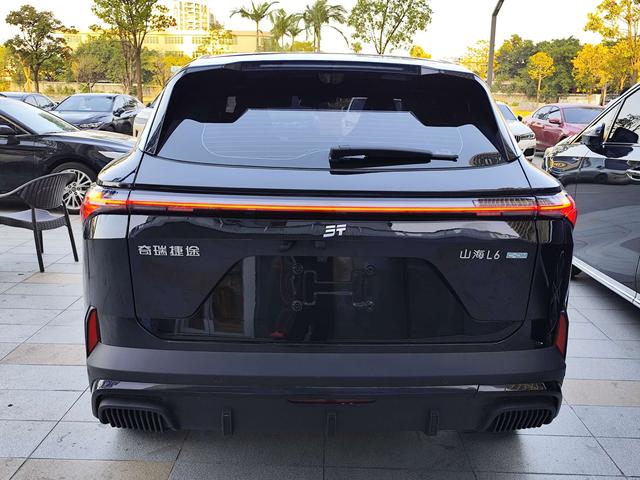
JETOUR Shanhai L6 2024 Vehicle Profile: Youthful Plug-In SUV with 125km EV Range, 1400km Total Range and Budget-Friendly Running Costs

JETOUR Shanhai L6 2024 1.5T DHT MAX Vehicle Profile: A Youthful Plug-In SUV That's Good-Looking, Easy to Drive and Cheap to Run
1. Verdict: Three Highlights & Three Caveats
- Design is the big icebreaker — the "New Chinese-Style" look stands out: The Shanhai L6 uses a "new guofeng (Chinese-style)" design language: a closed grille, sharp LED headlights with inlaid matrix daytime-running lights, flowing sides with a floating roof, 20-inch bladed wheels and fashionable colourways. It reads youthful, fresh and highly recognisable. As JETOUR's first plug-in SUV aimed at younger buyers under its "Travel+" strategy, its styling is among the most striking in its class — a genuine "love at first sight" for many owners.
- 125 km EV range + 1400 km total range — genuinely cheap to run: It runs Chery's fifth-generation Kunpeng C-DM hybrid (1.5T + front single motor), giving 125 km CLTC pure-electric range — enough to treat it as an EV on most short urban trips — while full-tank-plus-charge total range exceeds 1400 km for worry-free long drives. Official low-battery consumption is only about 5.2 L/100 km on 92 RON petrol, joined by 40 kW fast charging and standard 6.6 kW V2L that can power camping gear. Savings plus weekend fun in one package.
- Solid underpinnings, strong braking and generous tech: MacPherson front / multi-link rear four-wheel independent suspension, an electronic park brake and strong stopping performance sit alongside standard L2 driver assistance, 540° camera with transparent chassis, and a large central touchscreen run by a Snapdragon 8155. Equipment at this price point is genuinely generous.
- Rear space is a slight trade-off of the fastback look: At 4630 × 1910 × 1684 mm with a 2720 mm wheelbase the body is mainstream-sized, but the fastback roofline trims some rear headroom; several owners note the rear row — especially the centre seat — feels a little tight. Worth checking if you regularly carry a full family on long journeys.
- Some hard-trim plastics and a new-car smell inside: Budget-conscious materials mean patches of hard plastic, and a few owners report a new-car odour that needs airing out. Lower trims lack the finest detailing, with value-led rather than premium cabin materials.
- Gentle off-the-line acceleration: The single-motor front-drive PHEV delivers smooth, mild initial acceleration rather than launch-control punch. Fine for daily commutes, but buyers who want a sharp, spirited launch feel will find it a touch placid.
2. Model Overview: Market Position & Background
JETOUR is a Chery Holding brand focused on "Travel+" mobility and a youthful identity. The Shanhai L6 is a brand-new compact plug-in hybrid SUV in JETOUR's Shanhai new-energy series, launched in Guilin in August 2024 with an official suggested price band of roughly 12.39–14.49 (guide price only; no prices are discussed in this comparison), aimed squarely at younger buyers and families.
The model's pitch is "good-looking, well-equipped and worry-free," filling a gap in the Shanhai series in the compact plug-in SUV segment. Its sales story followed a pronounced "high open, slow fade": monthly volume reached about 1500–1800 units between August and October 2024, then receded as brand model proliferation and rival pressure mounted. On product strength it remains a well-balanced, sensible pick. Its styling blends New Chinese aesthetics with traditional landscape imagery — flowing haunches, a floating roof, blacked-out wheel arches, a rear spoiler and diffuser tuning it to a young audience, offered in a range of landscape-inspired colours drawn from traditional Chinese palettes.
You can get a full look at the exterior and interior design in this video:
3. Core Specifications (Main Vehicle Only)
The following covers only the main subject: JETOUR Shanhai L6 2024 1.5T DHT MAX.
Body & dimensions
- Model: 2024 JETOUR Shanhai L6 1.5T DHT MAX
- Body type: 5-door, 5-seat plug-in hybrid compact SUV
- Dimensions (L×W×H): 4630 × 1910 × 1684 mm
- Wheelbase: 2720 mm
- Seats: 5
Powertrain
- Engine: 1.5T hybrid-dedicated turbocharged 4-cylinder (max 115 kW / about 156 PS; max torque 220 N·m)
- Hybrid system: Chery 5th-gen Kunpeng C-DM
- Drive motor: front permanent-magnet single motor (max 150 kW / about 204 PS; max torque 310 N·m)
- Drive layout: front-wheel drive
- Transmission: 1-speed hybrid-dedicated gearbox (Super Electric DHT)
- Top speed: about 180 km/h
- 0–100 km/h: about 7.7 s (official reference)
Range & refuelling
- Pure-electric range (CLTC): 125 km
- Pure-electric range (WLTC): about 91 km
- Battery: ternary-lithium (approx. 19.43 kWh)
- DC fast charge: up to about 40 kW, roughly 20 minutes for 20%–80%
- AC slow charge: about 2.6 hours (20% to full, reference)
- Total range: exceeds 1400 km on a full tank plus charge
- V2L output: up to about 6.6 kW
Consumption
- Combined consumption (WLTC): about 1.25 L/100 km
- Official low-battery consumption: about 5.2 L/100 km; runs on 92 RON petrol
- Energy consumption note: approx. 16.8 kWh/100 km (official basis)
Warranty & factory service
- Vehicle warranty: 4 years or 100,000 km
- Lifetime vehicle + three-electric warranty for first non-commercial owner (exclusions per official terms)
Reference on subsidy policies: Purchase tax relief and subsidies for PHEVs vary by market and season. Follow the IEA Global EV Policy Explorer for the latest adjustments by country.
4. Ownership Costs & Service
Charging cost estimate: Using the Global Petrol Prices world-average residential electricity price of about 0.17 USD/kWh and roughly 16.8 kWh/100 km, pure-electric driving costs about 2.9 USD per 100 km. Combined with 125 km CLTC EV range, daily electric commuting is extremely cheap. On longer low-battery runs you refuel with 92 RON petrol — flexible and inexpensive.
Servicing & warranty: JETOUR provides a 4-year / 100,000 km vehicle warranty and, for first non-commercial owners, a lifetime vehicle + three-electric warranty entitlement (exclusions per official terms). The plug-in structure removes several wear-prone items vs a pure-ICE car; mid-term servicing centres on routine hybrid maintenance and stays manageable.
Subsidy & policy comparison (multi-market): Incentive support for PHEV / plug-in models differs significantly by market. Below are the broad policy directions; verify current figures for your destination.
| Market | Typical policy direction (PHEV / dual-fuel class) |
|---|---|
| China | PHEVs may enjoy phased purchase-tax relief or concessions under current rules, with local incentives varying by region |
| Parts of Europe | Purchase-tax or incentive schemes by CO₂/energy class; typically grouped under low-emission / new-energy cars |
| Southeast Asia & Latin America | Often encourage imports via duty reductions, tax breaks, or local-assembly incentives |
| Middle East / Africa | Some countries waive or reduce new-energy vehicle duties as infrastructure is built out |
(For detailed taxes and incentives, see the IEA Global EV Policy Explorer: https://www.iea.org/data-and-statistics/data-tools/global-ev-policy-explorer)
5. Competitor Comparison
The compact PHEV SUV segment is fiercely contested. Against the Exeed ZhuiFeng C-DM, Fengyun T8, and BYD Sealion 05 DM-i:
- Size & space: The Shanhai L6 (4630 mm long, 1910 mm wide, 2720 mm wheelbase) is clearly the widest, giving the most generous shoulder room, though the fastback trims rear headroom. The Fengyun T8 is the longest at 4730 mm and more family/spacious oriented; the Sealion 05 (4726 mm) is close behind; the ZhuiFeng C-DM (4538 mm / 2670 mm) is the most compact and nimble.
- Powertrain & hybrid layout: The Shanhai L6 and Fengyun T8 share Chery's 1.5T + front single-motor setup (both around 150 kW / 204 PS class), the L6 using a 1-speed DHT tuned for smooth efficiency; the Fengyun T8 uses the same 1.5T single motor but with a different gearbox on a heavier body. The Exeed ZhuiFeng C-DM uses a 3-speed DHT with 240 kW/545 N·m combined — the strongest on paper. The Sealion 05 DM-i combines BYD's 1.5L naturally-aspirated engine with a 120 kW motor and E-CVT for smooth, economical running on BYD's mature DM-i system.
- Range & energy structure: Shanhai L6 gives 125 km CLTC EV on a ~19.4 kWh ternary pack; Fengyun T8 130 km CLTC; Sealion 05 115 km CLTC; ZhuiFeng ~105 km NEDC. On total range the L6, T8 and Sealion 05 all clear 1400 km, so daily-EV + long-trip-hybrid capability is close; the differences lie mainly in battery chemistry and consumption curves.
- Refuelling & outdoor capability: The Shanhai L6's standard 6.6 kW V2L is a class advantage, paired with 40 kW fast charging that tops 80% in ~20 min for camping power. The ZhuiFeng, Fengyun T8 and Sealion 05 all sit around 3.3 kW external output with fast charging. For big external power plus quick charging, the L6 is the more convenient package.
Core configuration comparison table
| Dimension | JETOUR Shanhai L6 1.5T DHT MAX | Exeed ZhuiFeng C-DM 105KM Youxiang | Fengyun T8 130km Zungui | BYD Sealion 05 DM-i 115KM Flagship |
|---|---|---|---|---|
| Dimensions (mm) | 4630×1910×1684 | 4538×1848×1699 | 4730×1860×1747 | 4726×1880×1720 |
| Wheelbase (mm) | 2720 | 2670 | 2710 | 2712 |
| Seat layout | 5-door 5-seat SUV | 5-door 5-seat SUV | 5-door 5-seat SUV | 5-door 5-seat SUV |
| Drive layout | Front-wheel drive | Front-wheel drive | Front-wheel drive | Front-wheel drive |
| Pure-EV range | 125km(CLTC)/91(WLTC) | 105km(NEDC)/80(WLTC) | 130km(CLTC)/90(WLTC) | 115km(CLTC)/93(WLTC) |
| Total range | ~1400 km (official) | — | ~1400 km (CLTC) | ~1400 km |
| Transmission | 1-speed DHT | 3-speed DHT | 1-speed DHT | E-CVT |
| Engine power | 115kW(1.5T,156PS) | 115kW(1.5T,156PS) | 115kW(1.5T,156PS) | 74kW(1.5L,101PS) |
| Engine torque | 220 N·m | 230 N·m | 220 N·m | 126 N·m |
| Motor total power | 150kW (204PS) | 125kW (170PS) | 150kW (204PS) | 120kW (163PS) |
| Motor torque | 310 N·m | 315 N·m | 310 N·m | 210 N·m |
| System power/torque | — | 240kW/545N·m | —/530N·m | — |
| Top speed | ~180 km/h | ~180 km/h | ~175 km/h | ~180 km/h |
| Consumption (WLTC,L/100km) | ~1.25 | ~1.76 | ~1.3 | ~1.14 |
| Energy use (kWh/100km) | ~16.8 | ~17.8 | ~15.8 | ~15.8 |
| Battery | Ternary / 19.43kWh | Ternary | LFP | LFP |
| Fast/slow charge | Fast ~20min / slow ~2.6h | Fast ~25min | Fast ~19min / slow ~3h | Fast ~34min / slow ~5.4h |
| V2L output | ~6.6 kW | ~3.3 kW | ~3.3 kW | ~3.3 kW |
| Tyre spec | 235/60 R18 | 225/60 R18 | 235/50 R19 | 235/50 R19 |
| Warranty | 4yr/100k km + lifetime | 3yr/100k km | 4yr/100k km class | 6yr/150k km |
(Note: comparisons are based on the user-supplied four-vehicle configuration screenshot; main-vehicle figures are cross-checked with official channels. No prices are included.)
Summary: The Shanhai L6's core value is bundling youthful good looks, solid range economy (125 km EV + 1400 km total, 5.2 L low-battery) and generous chassis/tech into a pocket-friendly price — a balanced pick for "frugal urban commuting + fun weekend camping," especially for first-car buyers and younger drivers. If you want the strongest combined output, the Exeed ZhuiFeng's 3-speed DHT wins on paper; if you prize a bigger body for family hauling, the longer Fengyun T8 is more practical; if you trust BYD's DM-i system and fuel-sipping reputation, the mature Sealion 05 is the safe choice. The L6 ultimately asks one question: are you happy to give up a little rear headroom and a gentler launch in exchange for a stunning style and lower running costs?
6. Expert Test Drive: Pros & Cons
Pros (sourced from professional reviews)
- Pragmatic performance and consumption with solid EV-range accuracy: the 1.5T + single-motor combo is smooth and efficient; EV-range achievement and real-world fuel figures earn good word-of-mouth. City driving leans electric, longer trips blend in hybrid — better consumption than most rivals.
- Generous underpinnings and a comfortable ride: MacPherson front / multi-link rear four-wheel independent suspension with the cloud "sofa" seats filters bumps well, tracks cleanly through corners with little body roll, and general refinement (including NVH) is acceptable.
- Design and tech that leave an impression: the head-turning New Chinese styling, floating large touchscreen (15.6-inch on mid/high trims, Snapdragon 8155), L2 assistance and 540° camera with transparent chassis feel well equipped and pleasant day to day.
Areas to improve (sourced from professional reviews)
- Rear headroom limited by the fastback: the wide body adds shoulder room, but the fastback roofline trims rear headroom — especially the centre seat — so fully-laden long trips are less comfortable.
- Budget plastics and new-car smell inside: lower trims carry more hard plastic and some new units smell; detailing lags the more polished premium cabins of rivals.
- Gentle start-off throttle and some ADAS feature trimming: single-motor front drive delivers modest initial punch; some configurations cut back on certain L2 features versus claims, so check the spec sheet carefully before buying.
Measured scenarios (with sources noted)
- City commuting / pure-EV running (source: owner word-of-mouth and media tests): petrol-electric flexibility removes range anxiety; ~125 km covers most of a week's commuting on electricity; low-battery consumption around 5.2 L on 92 petrol — budget-friendly.
- Long trips / weekend camping (source: professional reviews and owner posts): full-tank-plus-charge range around 1400 km level means long drives rarely worry you; 6.6 kW V2L runs electric grills and coffee machines for easy camping power. The stable body stays composed with minimal roll on corners.
7. Real Owner Reviews
Positive feedback
- Summary: high exterior styling, fresh and youthful: "The Shanhai L6's looks mattered most to me — its front face is fresh, fashionable and youthful, full of charm. My family and I both love it."
- Summary: economical range, no anxiety thanks to petrol-electric flexibility: "The upside of a plug-in is driving shorts as a pure EV — when the battery is low, hybrid mode steps in, so there's no range anxiety; EV achievement is solid and running costs are genuinely low."
- Summary: comfortable seats, stable chassis, good value: "Seat support and wrapping are good, and corners don't upset the body; with this range and equipment at the price, the value is fair."
Negative feedback
- Summary: rear space is a visible trade-off of the fastback: "As a compact SUV its rear row is relatively tight, especially the middle seat — the fastback curve eats into rear headroom."
- Summary: interior materials/detail and gentle launch: "There's a fair bit of plastic trim which doesn't look premium, and the new car had a slight smell; start-off acceleration feels a touch weak and middling."
(Owner comments compiled from automotive-platform word-of-mouth and long-term reviews as product/usage impressions only.)
8. References
- Global Petrol Prices. World Average Electricity Prices, USD / kWh. Retrieved from https://www.globalpetrolprices.com/electricity_prices
- IEA. Global EV Policy Explorer. Retrieved from https://www.iea.org/data-and-statistics/data-tools/global-ev-policy-explorer
- JETOUR official launch materials and channel info for the Shanhai L6
- JETOUR Shanhai L6 YouTube walkaround video: https://youtu.be/hKdiHpO05qQ