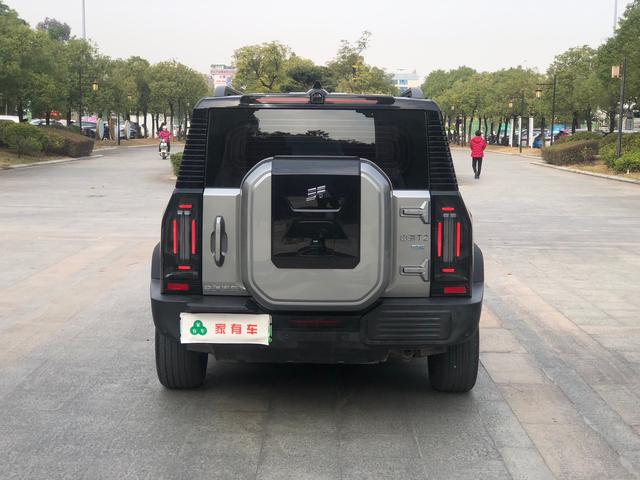
JETOUR Traveller C-DM 2026 Vehicle Profile: Box-Style PHEV SUV with 129km EV Range and 6.6kW Outdoor Power

JETOUR Traveller C-DM 2026 1.5TD DHT 129km "Discovery" Trim: The PHEV Box-SUV That Wants to Take You Off-Grid
1. Verdict: Three Highlights & Three Caveats
- Boxy rugged styling plus powerful V2L output, purpose-built for the outdoors: This car wears a classic box-shaped design with instantly recognizable presence. JETOUR pairs a low-cost PHEV system with a big battery to turn it into an outdoor tool: it supports up to about 6.6kW vehicle-to-load (V2L) discharge — enough to run a camping hotpot, camp lighting, or a small heater. Among the four vehicles compared here, it offers the strongest exterior power supply.
- 3-speed DHT hybrid plus real EV range, cheap around town: The 1.5TD engine and dual motors are deeply coupled through a 3-speed DHT. With around 129 km of CLTC pure-electric range, a 20 km daily commute can go a full week on an occasional charge at very low electricity cost; total range exceeds the 1000 km class, so long trips stay relaxed whether you drive electric or blend in fuel.
- Big cabin, high ground clearance, real-world capability: At nearly 4.8 metres long and over 2 metres wide, with roughly 205 mm of minimum ground clearance and R19 tyres, the box body delivers open headroom and an upright rear seat. It feels confident on rough ground — a genuine all-round "city + light off-road" SUV.
- Noticeable wind and tyre noise: The boxy shape carries large aerodynamic drag, so above roughly 100 km/h wind noise around the A-pillar and tyre roar become fairly prominent. It is a common trait of this body style, and long-distance motorway refinement is only moderate.
- Cabin tech and intelligent assistance feel ordinary, not polished: The cockpit chip is fine for daily use, but the app ecosystem and the perceived polish of the intelligent-driving suite do not push into the top tier. Buyers chasing a cutting-edge smart experience should test it in person.
- Tuned for comfort rather than sport: The chassis leans comfort-oriented, the steering is light, and there is evident body roll in fast corners — not a car for aggressive driving. If "fun to hustle" matters more than "comfortable and off-road ready," weigh this accordingly.
2. Model Overview: Market Position & Background
JETOUR is a passenger-vehicle brand under Chery Holding, focused on "Travel+" crossover and off-road mobility. The Traveller family is one of its strongest lines; in the 2026 refresh the previous "Shanhai T2" was formally renamed "Traveller C-DM", pitched as a plug-in hybrid box-SUV built around "city, off-road, and low running cost."
The C-DM hybrid measures 4795 × 2006 × 1875 mm with a 2800 mm wheelbase — classic hard-off-road box proportions: clean horizontal lines, exposed fenders, and a side-hinged tailgate, combining a tough stance with practical cargo room. JETOUR markets it as an all-scenario machine that "handles daily city life and light trail crossing alike," competing with other rugged PHEV box-SUVs in the same class.
You can get a full look at the exterior and interior design in this video:
3. Core Specifications (Main Vehicle Only)
The following covers only the main subject: JETOUR Traveller C-DM 2026 1.5TD DHT 129km "Discovery" trim.
Body & dimensions
- Model: 2026 JETOUR Traveller C-DM 1.5TD DHT 129km "Discovery"
- Body type: 5-door, 5-seat plug-in hybrid SUV (box-body)
- Dimensions (L×W×H): 4795 × 2006 × 1875 mm
- Wheelbase: 2800 mm
- Minimum ground clearance: approx. 205 mm
- Seats: 5
Powertrain
- Engine: 1.5TD four-cylinder turbo PHEV engine (max 115 kW / about 156 PS)
- Drive motors: front-mounted dual motors (P2+P2.5)
- Electric motor combined output: 165 kW (about 224 PS); combined motor torque about 390 N·m
- System combined power / torque: about 280 kW / 610 N·m
- Transmission: 3-speed DHT hybrid-dedicated gearbox
- Drive layout: front-wheel drive
- Top speed: about 197 km/h
Range & refuelling
- Pure-electric range (CLTC): 129 km
- Battery: LFP (approx. 27.2 kWh) — per CLTC figure
- DC fast charge: approx. 30 minutes (typical window)
- AC slow charge: approx. 4 hours
- V2L discharge: up to approx. 6.6 kW
Consumption
- Energy consumption: approx. 20.5 kWh/100 km (WLTC basis)
- Fuel consumption in low/dead-battery mode (WLTC): approx. 1.4 L/100 km (PHEV combined reference)
Warranty & factory service
- Vehicle warranty: 4 years or 100,000 km
- Lifetime vehicle + three-electric warranty entitlement for first non-commercial owner (exclusions per official terms)
Reference on subsidy policies: Purchase subsidies and tax relief for PHEV models vary by market and season. For the latest cash incentives and duty reductions by country, follow the IEA Global EV Policy Explorer data.
4. Ownership Costs & Service
Charging cost estimate: Using the Global Petrol Prices world-average residential electricity price of about 0.17 USD/kWh as the reference basis, and roughly 20.5 kWh/100 km consumption, pure-electric driving costs about 3.5 USD per 100 km of energy. Combined with the healthy CLTC pure-electric range (129 km), the per-kilometre energy cost of daily electric commuting is far below that of a similarly sized petrol SUV.
Servicing & warranty: JETOUR offers a 4-year / 100,000 km vehicle warranty and, for first non-commercial owners, a lifetime vehicle + three-electric warranty entitlement (exclusions per official terms). The PHEV structure removes many wear-prone items found on pure ICE cars, which helps keep long-term maintenance spend lower.
Subsidy & policy comparison (multi-market): Incentive support for PHEV / plug-in models differs significantly across markets. The table below sketches the broad directions; verify current figures for your destination market.
| Market | Typical policy direction (PHEV / dual-fuel class) |
|---|---|
| China | PHEVs may enjoy phased purchase-tax relief under current rules, with local incentives varying by region |
| Parts of Europe | Purchase-tax or incentive schemes based on CO₂/energy class; typically grouped under low-emission / new-energy cars |
| Southeast Asia & Latin America | Often encourage imports via duty reductions, tax breaks, or local-assembly incentives |
| Middle East / Africa | Some countries waive or reduce EVs/new-energy vehicle duties while local infrastructure is built out |
(For detailed taxes and incentives, see the IEA Global EV Policy Explorer: https://www.iea.org/data-and-statistics/data-tools/global-ev-policy-explorer)
5. Competitor Comparison
The PHEV box-SUV and compact-class PHEV market is fiercely contested. We compared the JETOUR Traveller C-DM against three close rivals — the Haval Dragon PHEV 102 Air, the Hongqi HS3 PHEV, and the Fengyun T8:
- Size & ruggedness: JETOUR is the widest and most substantial of the four at over 2 m wide and a 2800 mm wheelbase; the boxy stance brings stronger presence and cargo flexibility. The Hongqi HS3 reads more as a compact-leaning, city-oriented crossover.
- Seat-plan flexibility: The Fengyun T8 is the only 7-seat model of the group — a better fit for larger families; JETOUR is 5-seat but wins on its tidy, boxy cargo area.
- Consumption & powertrain layout: JETOUR uses a 3-speed DHT with dual front motors for a smoother blend of electric and petrol; the Haval uses Hi4 all-wheel drive with dual motors (front ~70kW / rear ~150kW), higher combined torque and true 4WD capability. There is a real trade-off between "smoother city efficiency" and "stronger off-road traction."
- Refuelling & outdoor capability: JETOUR's roughly 6.6kW V2L is the standout here for camping/outdoor power; Hongqi and Fengyun each offer about 3.3kW. All four support fast + home slow charging.
Core configuration comparison table
| Dimension | JETOUR Traveller C-DM 129km Discovery | Haval Dragon PHEV 102 Air | Hongqi HS3 PHEV 125km Plus | Fengyun T8 130km Zunxiang |
|---|---|---|---|---|
| Dimensions (L×W×H, mm) | 4795×2006×1875 | 4800×1916×1822 | 4655×1900×1668 | 4730×1860×1747 |
| Seat layout | 5-door 5-seat SUV | 5-door 5-seat SUV | 5-door 5-seat SUV | 5-door 7-seat SUV |
| Ground clearance (mm) | approx. 205 | approx. 200 | n/a | approx. 142 |
| Drive layout | Front-wheel drive | AWD (Hi4) | Front-wheel drive | Front-wheel drive |
| Pure-EV range (CLTC) | 129 km | approx. 102 km (WLTC basis) | 125 km | 130 km |
| Transmission | 3-speed DHT | 2-speed DHT | 1-speed DHT | 1-speed DHT |
| Engine max power | 115 kW | 123 kW | 110 kW | 115 kW |
| Motor combined power | 165 kW (dual) | 220 kW (dual) | 168 kW (single) | 150 kW (single) |
| System combined torque | approx. 610 N·m | approx. 750 N·m | — | approx. 530 N·m |
| Top speed | approx. 197 km/h | approx. 190 km/h | approx. 190 km/h | approx. 175 km/h |
| Energy consumption (kWh/100km) | approx. 20.5 | approx. 17.4 | approx. 16.3 | approx. 15.8 |
| Fast / slow charge | fast ~30 min / slow ~4 h | slow-charge oriented | fast ~19 min / slow ~2.6 h | fast ~19 min / slow ~3 h |
| V2L max output | approx. 6.6 kW | approx. 3.3 kW | approx. 3.3 kW | approx. 3.3 kW |
| Tyre spec | 255/60 R19 | 245/60 R18 | 235/50 R20 | 235/50 R19 |
| Central infotainment | ~15.6 in class | ~14.6 in class | ~12.6 in class | ~15.6 in class |
| Warranty | 4yr/100k km + lifetime first-owner entitlement | 6yr/150k km class | 4yr/100k km class + lifetime entitlement | first-owner lifetime-class entitlement |
(Note: this comparison is based on the user-supplied four-vehicle configuration screenshot; main-vehicle figures are cross-checked with official channels.)
Summary: JETOUR Traveller C-DM is less about stacking raw specs and more about the combination of "boxy rugged looks + strong V2L + practical PHEV running cost" into an all-round experience. It suits buyers wanting a wide-body, camping-friendly SUV. If you need stronger four-wheel-drive capability off-road, the Haval Hi4 is the better pick; if your goal is lower-cost city commuting or a roomier family layout, the Hongqi and Fengyun give smoother compact options and the Fengyun adds a 7-seat choice. The deciding factor is whether you are paying for a "city + off-road lifestyle" or for the best single-scenario solution.
6. Expert Test Drive: Pros & Cons
Pros (sourced from professional reviews)
- Quiet, smooth EV starts: in pure-electric mode the drivetrain is linear and hushed for comfortable city stop-and-go; when the hybrid cuts in, throttle response is quick and overtaking/climbing feels effortless.
- Comfortable chassis, confident off-road: the comfort-biased suspension and soft seats absorb city bumps well, larger potholes are handled effectively, and the platform feels planted on rough ground with reassuring capability.
- Practical space and equipment: generous front/rear headroom and legroom, plentiful and sensibly placed storage, plus handy kit such as a multifunction steering wheel, panoramic sunroof, and large display — suited to family use.
Areas to improve (sourced from professional reviews)
- Moderate motorway refinement: the boxy body creates noticeable wind drag; above 100 km/h A-pillar wind and tyre noise are pronounced — a widespread trait of this body style.
- Cockpit ecosystem and intelligent-drive polish: the cabin chip is adequate day-to-day, but the app ecosystem is not refined, and the driver-assist suite does not feel first-tier.
- Comfort-biased, not for sport: steering is light and the chassis leans comfortable, with gradual body roll on faster bends — better suited to relaxed driving than aggressive cornering.
Measured scenarios (with sources noted)
- City / pure-electric commuting (source: owner long-term posts): with electric-first driving for a daily commute, owners report charging roughly every two days with low cost; around-town pure-electric range sits at the ~100 km level in real use and meets daily expectations.
- Long trips / running low on charge (source: a 40,000 km owner test): highway cruising keeps ample power reserve, total range with a full tank + charge exceeds 1000 km so long trips don't force frequent charge stops; in low-battery city driving consumption was about 6.5 L/100 km and about 7 L/100 km at a 120 km/h cruise — economical for a ~2-tonne battery PHEV SUV.
7. Real Owner Reviews
Positive feedback
- Summary: running cost and economy are very satisfying: "With home off-peak power at about 0.23 CNY/kWh... my 20 km daily commute charges once a week and the monthly electricity bill is under 50 CNY — cheaper than the metro... in low-battery city driving about 6.5L, and about 7L at a 120km/h cruise. For a 2.3-tonne rugged SUV that consumption is very pleasing."
- Summary: space and camping practicality stand out: "2,800mm wheelbase, at 180cm my knees had over two fists of rear room, and with the rear seats folded flat it is level enough to use as a bed; the 6.6kW V2L handled a camping hotpot and lighting without any problem."
- Summary: adequate power, solid chassis, good capability: "The chassis and suspension felt well composed, stable over rough roads, and confident for overtaking and lane changes on the motorway; the 4WD version's 220mm clearance gives real peace of mind on weekends over bad roads and light trails."
Negative feedback
- Summary: cargo volume is on the smaller side and needs tidying to carry a lot: "The only small gripe is the boot is on the small side — you have to pack things neatly to fit more, which is a bit of a hassle."
- Summary: motorway noise and the cockpit ecosystem are not refined: "The boxy body carries a lot of drag — above 100km/h A-pillar wind noise and tyre roar are obvious, a common trait of box-body cars; the 8155 chip is fine day-to-day but the app ecosystem is average, and the smart experience is not polished."
(Owner comments compiled from automotive-platform long-term reviews and word-of-mouth as product/usage impressions only.)
8. References
- Global Petrol Prices. World Average Electricity Prices, USD / kWh. Retrieved from https://www.globalpetrolprices.com/electricity_prices
- IEA. Global EV Policy Explorer. Retrieved from https://www.iea.org/data-and-statistics/data-tools/global-ev-policy-explorer
- JETOUR official website, 2026 Traveller C-DM vehicle page & specs: https://www.jetour.com.cn/vehicles/travelercdm
- JETOUR Traveller C-DM YouTube walkaround video: https://youtu.be/EPIXuAK9WA4?si=lYxn1FlVRCrdBjzS