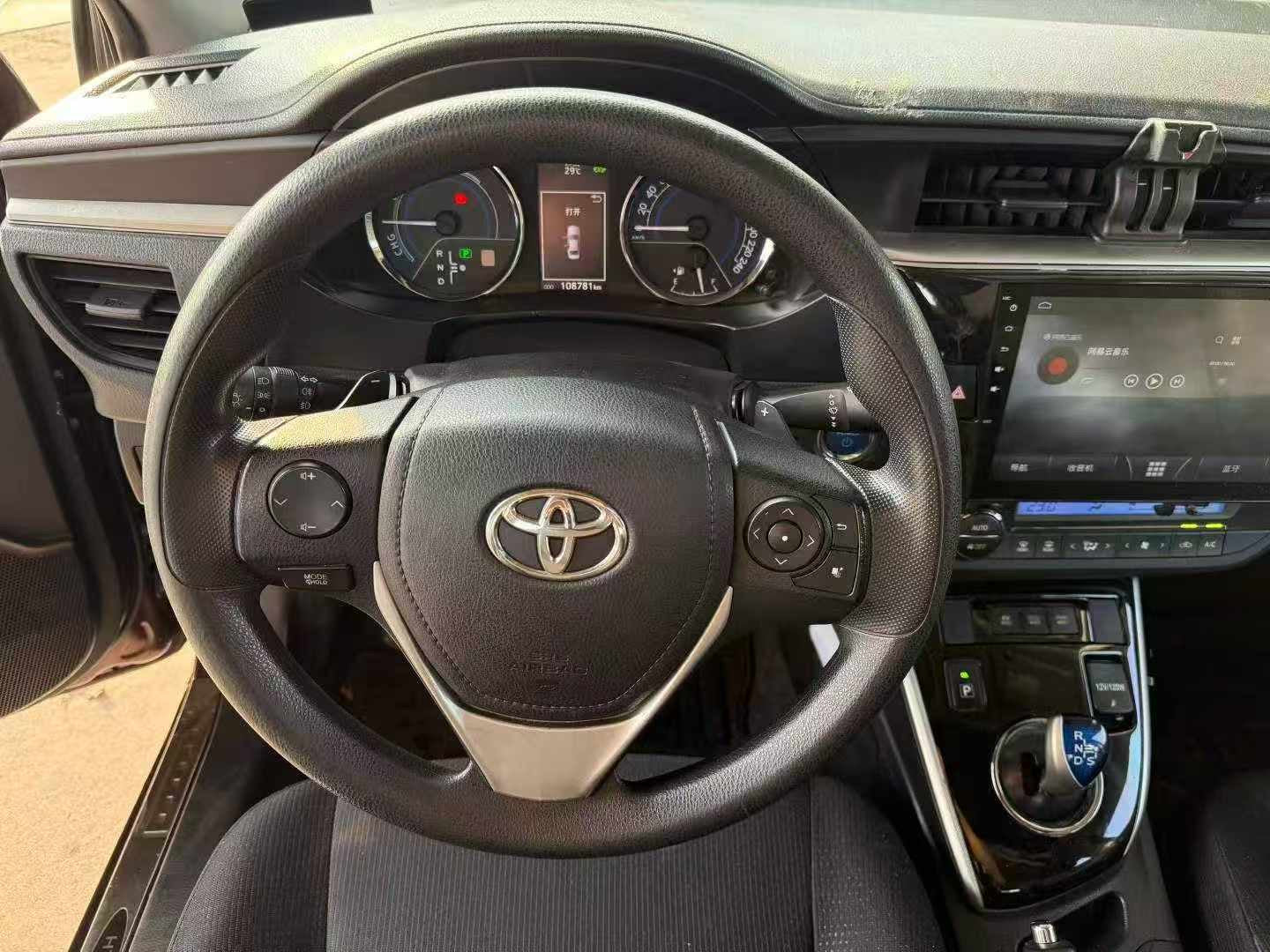
Toyota Levin Hybrid 2016 Vehicle Profile: 4.2L/100km Fuel-Efficient Compact Sedan

Model Overview
The Toyota Levin rides on Toyota's global MC platform with a GOA high-strength body, featuring door impact beams with tensile strength up to 1500 MPa. The 2016 Levin Hybrid is the hybrid version of the Levin, launched by GAC Toyota in October 2015, positioned as a compact family sedan built around "economical value and dependable longevity."
The Levin Hybrid pairs Toyota's second-generation THS hybrid system: a 1.8L Atkinson-cycle naturally aspirated engine driven through a front-mounted single electric motor and an E-CVT. The engine delivers 73kW (99 hp) and 142N·m of peak torque; the motor contributes 53kW (72 hp) and 207N·m. Combined system output is roughly 135 hp. Power flows through the E-CVT and is distributed between engine and wheels in varying ratios, combining low fuel consumption, low emissions, and smooth driving.
Externally it differs little from the gasoline model, distinguished mainly by HYBRID badging and a dedicated CHG/ECO/POWER three-zone energy display. It is positioned against the Corolla Hybrid, Civic, and Axela/3 in the compact sedan segment, winning a strong following among family buyers through its fuel economy and trouble-free reputation.
You can get a full look at the car's exterior and interior design in this video:
Core Specifications
|
Item
|
Specification
|
|
Model
|
Levin 2016 Hybrid 1.8H GS CVT Elite Sunroof
|
|
Powertrain
|
Hybrid (HEV)
|
|
Engine
|
1.8L 99hp L4 Atkinson-cycle NA
|
|
Engine power
|
73kW (99 hp)
|
|
Engine torque
|
142N·m
|
|
Motor power
|
53kW (72 hp)
|
|
Motor torque
|
207N·m
|
|
Transmission
|
E-CVT
|
|
Combined consumption (NEDC)
|
4.2 L/100km
|
|
Battery
|
Nickel-metal-hydride (self-charging, no plug-in)
|
|
Dimensions (mm)
|
4630 × 1775 × 1485
|
|
Wheelbase (mm)
|
2700
|
|
Body
|
4-door 5-seat sedan
|
|
Fuel tank (L)
|
45.0
|
|
Fuel grade
|
92# gasoline
|
|
Vehicle warranty
|
3 years / 100,000 km
|
|
Battery warranty
|
8 years / 200,000 km
|
Maintenance & manufacturer service The Levin Hybrid's powertrain is structurally mature and dependable; routine service mainly involves periodic oil and filter changes. Estimated total maintenance cost over 60,000 km is about RMB 3,915 (≈ USD 550). GAC Toyota operates a nationwide service network with ample parts supply, making upkeep convenient. The hybrid battery's 8-year/200,000 km warranty further eases long-term ownership concerns.
Incentives As a non-plug-in hybrid (HEV), the Levin Hybrid does not qualify for the purchase subsidies or purchase-tax exemptions offered to pure-electric and plug-in hybrid vehicles. Its cost advantage lies primarily in day-to-day low fuel consumption.
Three Highlights & Three Caveats
Highlight 1: Outstanding city fuel economy The 1.8L Atkinson-cycle engine works with an electric motor to deliver an NEDC combined fuel consumption of just 4.2L/100km. In congested urban traffic, the hybrid system makes full use of the motor for launches and regenerative braking, keeping real-world city consumption around the low 4L mark — a clear win for daily commuters.
Highlight 2: Smooth, seamless power delivery The E-CVT continuously variable transmission makes power delivery silky smooth. Acceleration from standstill and mid-speed overtaking feel light and effortless, delivering excellent ride comfort with virtually no shift shock for daily and family use.
Highlight 3: Mature, dependable hybrid system Toyota's hybrid technology has been validated by roughly 8 million owners globally. The nickel-metal-hydride battery pack carries an 8-year/200,000 km warranty, so there is little day-to-day worry about battery life — a genuinely "hassle-free" family choice.
Caveat 1: Average noise isolation Overall cabin insulation is a mid-to-lower pack for its class. The engine gets noticeably loud under hard acceleration, and highway tire noise is pronounced — worth noting if you prioritize quietness.
Caveat 2: Middling rear space and trunk Rear legroom is adequate but not generous, and the rear headrests cannot be adjusted. Because of the hybrid battery layout, trunk volume is on the small side, making large luggage loads more of a challenge.
Caveat 3: Practical, no-frills equipment As an entry hybrid trim, interior materials lean conventional, the central screen is small, and the multimedia system offers basic functions. Connected-car and remote-control features are essentially absent.
Ownership Costs & Service
|
Item
|
Details
|
|
Vehicle warranty
|
3 years / 100,000 km
|
|
Battery warranty
|
8 years / 200,000 km
|
|
Service interval
|
Regular periodic maintenance; ~RMB 3,915 (≈ USD 550) over 60,000 km
|
|
Combined consumption
|
4.2 L/100km (NEDC)
|
|
Global average gasoline price
|
USD 1.423/L (Global Petrol Prices, Q2 2026)
|
|
Fuel cost per 100 km
|
≈ 4.2 × 1.423 ≈ USD 5.98
|
|
Annual fuel cost (20,000 km)
|
≈ USD 1,196
|
Real ownership cost analysis At the global average gasoline price of USD 1.423/L, the Levin Hybrid costs about USD 5.98 per 100 km, or roughly USD 1,196 per year at 20,000 km driven. Compared with same-class 1.5T/2.0L gasoline cars (5.7–5.8L/100km), it saves about USD 400–500 in fuel each year. Combined with the low failure rate of the simple hybrid system, its long-term cost of ownership is a clear advantage in its class. As a self-charging hybrid, it needs no charging station and behaves exactly like a conventional car, with zero range anxiety.
Competitors Comparison
The Levin Hybrid faces a competitive compact-sedan market. This comparison covers the Corolla Hybrid, the Civic 220TURBO, and the Mazda Axela, examining differences in powertrain, fuel economy, and equipment.
-
Powertrain approach: The Levin and Corolla are both hybrid-electric (HEV); the Civic uses a 1.5T turbo; the Axela uses a 1.5L naturally aspirated engine. Hybrids lead on city fuel economy and smoothness, while the turbo and high-revving NA units respond more directly at higher speeds.
-
Fuel economy: The Levin/Corolla hybrids show an NEDC combined 4.2L/100km, clearly better than the Civic's 5.7L and the Axela's 5.8L — a gap that widens further in city driving.
-
Power reserve: The Civic 1.5T offers 177 hp/220N·m and a 0-100 km/h time of about 8.7s, the most punchy here; the Levin Hybrid's ~135 hp system output prioritizes smoothness and economy over performance.
-
Chassis and positioning: The Civic and Axela lean sportier with more engaging handling; the Levin/Corolla hybrids focus on comfort, family use, and low running costs.
|
Dimension
|
Levin Hybrid 1.8H GS CVT Elite Sunroof
|
Corolla Hybrid 1.8L CVT Elite
|
Civic 220TURBO CVT Premium
|
Axela Hatch 1.5L Auto Luxury
|
|
Powertrain
|
Hybrid-electric
|
Hybrid-electric
|
Gasoline (turbo)
|
Gasoline (NA)
|
|
Engine
|
1.8L 99hp L4
|
1.8L 99hp L4
|
1.5T 177hp L4
|
1.5L 117hp L4
|
|
Engine power
|
73kW
|
73kW
|
130kW
|
86kW
|
|
Engine torque
|
142N·m
|
142N·m
|
220N·m
|
148N·m
|
|
Motor power
|
53kW
|
53kW
|
—
|
—
|
|
Motor torque
|
207N·m
|
207N·m
|
—
|
—
|
|
Transmission
|
E-CVT
|
E-CVT
|
CVT
|
6-speed AT
|
|
0-100 km/h
|
—
|
—
|
~8.7s
|
—
|
|
Combined consumption (NEDC)
|
4.2 L/100km
|
4.2 L/100km
|
5.7 L/100km
|
5.8 L/100km
|
|
Dimensions (mm)
|
4630×1775×1485
|
4630×1775×1485
|
4649×1800×1416
|
4461×1795×1474
|
|
Wheelbase (mm)
|
2700
|
2700
|
2700
|
2700
|
|
Body
|
4-door sedan
|
4-door sedan
|
4-door sedan
|
5-door hatch
|
|
Top speed (km/h)
|
—
|
180
|
200
|
180
|
|
Fuel tank (L)
|
45.0
|
45.0
|
47.0
|
51.0
|
|
Trunk volume (L)
|
—
|
—
|
—
|
350
|
|
Front tire
|
195/65 R15
|
205/55 R16
|
215/50 R17
|
205/60 R16
|
|
Rear tire
|
195/65 R15
|
205/55 R16
|
215/50 R17
|
205/60 R16
|
|
Service estimate (60,000 km)
|
RMB 3,915
|
RMB 7,705
|
RMB 4,890
|
RMB 13,613
|
|
Sunroof
|
Single sunroof
|
—
|
—
|
—
|
|
Seat material
|
Fabric
|
Leather
|
Leather
|
Fabric
|
|
Keyless start
|
Standard
|
Standard
|
Standard
|
Standard
|
|
Reverse camera
|
Standard
|
Standard
|
Standard
|
Standard
|
|
Parking brake
|
Handbrake
|
Handbrake
|
Electronic
|
Handbrake
|
|
Front brakes
|
Ventilated disc
|
Ventilated disc
|
Ventilated disc
|
Ventilated disc
|
|
Rear brakes
|
Solid disc
|
Solid disc
|
Solid disc
|
Solid disc
|
These four cars serve different priorities. The Levin and Corolla Hybrids lead on city fuel economy and running costs and are classic "best urban-family choice" picks — and the Levin Hybrid's 60,000 km service estimate of about RMB 3,915 is well below the Corolla Hybrid's RMB 7,705, making it cheaper to run daily. The Civic offers the strongest performance and more driving fun but higher fuel and service costs. The Axela hatch is the smallest and most sportily tuned. If your core priorities are fuel economy, reliability, and low running costs, the Levin Hybrid is the most balanced blend of value and practicality in this comparison.
Expert Test Drive — Pros & Cons
Pros
-
Outstanding fuel economy: Real-world combined highway/city consumption test about low 4L/100km, with the advantage growing in congested traffic — one of the rare models in class that "saves more in heavier traffic" (Source: Autohome, Xchuxing test drives).
-
Smooth, light performance: The E-CVT delivers seamless power, with brisk launches and mid-speed overtaking and easy everyday driving (Source: Autohome, Xchuxing test drives).
-
Comfortable, durable chassis: Suspension is tuned for comfort with controlled body motions over bumps and rough roads; the mature hybrid system is dependable over the long term (Source: Yiche real-world test).
To improve
-
Average noise isolation: The engine gets loud under hard acceleration and highway tire noise is noticeable; overall NVH is mid-to-lower pack in class (Source: Autohome, Pacific Auto reviews).
-
Basic equipment: The central screen is small, multimedia functions are simple, and connected-car/remote-control features are absent, with a plasticky interior feel (Source: Xchuxing review).
-
Rear and trunk limitations: Rear headrests cannot be adjusted, and trunk volume is small due to the hybrid component layout, limiting cargo capacity (Source: Xchuxing, Sohu road test).
Real-world scenarios
-
City commuting: In congested morning/evening rush hour, long-term displayed consumption can hold at 3.6–4.2L/100km; a 60 km daily round-trip costs very little in fuel (Source: owner fuel-consumption reports).
-
Family trips: The comfort-tuned chassis, supportive seats with good wrapping, and relatively flat rear center floor mean a full 5-person load rides without feeling cramped — a solid everyday family car (Source: China News test drive).
Real Owner Reviews
Positive feedback
Economical and durable The quality owners praise most is the hybrid's low fuel consumption and tough, dependable build; routine maintenance is all that's needed, keeping ownership simple and cheap.
"Tough, reliable, economical and fuel-efficient — a good family car." "Under 5L/100km at 120–130 km/h highway, a pleasant surprise; fuel economy is satisfying and power delivery is smooth."
Smooth power delivery Owners consistently note linear, jerk-free hybrid power, lively launches, and a great urban driving experience.
"Hybrid power is sufficient, acceleration is linear with no jerk; steering feels nice and the suspension is supple."
Very low city consumption Long-distance commuters are very satisfied with city consumption; heavy traffic actually makes it more economical.
"60 km round-trip daily, rush-hour congestion and lots of traffic lights — long-term displayed consumption holds steady at 3.6L, which I'm really happy with."
Negative feedback
Noise isolation Insulation is the most-cited complaint; the engine is loud under hard acceleration and highway tire noise is obvious.
"Overall insulation is average; the engine is loud, especially under hard acceleration, with noticeable tire noise that varies with the road surface." "Poor insulation, interior rattles — apart from fuel economy and stability there's not much to recommend."
Space and equipment limits Some owners find rear space small and trunk volume limited, with fairly basic features.
"Rear space is small, trunk space is small, and the features are pretty basic too."
References
-
Global Petrol Prices (2026). World Average Gasoline Prices, USD / Liter. Retrieved from https://www.globalpetrolprices.com/gasoline_prices/
-
IEA. Global EV Policy Explorer. Retrieved from https://www.iea.org/data-and-statistics/data-tools/global-ev-policy-explorer
-
GAC Toyota Official Website. Retrieved from https://www.gac-toyota.com.cn
-
China News (2026). Lower Cost of Ownership – Test Driving the GAC Toyota Levin Hybrid. Retrieved from https://www.chinanews.com.cn
Note: The above is provided for used-car purchase reference only. Please verify actual condition against the vehicle itself.