Cadillac XT5 2026 Vehicle Profile: Space-First American Luxury SUV with 33-inch 9K Curved Cockpit, 1,589 L Cargo & Hummingbird AWD Chassis

1. Verdict: Three Highlights & Three Caveats
Highlight 1: Class-leading body size and space The locally built, all-new-generation XT5 stretches 4,888 mm long with a 2,863 mm wheelbase, and its 1,957 mm width is the widest of the four rivals compared here. Cargo volume starts at 653 L (expanding to 1,589 L with the rear seats folded), and the rear floor is completely flat — among premium mid-size SUVs, its three-across practicality and load-carrying ability stand out.
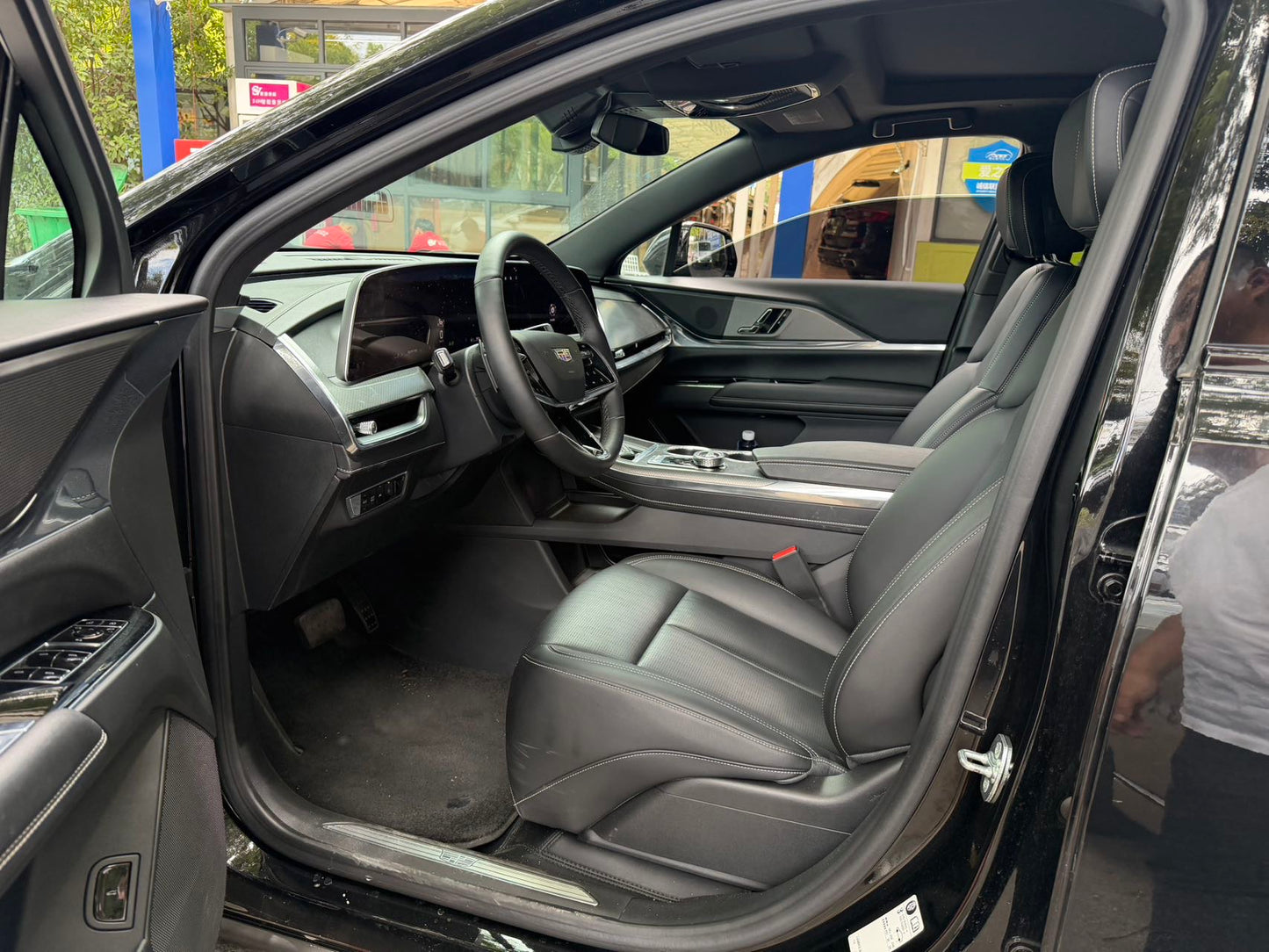
Highlight 2: Generous tech cabin and comfort features across the range Every version carries a 33-inch 9K curved display with a Qualcomm Snapdragon 8155 chip, 5G connectivity, and full-vehicle OTA. Heated/ventilated/massaging front seats, a heated steering wheel, AKG premium audio, and double-layer acoustic glass come as standard kit. That "entry trim = fully loaded" approach makes the XT5 notably more generous on the spec sheet than many German rivals.
Highlight 3: Chassis and all-wheel drive are its calling card Every version runs a 2.0T engine with 48V mild-hybrid assistance and a 9-speed automatic. The "Hummingbird chassis" with RTD real-time adaptive dampers balances comfort and handling nicely, while the AWD versions emphasize stability and traction on ice, snow, and slippery roads — of the four on show, the XT5 brings the most American, solid-feeling chassis and AWD tune.
Caveat 1: Higher urban fuel consumption WLTC combined fuel consumption of about 8.23 L/100 km looks acceptable on paper, but real city commuting is commonly over 10 L/100 km, and it requires 95-octane (or higher) petrol — the day-to-day fuel bill sits at the higher end of the four cars here.
Caveat 2: Weaker brand premium and resale value Compared with Mercedes-Benz and Volvo, Cadillac's used-car resale value in China runs lower overall, and new cars depreciate faster. If you plan to change cars within three to five years, factor the resale loss into the total cost.
Caveat 3: Smart-cockpit experience still trails Despite the 8155 chip and large display, the infotainment's smoothness and voice-recognition accuracy still lag some newer brands or the latest systems in the Evoque/Volvo. Buyers who prioritize a cutting-edge smart cockpit should try the car first.
2. Model Overview
The Cadillac XT5 is a large luxury SUV from SAIC-GM Cadillac in China (positioned in the country as a premium mid-size SUV), sitting between the XT4 and XT6 in the range and serving as one of Cadillac's core sales pillars in China. First locally produced in 2016 as the successor to the SRX, the 2026 model is the newest annual product after the full redesign. It continues Cadillac's signature "diamond-cut" design language — a shield grille, split "7"-shaped LED headlights, taut body lines, and a floating roofline — giving a distinctly powerful and recognizable presence.
The 2026 28T AWD Luxury version studied here is the domestically produced model, launched in September 2025, with body dimensions of 4,888 × 1,957 × 1,694 mm and a 2,863 mm wheelbase. Every version under the hood shares a 2.0T variable-valve turbocharged engine with standard 48V mild-hybrid assistance, mated to a 9-speed automatic and front-biased on-demand all-wheel drive. The cabin adopts a wraparound "yacht-inspired" design with an all-standard 33-inch 9K curved display and a Qualcomm Snapdragon 8155 infotainment system — the reference point for a "tech + luxury" approach across the range.
In today's premium mid-size SUV market, the XT5 mainly rivals the Mercedes-Benz GLC, Audi Q5L, BMW X3, and Volvo XC60. Against the German players, the XT5 differentiates on "oversized body + generously loaded specs + chassis substance," backed by sizable dealer discounts that build a strong value-for-money image — an appealing pick for families who value space, features, and ride quality without insisting on a German badge.
You can get a full look at the exterior, interior, and on-road character of the model in the video below:
3. Basic Specifications
- Model: Cadillac XT5 2026 28T AWD Luxury
- Powertrain: Petrol (2.0T + 48V mild hybrid, front-biased on-demand AWD)
- Engine: 2.0T (LSY/LXH-type) turbocharged inline-four, 174 kW (237 hp) / 350 N·m
- Transmission: 9-speed automatic
- Drivetrain: Front-engine, four-wheel drive (on-demand AWD)
- Official 0-100 km/h: 8.3 s
- Top speed: 210 km/h
- Fuel consumption (WLTC combined): approx. 8.23 L/100 km (95-octane or higher required)
- Body dimensions (mm): 4,888 × 1,957 × 1,694
- Wheelbase (mm): 2,863
- Body style: 5-door 5-seat SUV
- Curb weight: approx. 1,970 kg
- Fuel tank: 82 L
- Luggage volume: 653–1,589 L
- Front / rear track (mm): 1,687 / 1,683
- Minimum ground clearance: 158 mm
- Front tire size: 235/55 R20
- Suspension: Front MacPherson independent / rear five-link independent
- Emission standard: China VI
Service & warranty note SAIC-GM Cadillac offers a relatively long whole-vehicle warranty for this lineup ("3 years / unlimited mileage" or similar, depending on the local dealer policy at purchase time). As a petrol model, subsidy and tax incentives are limited, and some Chinese cities enforce stricter registration/restriction rules on petrol vehicles; for overseas-introduction use, evaluate target-market emissions, fuel-economy (CAFE/CO₂) rules, and import/certification requirements.
4. Ownership Costs & Service
Maintenance & warranty This model runs a 2.0T with a 48V mild-hybrid setup and a 9-speed automatic, and requires 95-octane (or higher) petrol day to day. Measured over a 60,000 km cycle, routine servicing (oil, filters, etc.) plus wear-item replacement through the authorized 4S network sits in the upper-middle band for premium mid-size SUVs in the domestic market, with fairly complete factory warranty coverage. Servicing at authorized outlets and keeping records supports resale value and warranty continuity later.
Fuel cost estimate (using Global Petrol Prices world-average petrol pricing) At a WLTC combined figure of about 8.23 L/100 km and roughly 15,000 km per year, annual fuel use is about 1,235 litres. Converted at the world-average petrol price level above, the annual fuel spend lands in the upper-middle range for the premium segment; with real city-dominant driving at 10–11 L/100 km, the actual bill rises noticeably. For an export-trade view of overseas buyers, recalibrate the local per-km fuel cost against the target country's petrol price (latest figures available from Global Petrol Prices).
After-sales network and overseas support considerations The lineup is covered domestically by the authorized dealer network. If you intend to bring it to an overseas market, confirm the local availability and ease of servicing for the powertrain, chassis, and wear components — this is the key variable in long-term running costs, so research target-market support and certification before purchase.
5. Competitor Comparison
In the premium mid-size SUV market, the XT5's main rivals are the Mercedes-Benz GLC, Volvo XC60, and Range Rover Evoque L among comparable German/European SUVs. The XT5's core strengths are its oversized body, generously loaded tech and comfort cabin, and the solid "Hummingbird chassis" with AWD traction; its weaknesses are higher urban fuel consumption, weaker brand resale, and a smart-cockpit that trails the newest rivals. The Mercedes-Benz GLC sells on badge prestige and interior luxury, the Volvo XC60 on balance and its safety reputation, and the Range Rover Evoque L on refined British design with a shorter body for a younger, sportier image. Below is the core spec and feature comparison of the four cars:
Four models compared (all premium mid-size SUVs / petrol with 48V mild hybrid): Cadillac XT5 2026 28T AWD Luxury · Mercedes-Benz GLC 2026 GLC 260L 4MATIC Dynamic 5-seat · Volvo XC60 2026 B5 AWD Zhiyi Luxury · Range Rover Evoque 2026 Evoque L 2.0T SE
Core specification comparison
| Spec | Cadillac XT5 2026 28T AWD Luxury | Mercedes-Benz GLC 2026 260L 4MATIC Dynamic | Volvo XC60 2026 B5 AWD Zhiyi Luxury | Range Rover Evoque 2026 Evoque L 2.0T SE |
|---|---|---|---|---|
| Engine | 2.0T (LXH) turbo inline-4 + 48V mild hybrid | 2.0T turbo + 48V mild hybrid | 2.0T turbo + 48V mild hybrid | 2.0T turbo + 48V mild hybrid |
| Max power | 174 kW (237 hp) | 150 kW (204 hp) | 184 kW (250 hp) | 183 kW (249 hp) |
| Peak torque | 350 N·m | 320 N·m | 360 N·m | 365 N·m |
| Drivetrain | Front-biased on-demand AWD | AWD | AWD | Front-biased on-demand AWD |
| Transmission | 9-speed automatic | 9-speed automatic | 8-speed automatic | 9-speed automatic |
| Dims L×W×H (mm) | 4,888 × 1,957 × 1,694 | 4,826 × 1,890 × 1,714 | 4,708 × 1,902 × 1,660 | 4,531 × 1,904 × 1,650 |
| Wheelbase (mm) | 2,863 | 2,977 | 2,865 | 2,841 |
| 0-100 km/h (official) | 8.3 s | 8.2 s | 7.1 s | 8.2 s |
| Top speed | 210 km/h | 212 km/h | 180 km/h | 229 km/h |
| WLTC combined fuel | 8.23 L/100 km | 7.2 L/100 km | 7.43 L/100 km | 8.98 L/100 km |
| Curb weight | approx. 1,970 kg | approx. 2,000 kg | approx. 1,920 kg | approx. 2,000 kg |
| Fuel tank | 82 L | 66 L | 71 L | 67 L |
| Luggage volume | 653–1,589 L | approx. 550 L | 483–1,410 L | 492–1,256 L |
| Front tires | 235/55 R20 | 235/55 R19 | 235/60 R18 | 235/50 R20 |
| Whole-vehicle warranty | 3 years / unlimited mileage | 3 years / unlimited mileage | 3 years / unlimited mileage | 3 years or 100,000 km |
Representative comfort/tech features (standard unless noted)
| Feature | XT5 | GLC 260L | XC60 B5 | Evoque L |
|---|---|---|---|---|
| Openable panoramic sunroof | Standard | Standard | Standard | Standard |
| Front seat heating | Standard | Standard | Standard | Standard |
| Seat ventilation / massage | Standard (Luxury includes ventilation/massage) | Some standard / optional | Optional | Limited / optional |
| Front multi-layer acoustic glass | Standard | Standard | Optional | Standard |
| Heated steering wheel | Standard | Optional | Standard | — |
| Adaptive damping / air suspension | RTD adaptive damping (high-trim Hummingbird chassis) | Optional | — | Optional (high trim) |
| L2 driving assistance (full-speed adaptive cruise, etc.) | L2 | L2 | L2 | L1 |
| Infotainment display | 33-inch curved screen | approx. 11.9-inch | approx. 12.3-inch | approx. 11.4-inch |
A few analytical notes (based on the data):
- On power, all four run a 2.0T + 48V mild-hybrid route, with the Volvo XC60 B5 strongest on paper (250 hp / 360 N·m and the fastest 0-100 at 7.1 s); the XT5's 237 hp / 350 N·m is more of a composed, progressive setup than an aggressive one.
- On fuel and daily costs, the lowest WLTC figures are the Mercedes-Benz GLC at about 7.2 L and the XC60 at 7.43 L, against the higher XT5 (~8.23 L) and Evoque L (~8.98 L); in real urban driving the gap widens further for the thirstier cars.
- On size, the XT5 leads in width (1,957 mm) and luggage volume (653–1,589 L), while the GLC has the longest wheelbase (2,977 mm) for a clear second-row legroom edge; the shorter Evoque L is easier to park and nimbler in town.
- On driver-assistance and tech, the XT5, GLC, and XC60 all reach L2 with full-speed adaptive cruise; the XT5 wins on cockpit tech with its 33-inch 9K curved display plus 8155 chip and fully loaded comfort kit, while the Evoque L sits at L1 and leans more on design and brand flair.
Summary: If your priorities are "space + a generously loaded tech/comfort cabin + a solid chassis with AWD traction," the XT5 is the most value-and-feature-rich of the four. If you care more about brand prestige and interior luxury, the Mercedes-Benz GLC fits; for a safety-conscious all-rounder with dependable power, the Volvo XC60 is a composed, easy-to-live-with pick; and if you favor young, refined British style without high space demands, the Range Rover Evoque L stands apart. Buying a car is a trade-off — decide whether you value space, brand, or driving character most, and the answer becomes much clearer.
6. Expert Test Drive — Pros & Cons
Online and professional test-drive reviews converge on the XT5's space practicality, chassis substance, and cockpit tech, while also noting higher urban fuel use, weaker brand resale, and infotainment smoothness as areas to improve.
Pros
- Spacious and practical: the 4,888 mm body and flat rear floor deliver generous seating and load space, with cargo starting at 653 L and expanding to 1,589 L with seats folded — the most capacious of the four (source: combined automotive-portal and media space tests).
- Weighty, refined chassis: the "Hummingbird chassis" (RTD real-time adaptive dampers) balances bump absorption with cornering support, with a stable high-speed cruise and soft filtering of small ripples — an American-spec substance that is a clear signature (source: multiple media test drives and chassis reviews).
- Generous tech and comfort: the all-standard 33-inch 9K curved display and Snapdragon 8155 chip, with AKG audio, ventilated/heated/massaging front seats, and double-layer acoustic glass, make it stand out for interior tech and comfort in the segment (source: manufacturer specs and media cabin reviews).
To improve
- Higher fuel consumption: real urban figures are commonly over 10 L/100 km and it needs 95-octane petrol, so the medium-to-long-term fuel burden is heavier than rivals.
- Infotainment smoothness and voice recognition: versus some newer brands or the latest rivals, screen response and voice accuracy still trail, limiting the full smart-cockpit experience.
- Weaker resale and brand premium: Cadillac's used values in China run below its German peers, and new cars depreciate relatively faster.
Test scenarios (with sources)
- City and highway NVH: media tests commonly report good cabin quietness, with the front double-layer acoustic glass controlling wind and road noise well; in-cabin noise at 120 km/h cruise ranks in the segment's upper tier (sources: comparative NVH tests by several outlets).
- AWD and traction: versions with on-demand AWD and the Hummingbird chassis show stable behavior and decent one-wheel traction recovery on ice, wet, and mild off-road surfaces (sources: four-wheel-drive track tests by autohome-style and media outlets).
7. Real Owner Reviews
The feedback below is organized around the car itself — chassis, performance, fuel economy, space, NVH, and features — drawn from real owner reviews.
Positive feedback
Space and practicality — Summary: Most owners approve of the spacious seating and practical loading; the flat rear floor makes three-across seating comfortable, and a roomy trunk is a frequent highlight. Example: owners report "the space is genuinely large, the rear floor is flat, and three people don't feel cramped" and "the trunk is very roomy — family trips load up with ease."
Chassis and ride quality — Summary: Owners broadly praise the weighty, stable chassis and comfortable ride filtering, with strong high-speed confidence and a sense of security. Example: "It drives very steadily, the chassis is solid and substantial — reassuring on the highway, and bumps are filtered comfortably."
Power and quietness — Summary: Most people find the power adequate and acceleration composed, and are satisfied with cabin quietness, especially low noise at highway speeds. Example: "Step on it and it goes; power is more than enough. Sound deadening is good — very quiet on the highway, and not tiring to drive."
Features and comfort — Summary: Owners value the generously loaded comfort kit — ventilated/heated seats, AKG audio, and the large screen make everyday use more enjoyable. Example: "The spec sheet is honestly generous — ventilation, heating, and massage all there, the audio sounds great, and the value is undeniable."
Negative feedback
Higher urban fuel consumption — Summary: City fuel use is commonly reported as high — one of the most-cited owner complaints. Quote: "My biggest gripe is city fuel economy — even driving gently it's 10 L/100 km or more, and on 95 octane, so the long-term bill is not small."
Resale value and brand recognition — Summary: Owners widely note that Cadillacs depreciate relatively quickly, with used values below their German peers. Quote: "The car is good, it just doesn't hold value — try to change it after two or three years and the used price drops faster than the German rivals."
Infotainment experience and details — Summary: Some owners report occasional screen lag and average voice recognition, and a few lower-trim detail features are trimmed. Quote: "The big screen looks great but occasionally stutters, and the voice recognition isn't all that smart — on that front it loses to some newer brands."
8. References
- Cadillac. XT5 – Overview & Specs. Retrieved from https://www.cadillac.com/suvs/xt5
- Cadillac. 2026 XT5 Specifications. Retrieved from https://www.cadillac.com/suvs/xt5/specs
- GM Authority. Updated 2026 Cadillac XT5 Now on Sale. Retrieved from https://gmauthority.com/blog/2025/09/updated-2026-cadillac-xt5-now-on-sale
- Wikipedia. Cadillac XT5. Retrieved from https://en.wikipedia.org/wiki/Cadillac_XT5
- Cadillac XT5 official spec page (SAIC-GM, China) — see cnsuv / sohu / yiche parameter sources
- Global Petrol Prices. Gasoline and Electricity Prices. Retrieved from https://www.globalpetrolprices.com
- Automotive-portal owner reviews and media reports (source of owner-feedback material: xiaoxiongyouhao owner reviews, autohome/dongchedi, etc.)