Jetour Traveler 2026 1.5TD (TanSuo+): Affordable Box-Style Light Off-Road SUV with Spacious Cabin

1. Verdict: Three Highlights & Three Caveats
Three Highlights:
- Eye-catching boxy off-road styling: The Traveler inherits Jetour’s “square box” family design — sharp, angular body lines, matrix headlights, and flared wheel arches create a strong off-road look that stands out on the road. It is one of the most characterful designs in its class.
- Practical space for family and light outdoor use: At 4795 mm long with a 2800 mm wheelbase, the 5-seat cabin is roomy, the trunk holds about 700 L, and the rear seats fold down for camping, moving, or road trips. Ample storage throughout adds to the practicality.
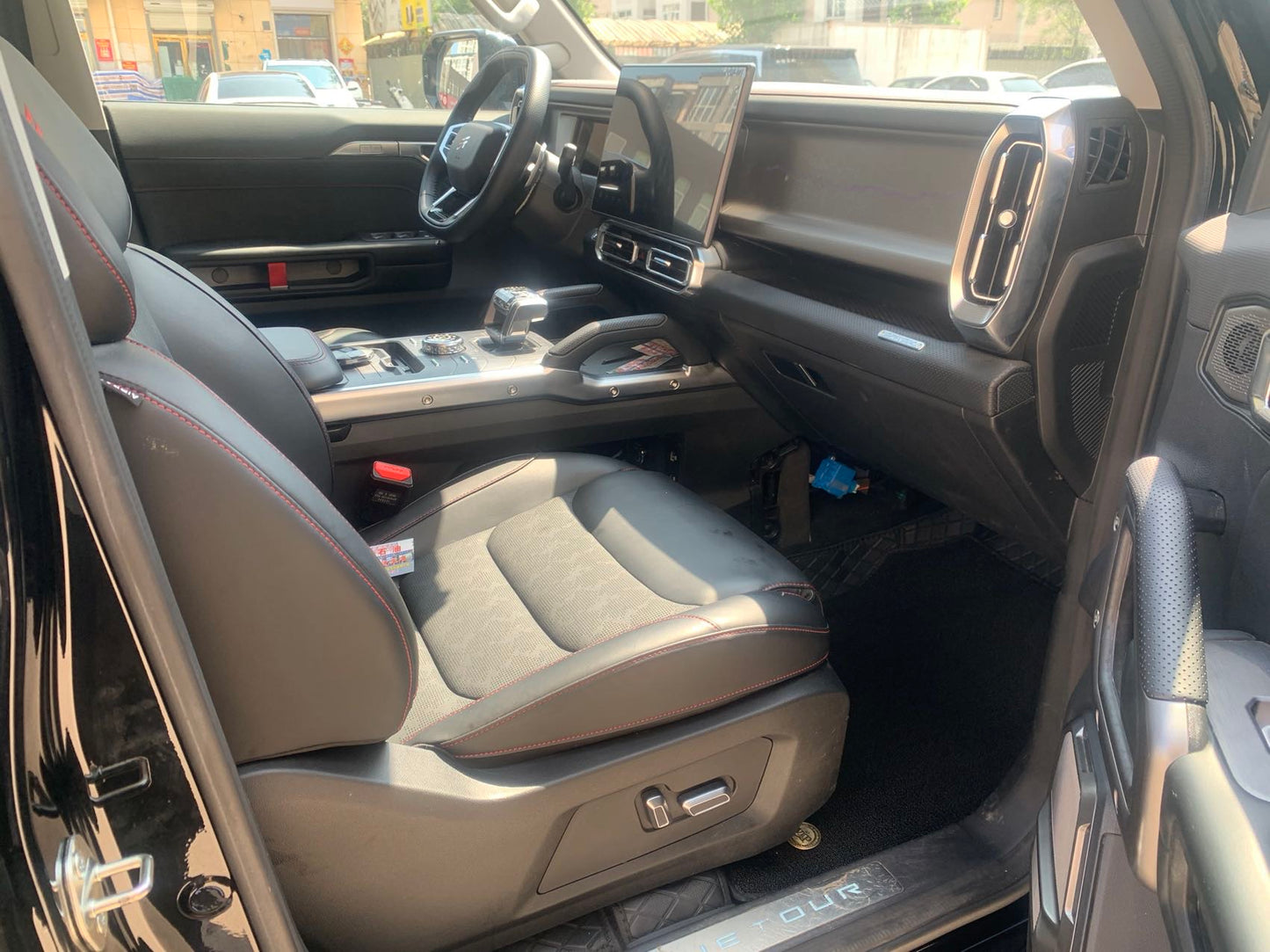
- Affordable price with generous equipment: This entry-level model includes a 12.3-inch digital instrument cluster, a 15.6-inch center touchscreen, full-speed adaptive cruise, and a 360° camera — plus a lifetime warranty for the first owner — making its value proposition strong among fuel-powered SUVs.
Three Caveats:
- Front-wheel-drive 1.5T — upgrade for all-wheel drive: The 1.5TD TanSuo+ is front-wheel drive without AWD or diff lockers, so its true off-road capability is limited. It suits city commuting and light unpaved roads; buyers who want real four-wheel-drive off-roading should step up to the 2.0T AWD version.
- Fuel economy is on the high side, power is average: WLTC combined fuel consumption is 8.35 L/100 km — high for a compact SUV. The 1.5T produces only 135 kW / 290 N·m, so power reserves feel modest when loaded or accelerating on the highway.
- Big body means higher fuel use and parking challenges: At 2006 mm wide, it can be awkward to park in narrow city streets and mechanical bays, and the large footprint pushes daily fuel consumption up — not the most economical choice for pure city commuters.
2. Model Overview
The Jetour Traveler is a key compact SUV from Jetour, a brand under the Chery Group, and an important member of Jetour’s “square box” family. Positioned as a “light off-road” model between city SUVs and dedicated hardcore 4x4s, it uses a blocky, rugged design language focused on “good-looking, city-friendly, off-road-capable, and enjoyable” multi-scenario driving. It targets younger, family-oriented users who want character and a balance between commuting and weekend light outdoor trips.
Design-wise, the Traveler uses crisp, angular lines and a boxy body. The rugged front with matrix LED headlights gives strong presence, echoed by a wraparound tail design; inside, the cabin carries an off-road theme with a rugged multi-function steering wheel and a large floating touchscreen. It is powered by Chery’s Kunpeng 1.5T / 2.0T engines, with some higher trims offering XWD intelligent all-wheel drive and an optional electronic dog-clutch rear diff lock. A high-strength-steel cage body supports safety and some off-road rigidity.
The 2026 model, launched in late 2025, keeps the boxy style while upgrading features and cabin experience. The fuel version offers a 5-door, 5-seat layout with strong space utilization and light-off-road DNA. The Traveler family, with affordable pricing and rich equipment, is popular in the boxy light-off-road segment, complementing its sibling, the Jetour Freedom.
3. Core Specifications
| Category | Item | Specification |
|---|---|---|
| Model & Powertrain | Model | Jetour Traveler 2026 1.5TD TanSuo+ |
| Powertrain | Petrol (gasoline) | |
| Body | 5-door, 5-seat SUV | |
| Engine & Transmission | Engine | 1.5T turbocharged L4, 135 kW (184 PS), 290 N·m |
| Transmission | 7-speed wet dual-clutch (7DCT) | |
| Drive layout | Front-wheel drive (FWD) | |
| Top speed | 180 km/h | |
| Fuel & Economy | Fuel consumption | 8.35 L/100 km (WLTC combined) |
| Fuel tank | approx. 70 L | |
| Fuel grade | 92 RON gasoline | |
| Dimensions & Space | L × W × H | 4795 × 2006 × 1870 mm |
| Wheelbase | 2800 mm | |
| Curb weight | approx. 1700 kg | |
| Cargo volume | approx. 700 L | |
| Chassis & Capability | Suspension | Front MacPherson independent; Rear multi-link independent |
| Ground clearance | Minimum 220 mm | |
| Off-road angles | Approach approx. 28° / departure approx. 29° | |
| Tires | 235/65 R18 | |
| Warranty | Vehicle warranty | 4 years / 100,000 km |
| First-owner | Lifetime warranty for first private non-commercial owner (subject to official terms) |
Incentive Overview (framework per IEA Global EV Policy Explorer):
| Country / Region | Relevant Incentive (for reference) | Notes |
|---|---|---|
| China | Fuel-vehicle purchase tax incentives per current policy | Petrol model, no NEV subsidy |
| Several European countries | Higher taxes on high-consumption petrol vehicles | Higher running cost |
| Emerging markets (e.g., SE Asia) | Tariff / industrial-policy support for compact SUVs in some markets | Varies by country |
Note: Policies shift with fiscal cycles and market regulation — always verify the latest official rules in your target market.
4. Ownership Costs & Service
- Warranty: 4 years or 100,000 km vehicle warranty, plus lifetime warranty for the first private non-commercial owner (subject to official terms), lowering long-term ownership risk.
- Maintenance & running costs: As a 1.5T turbo petrol model, service intervals are around 5,000–7,500 km with class-standard costs for oil and filters. It runs on 92 RON gasoline, keeping fuel costs manageable. At 8.35 L/100 km WLTC, running costs sit at the upper-middle range for a compact SUV.
- Energy cost estimate: At 8.35 L/100 km and a world-average gasoline price of about 1.42 USD/L, fuel works out to roughly 12 USD per 100 km. With a ~70 L tank, single-tank range is strong for long road trips.
- Incentive & policy: See the subsidy table above; confirm the policy in effect at your place of purchase.
Subsidies and policy table (source: IEA Global EV Policy Explorer):
| Country / Region | Policy | Source |
|---|---|---|
| China | Fuel-vehicle purchase-tax incentives per current policy | IEA Global EV Policy Explorer |
| Germany | Increasing tax burden on high-consumption petrol vehicles | IEA Global EV Policy Explorer |
| United States | No NEV credit for petrol SUVs; fuel taxes in many states | IEA Global EV Policy Explorer |
| Nordic countries | Carbon-related taxes on petrol vehicles | IEA Global EV Policy Explorer |
5. Competitors Comparison
Introduction: The Jetour Traveler 1.5TD TanSuo+ faces the BAIC BJ40 Explorer, the 212 T01 Machinist, and the Mazda CX-50 — three similarly priced compact / light-off-road SUVs. Although similar in size, they diverge clearly in character:
- Different off-road architecture: The BAIC BJ40 and 212 T01 are hardcore off-roaders with body-on-frame chassis, four-wheel drive, and diff lockers — far stronger on rough terrain than the Traveler’s unibody light-off-road setup. The Mazda CX-50 is a city SUV with the least off-road ability. The Traveler 1.5TD, FWD and unibody, sits between them, emphasizing style and city practicality.
- Different powertrains: The BJ40 (2.0T, 224 PS) and 212 T01 (2.0T, 252 PS) deliver clearly more power but drink more fuel (11.84 / 10.9 L/100 km WLTC). The Traveler 1.5T and CX-50 (2.5L naturally aspirated) are more economical for daily use.
- Different size and weight: The Traveler is the widest (2006 mm) and lighter (1700 kg); the BJ40 and 212 T01 are heavier (2080 / 2150 kg) with stronger off-road geometry; the CX-50 is lowest (1638 mm), leaning toward on-road handling and comfort.
- Different pricing and profile: The Traveler 1.5TD offers hardcore looks and rich tech at a friendlier price, suiting buyers who want the image without full 4x4 capability; the CX-50 appeals through joint-venture quality and Mazda’s driving character.
| Metric | Jetour Traveler 2026 1.5TD TanSuo+ | BAIC BJ40 2026 2.0T Explorer (Petrol) | 212 T01 2026 2.0T Machinist | Mazda CX-50 2026 2.5L Auto (Changxing) |
|---|---|---|---|---|
| Body structure | Unibody SUV | Body-on-frame SUV | Body-on-frame SUV | Unibody SUV |
| Engine | 1.5T L4 135 kW (184 PS) | 2.0T L4 165 kW (224 PS) | 2.0T L4 185 kW (252 PS) | 2.5L L4 138 kW (188 PS) |
| Engine torque (N·m) | 290 | 380 | 410 | 250 |
| Transmission | 7-speed wet DCT | 8-speed AT | 8-speed AT | 6-speed AT |
| Drive | Front-wheel drive | All-wheel drive | All-wheel drive | Front-wheel drive |
| WLTC fuel (L/100 km) | 8.35 | 11.84 | 10.9 | 7.35 |
| L × W × H (mm) | 4795×2006×1870 | 4630×1925×1871 | 4705×1895×1936 | 4785×1920×1638 |
| Wheelbase (mm) | 2800 | 2745 | 2850 | 2815 |
| Curb weight (kg) | 1700 | 2080 | 2150 | 1660 |
| Doors / Seats | 5 / 5 | 4 / 5 | 5 / 5 | 5 / 5 |
| Ground clearance (mm) | 220 | 220 | 235 | 152 |
| Front suspension | MacPherson | Double wishbone | Solid axle | MacPherson |
| Rear suspension | Multi-link | Solid axle | Solid axle | Torsion beam |
| Fuel tank (L) | 70 | 75 | Large off-road tank | 55 |
| Tires | 235/65 R18 | 265/65 R17 | 265/70 R17 | 225/65 R17 |
| AWD / lockers | None (FWD) | AWD + optional locker | AWD | None |
| Top speed (km/h) | 180 | 160 | 170 | 190 |
| Tech | 12.3-in cluster + 15.6-in screen, full-speed ACC, 360 cam | 15.6-in screen, full-speed ACC | 12.3-in screen | 10.25-in screen, CarPlay |
| Vehicle warranty | 4 yr/100k km + lifetime (1st owner) | 3 yr/100k km | 5 yr/150k km | 3 yr/100k km |
Note: Competitor data sourced from publicly available specifications. Cells marked “—” indicate data not confirmed.
Summary: If your priority is “city living, occasional road trips, and a good-looking boxy SUV,” the Jetour Traveler 1.5TD TanSuo+ offers excellent value with personality and practicality at a friendly price. If you regularly tackle rough terrain and need genuine off-road capability, the body-on-frame, AWD BJ40 and 212 T01 are clearly more capable — at the cost of higher fuel use. If you value joint-venture quality, on-road handling, and low fuel consumption, the Mazda CX-50 is a solid pick. Choose based on whether you spend more time on paved roads or on trails that genuinely need lockers.
6. Expert Test Drive — Pros & Cons
Compiled from third-party professional media road tests and official launch information.
Pros:
- Strong styling identity: The boxy, rugged design is very distinctive in its class, widely liked by younger buyers for its road presence.
- Practical space: Over 2 m of width gives good lateral room; the rear and trunk volumes are generous, and folding the rear seats expands payload for family and light-outdoor use.
- Rich equipment, good value: A 15.6-inch center screen and other tech are well equipped, plus a lifetime warranty for the first owner, making it stand out on value in the fuel boxy segment.
Cons:
- Modest 1.5T power: Under load or when overtaking at speed it feels short on reserve, and the 7-speed dual-clutch can occasionally feel hesitant at low-speed crawling.
- Higher fuel consumption: At 8.35 L/100 km WLTC, actual urban stop-start figures may run higher — fuel control is only average for a compact SUV.
- Average NVH: Wind and tire noise are noticeable at speed, and the infotainment can occasionally lag; some build-quality details still need polish.
Real-world scenarios (data source: public media coverage and test-drive reviews):
- Light off-road passability: Around 220 mm ground clearance with a ~28° approach angle handles light unpaved roads and country trails (source: manufacturer data and off-road evaluation content).
- Cargo test: With the rear seats folded, loading capacity expands sharply, accommodating multiple pieces of camping and road-trip luggage (source: media space-test coverage).
7. Real Owner Reviews
Positive feedback:
- Styling: Most owners praise the boxy design’s good looks and presence, drawing attention wherever parked. “The real car looks great — the boxy shape is really rugged and stands out wherever it’s parked.”
- Space: The cabin is roomy, with the rear and trunk comfortably meeting family needs. “The space is really big and plenty — three adults fit in the back without feeling cramped, and the trunk is large enough.”
- Power and value: The 1.5T is adequate and smooth for daily commuting, and the price-to-equipment ratio is very attractive. “With a light touch on the throttle you feel plenty of power from the 1.5T, and getting this much equipment at this price is great value.”
Negative feedback:
- Fuel economy: Some owners report consumption running higher than expected, especially in city traffic. “Fuel use is higher than I expected — in the city it basically runs over 9 L/100 km.”
- Infotainment and NVH: The infotainment occasional lags, highway noise is average, and a few cars have rattles or other issues. “The downsides are real: higher fuel use, occasional infotainment lag, and average sound insulation.”
8. References
- Global Petrol Prices (2026). World Average Fuel and Electricity Prices, USD. Retrieved from https://www.globalpetrolprices.com/
- IEA. Global EV Policy Explorer. Retrieved from https://www.iea.org/data-and-statistics/data-tools/global-ev-policy-explorer
- Jetour official information and 2026 Traveler launch content
- Jetour Traveler owner reviews and spec data via public auto platforms
- Jetour Traveler YouTube introduction: https://youtu.be/EPIXuAK9WA4
Disclaimer: This profile is for reference only. Actual specifications and configurations are subject to the vehicle sold at local dealerships and the latest official information. Before importing, verify the certification, emissions, and subsidy policies of your target market.