Toyota Wildlander 2026 Vehicle Profile: Toyota Hybrid-Friendly Compact SUV with 2.0L Petrol Economy, Big Space & Strong Value

1. Bottom Line: Three Highlights & Three Caveats
Highlight One: Toyota build + 2.0L naturally aspirated CVT—frugal and worry-free to own The Wildlander PRO carries Toyota's 2.0L naturally aspirated engine (M20C, 1,987 mL) with a CVT (simulating 10 gears). Drive is linear and smooth, and the car is robust and durable. It runs on 92-octane petrol, with WLTC combined fuel use of about 6.29 L/100km. Combined with Toyota's mature reliability reputation, servicing is economical and fault rates are low—the "easy-going family car" archetype (source: official WLTC + owner/industry reviews combined).
Highlight Two: flexible big space and practical load-carrying On a 4,600 × 1,855 × 1,680 mm body with a 2,690 mm wheelbase, the Wildlander offers roomy rear legroom on a near-flat floor. The boot is about 580 L base, expanding (to roughly 1,900-L class per official figures) once the rear seats fold, easily swallowing a stroller or bulky items—ideal for family use and trips (source: model reviews + owner feedback).
Highlight Three: smart cockpit and standard L2 driver assist The 2026 Wildlander also steps up on tech and safety: a 15.6-inch centre touchscreen on Qualcomm Snapdragon 8155P, a full-LCD instrument cluster, plus standard Toyota TSS 3.0 intelligence (the L2-level driver-assist family). The voice assistant ("Hi Xiaoyue") handles zone-based recognition smoothly, pulling practicality closer to newer-energy rivals.
Caveat One: Power is adequate rather than punchy As the 2.0L NA + CVT prioritises smooth economy, everyday city driving is fine but hard acceleration and loaded hill/highway overtakes feel mild—consider if you value driving excitement.
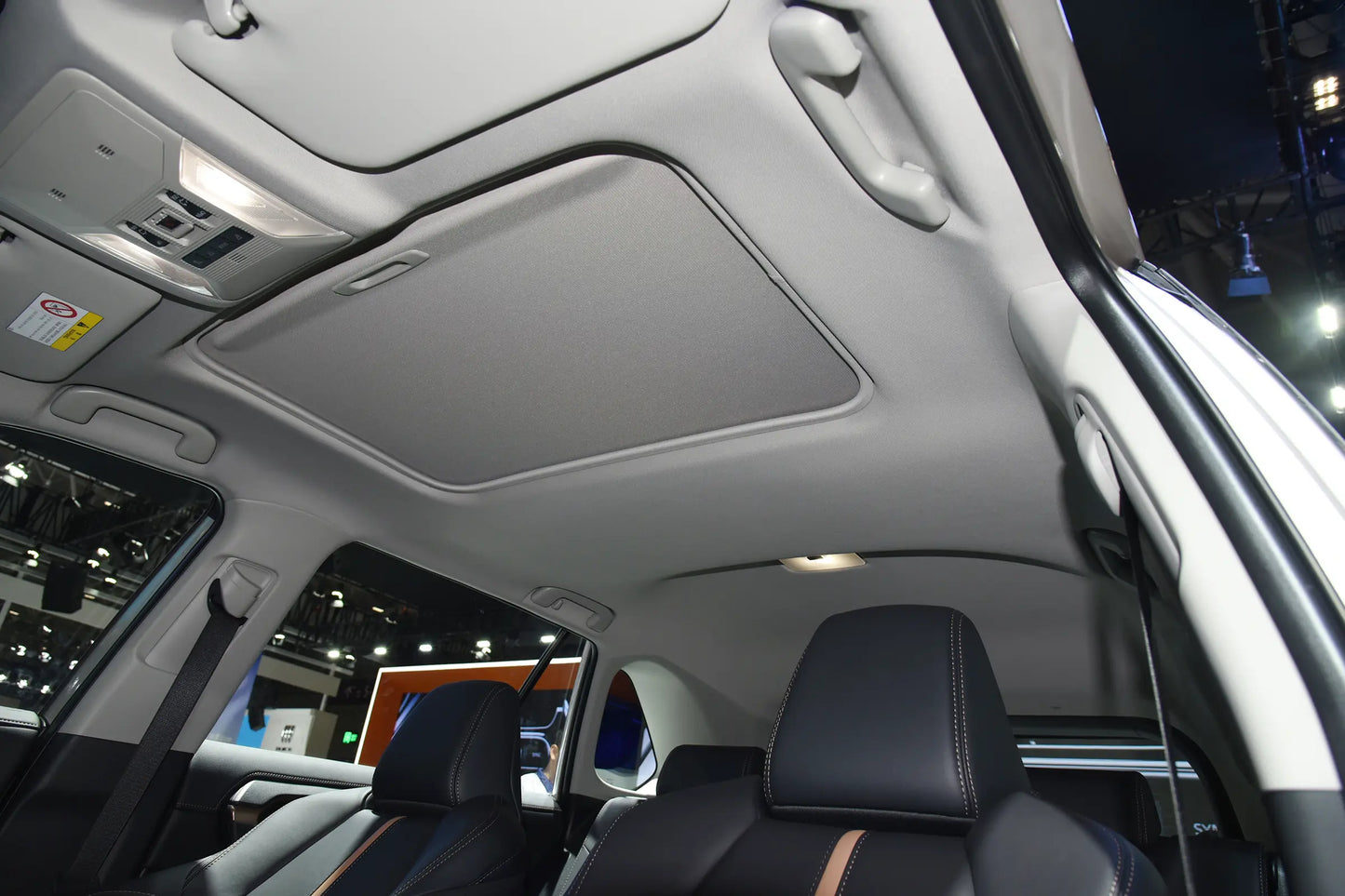
Caveat Two: Interior materials lean practical; lower trims use fabric/hard plastic The cabin is usability-first, and some lower-trim materials are plainer than rivals, with a fair share of hard cockpit plastic; buyers after premium feel should look at higher trims.
Caveat Three: Infotainment response and imaging still have room to improve Owners commonly note the head-unit responds slowly, voice accuracy needs work, and 360° camera clarity is not outstanding (source: clustering of owner-community feedback).
2. Model Overview: What Kind of SUV Is the Toyota Wildlander
The Toyota Wildlander is GAC Toyota's compact SUV—a TNGA-K twins model of the FAW Toyota RAV4 and a volume pillar for GAC Toyota in the compact family-SUV market. Built on Toyota's mature global platform with strong hybrid know-how and a proven reliability record, the Wildlander follows a balanced family line that is "robust, practical, tech-forward," targeting family buyers whose core needs are "quality that's stable, carefree and enough."
Its positioning is clear: a high-value family compact SUV covering daily commuting, weekend outings and everyday hauling, leaning on Toyota reliability + big space + a gradually upgraded smart cockpit—setting it apart from rivals chasing driving thrills, extreme tech or luxury ambience.
The Wildlander offers varied powertrains: a 2.0L petrol version (the 2.0L PRO profiled here sits in this line, at the higher-value end) plus 2.0L/2.5L intelligent dual-engine hybrid versions. The 2.0L petrol opens Toyota's compact SUV at a lower threshold with a simpler ownership ecosystem suited to budget-minded families, while the hybrids appeal with lower fuel use and quietness. This 2026 2.0L PRO is Toyota's steady, pragmatic pick in the petrol compact-SUV class.
From an overseas standpoint, the Wildlander is a GAC-Toyota market model (the twin of the North American/global RAV4). As a "Toyota-built, robust, space-practical" compact SUV it earns solid praise among family buyers with several children who need a balance of daily use and hauling.
Design-wise the Wildlander uses Toyota's family styling—clean, well-proportioned and presentable rather than loud. With the full redesign it echoes the RAV4 in details (C-shaped lamps, Y-waistline, piano-key tail lamps), adding a younger and more refined look.
You can get a full look at the car via this video:
3. Core Specifications (2026 2.0L PRO, petrol)
- Manufacturer: GAC Toyota (Toyota system)
- Class: Compact 5-door 5-seat SUV
- Energy type: Petrol (2.0L naturally aspirated)
- Engine: 2.0L / 1,987 mL, M20C, L4 NA, DOHC, compression ≈13, bore 80.5 / stroke 97.6 mm, D-4S dual injection, 92-octane fuel
- Engine output: 171 PS / max 126 kW @6,600 rpm / 206 N·m @4,600–5,000 rpm
- Transmission: CVT (simulating 10 gears)
- Drive: Front-wheel drive
- WLTC fuel use: 6.29 L/100km (certified owner average ≈7.1 L/100km)
- Top speed: 180 km/h
- Dimensions (L×W×H): 4,600 × 1,855 × 1,680 mm; wheelbase 2,690 mm; front track 1,600 mm / rear 1,620 mm
- Seats / layout: 5 seats
- Boot: about 580 L base; rear seats fold for expansion (to ~1,900-L class per official figures)
- Kerb weight: ≈1,615 kg
- Fuel tank: 55 L
- Emissions standard: China VI
- Launched: Nov 2025 (2026 model year)
Key feature highlights (in PRO trim) Centre touchscreen on Qualcomm Snapdragon 8155P chip with a full-LCD cluster and generous screen; voice assistant "Hi Xiaoyue" with zone-based recognition, connected-car/OTA and an app for remote functions (vehicle check, locating, service booking); standard Toyota TSS driver-intelligence with L2-level assist. Specific functions and data policies follow the dealer config sheet and official notices.
Maintenance & manufacturer service Whole-vehicle warranty is 3 years / 100,000 km. Routine care is mainly oil/filter and cabin filter; the 2.0L NA is economical to maintain and has low fault rates. Some connected-car and telematics features come with a free period and data package per manufacturer policy.
Tax and purchase note (petrol model, not new-energy) As a conventional petrol car, in mainland China the 2.0L Wildlander pays purchase tax at the ordinary passenger-car rate (around 10%) and does not qualify for the new-energy purchase-tax break or BEV/PHEV-specific green plates/subsidies. Fuel-car taxation across markets differs mainly by displacement/emissions. Overview:
| Model / energy type | Policy / region | Note |
|---|---|---|
| Wildlander 2.0L PRO (petrol) | Mainland China | Treated as fuel car; ordinary purchase tax; no new-energy subsidy |
| Compact SUV (petrol, illustrative) | Mainland China / overseas | Tax/registration by local displacement & emissions |
| (BEV/PHEV reference) | Europe / US etc. | Most purchase/tax perks target BEV/PHEV |
Overview only. Amounts and eligibility change with policy and region; verify against the target country's current rules for export purchases.
4. Ownership Cost & Service
Fuel cost (world-average gasoline as reference) At a world-average gasoline price of ≈1.42 USD/L and WLTC of 6.29 L/100km, each 100 km costs ≈8.9 USD; at a realistic certified-owner 7.1 L/100km it is ≈10.1 USD/100km. Over ~15,000 km a year that is roughly 1,340–1,520 USD annually (varies with local prices and use; city congestion raises it). Against same-size pure-petrol compact SUVs, the Toyota 2.0L holds an edge on fuel and servicing, though it is less frugal than its platform hybrids—if minimising running cost matters, the Wildlander dual-engine hybrid is the one to consider.
Servicing & holding cost The 2.0L NA + CVT is well known for cheap maintenance and low fault rates: long oil/filter intervals with modest per-visit cost, and affordable, easy-to-find Toyota parts. The 3-year/100,000-km whole-vehicle warranty covers major repairs within the window. This is especially friendly to budget- and long-ownership-cost-conscious families.
Tax & other (petrol-car basis) As a conventional fuel car, the Wildlander gets no new-energy-specific perks in most markets; it mainly pays purchase/registration tax by displacement/emissions. An export view:
| Country/Region | Purchase / tax | Note |
|---|---|---|
| Mainland China (origin) | Ordinary fuel-car purchase tax | Original RMB pricing; economical 92-octane running |
| Overseas markets (reference) | Taxed by local displacement/emissions | 2.0L is relatively friendly vs larger engines |
| (BEV/PHEV reference) | Varies by country | Perks mostly target BEV/PHEV; verify per market |
Policy is time-sensitive. For export and purchase decisions, refer to the destination country's official announcements.
5. Competitor Comparison: Wildlander 2.0L PRO vs Tharu New 300TSI vs Tucson L 1.5T Premium vs X-Trail Honor 2.0L 2WD
In the "family compact / joint-venture 5-seat petrol SUV" arena, the three rivals shown are established joint-venture products. All four run petrol and share a 5-door 5-seat SUV body; the real differences sit in powertrain character, size and feature focus:
- Wildlander 2026 (2.0L PRO) is Toyota's naturally-aspirated + CVT family SUV, strongest on "robust, spacious, economical 92-octane worry-free" drive and as the steady, all-round pick with cheap maintenance and good resale.
- VW Tharu New (2026 300TSI Premium) comes from SAIC Volkswagen, using a 1.5T turbo with a dual-clutch, in a more compact shell (2,651 mm wheelbase)—the Volkswagen badge plus sportier tuning/agility are the selling points.
- Hyundai Tucson L (2026 1.5T Premium) is Beijing Hyundai's 1.5T (200 hp) with an 8-speed auto; one of the larger bodies here (4,670 mm, 2,755 mm wheelbase), pitched on more space and stronger turbo punch.
- Nissan X-Trail Honor (2025 2.0L 2WD Leading trim) is Dongfeng-Nissan's 2.0L NA (151 hp) with a CVT (simulating 7 gears); the longest body (4,675 mm) with higher ground clearance (208 mm unladen), offering naturally aspirated smoothness plus Japanese space and rough-road ability.
Core contrast: Wildlander (Toyota NA, carefree and balanced) vs Tharu New (German turbo, more compact) vs Tucson L (1.5T big power, larger space) vs X-Trail Honor (Nissan 2.0L NA, higher clearance).
Full configuration comparison (from the supplied screenshots, no prices)
| Spec | Wildlander 2026 2.0L PRO | VW Tharu New 2026 300TSI Premium | Hyundai Tucson L 2026 1.5T Premium | Nissan X-Trail Honor 2025 2.0L 2WD |
|---|---|---|---|---|
| Class | Compact SUV | Compact SUV | Compact SUV | Compact SUV |
| Energy | Petrol | Petrol | Petrol | Petrol |
| Body | 5-door 5-seat SUV | 5-door 5-seat SUV | 5-door 5-seat SUV | 5-door 5-seat SUV |
| Dims L×W×H (mm) | 4600×1855×1680 | 4355×1762×1605 | 4670×1865×1690 | 4675×1820×1722 |
| Wheelbase (mm) | 2690 | 2651 | 2755 | 2706 |
| Kerb weight (kg) | 1615 | 1335 | 1557 | 1494 |
| Engine | 2.0L 171hp L4 | 1.5T 160hp L4 | 1.5T 200hp L4 | 2.0L 151hp L4 |
| Displacement (mL) | 1987 | 1498 | 1497 | 1997 |
| Induction | Naturally aspirated | Turbo | Turbo | Naturally aspirated |
| Max power (PS/hp) | 171 | 160 | 200 | 151 |
| Max net power (kW) | 126 | 118 | 147 | 103 |
| Peak torque (N·m) | 206 | 250 | 253 | 194 |
| Fuel grade | 92 | 95 (min 92) | 92 | 92 |
| Transmission | CVT (sim. 10) | 7-speed dry DCT | 8-speed auto | CVT (sim. 7) |
| Drive | Front-wheel drive | Front-wheel drive | FWD (opt. on-demand AWD) | Front-wheel drive |
| Rear suspension | Multi-link style (Toyota) | Torsion-beam non-independent | Multi-link independent | Multi-link independent |
| WLTC fuel (L/100km) | 6.29 | 5.70 | 7.09 | 7.26 (combined/cycle reference) |
| Top speed (km/h) | 180 | 190 | 205 | 183 |
| Fuel tank (L) | 55 | — | 54 | 57 |
| Centre screen | 15.6 in touch (8155P) | 9.2 in touch | 12.3 in touch | 12.3 in touch |
| Voice wake word | Hi Xiaoyue | Hi Dazhong | Hi Hyundai | Hi Nissan |
Note: All figures in this table were compiled (via OCR) from the configuration screenshots provided; no prices appear. Fields unmarked in the original images show "—" or reflect option-stacked configurations; confirm against the dealer config sheet. Competitor specs come from the screenshots only; no online lookups were used.
Summary: If you value "Toyota brand + naturally aspirated economy + big space + easy 92-octane running," the Wildlander 2.0L PRO is the steadiest, most balanced pick. If you want a smaller, agile German-turbo product, look at the VW Tharu New. If big power and more interior room in a 1.5T joint-venture SUV matter more, the Tucson L fits. If you prefer a higher-riding, more off-road-capable natural-aspiration Japanese family form, the X-Trail Honor suits. Each trades something off; the Wildlander's core is reliability, space, carefree running and balance.
6. Expert & Owner Test Notes: Pros & Cons
As a joint-venture compact family SUV, insights reflecting professional reviews and owner usage:
Pros
- Practical space: the 4,600/1,855 mm body and 2,690 mm wheelbase deliver roomy rear space on a near-flat floor, with a ~580 L boot extending when folded—handy for strollers and bulky loads (source: model reviews + owner feedback).
- Smooth, carefree and good resale: the 2.0L NA CVT is linear and smooth, runs on cheap 92-octane, and Toyota's reliability, resale and low maintenance costs all support long-term family use (source: official WLTC + industry & owner feedback).
- Tech and safety keep pace: the 15.6-inch screen + 8155P chip + full-LCD cluster and standard TSS (L2-level intelligence) with the "Hi Xiaoyue" zone voice assistant pull the experience toward newer-energy rivals (source: official config + owner feedback).
Cons
- Power is smooth rather than punchy; hard acceleration / loaded highway overtakes feel mild (concentrated owner feedback).
- Lower trims lean on fabric seats and hard plastic, with quality below some rivals (concentrated owner feedback).
- Head-unit response, voice accuracy and 360° camera clarity still have room to improve (owner communities).
Measured scenarios (sources noted)
- Family commuting and trips: space and loading are balanced; the rear seat and boot handle daily kids/luggage fine (source: owner tests + media experiences).
- Fuel use in practice: official WLTC 6.29 L/100km; certified-owner average ≈7.1 L/100km—higher in stop-go city traffic, lower on highways (compiled from owner fuel reports and media tests).
Note: points above compile open professional tests, motoring media and owner reports; individual figures reflect specific conditions, and actual results vary with traffic, load, driving style and weather. Test-drive before purchase.
7. Real Owner Feedback
Positive feedback
Space — Summary: Most owners rate the roomy rear and near-flat floor highly; the ~580 L boot folding larger suits family use. "Space is enough—the rear is roomy and the boot takes a stroller with no problem; very suitable for the family." (paraphrased from owner reviews)
Smooth running / fuel economy — Summary: Owners value the 2.0L NA smoothness, cheap 92-octane running and overall acceptable city fuel use, calling it robust and durable. "I've done both city and highway; the NA is very smooth, 92-octane is cheap, and this car is durable—cheap to run and maintain." (paraphrased owner comment)
Smart & safety — Summary: Owners praise the upgraded 15.6-inch screen + 8155P and L2-level safety, noting the tech now closer to newer-energy rivals. "The big 15.6-inch Snapdragon screen is fluid, L2 assist makes highway driving relaxing, and 'Hi Xiaoyue' voice works okay." (paraphrased owner comment)
Negative feedback
Power / spirited driving — Summary: Some owners feel the 2.0L NA is adequate but mild on punch; overtaking loaded or on hills feels unhurried. "For city driving it's enough, but if I want to drive hard, carry a full load uphill or overtake on the highway, the response comes in slower." (paraphrased owner quote)
Interior materials / feel — Summary: Owners note lower-trim interiors are practical with fabric seats and notable hard plastic; premium feel is limited. "The cabin is still practical—low trim is fabric with quite a lot of hard plastic, so vs same-price cars the premium feel is average." (paraphrased owner quote)
Infotainment details — Summary: Owners say head-unit response, voice accuracy and 360° image quality can still improve. "The head unit and voice are sometimes slow, and the 360 camera image is average—hope an OTA can optimise it." (paraphrased owner quote)
Owner feedback above is drawn from public community and review platforms and focuses only on the vehicle itself (ride, space, fuel use, interior, ADAS/tech), for reference only.
8. References
- Global Petrol Prices. World Average Gasoline Prices, USD/Liter. Retrieved from https://www.globalpetrolprices.com/gasoline_prices/
- IEA. Global EV Policy Explorer. Retrieved from https://www.iea.org/data-and-statistics/data-tools/global-ev-policy-explorer
- GAC Toyota official website — Wildlander model & configuration pages
- YouTube: All New 2026 Toyota Wildlander First Look – Exterior And Interior (AutoWorld) — https://youtu.be/xWfjU_y4KXc
- Test-drive and owner insights compiled from public automotive media and owner communities for reference only; they do not constitute purchase advice.