Geely Galaxy Xingyao 8 PHEV 2026 Vehicle Profile: 225km Range, 1725km Comprehensive Range, 3.32L Fuel Consumption

1. Verdict: Three Highlights & Three Caveats
- Highlight 1: Class-leading pure-electric range — A 225km CLTC pure-electric range stands out among mid-to-large plug-in hybrids. Paired with the 28.3kWh Shen Dun golden-brick battery, it comfortably covers a full week of city commuting on pure electric alone.
- Highlight 2: Comprehensive range balanced with efficiency — Full-tank, full-charge range reaches 1725km, with CLTC charge-depletion fuel consumption as low as 3.32L/100km. It eases long-distance range anxiety while keeping running costs impressively low, covering both urban and long-haul use.
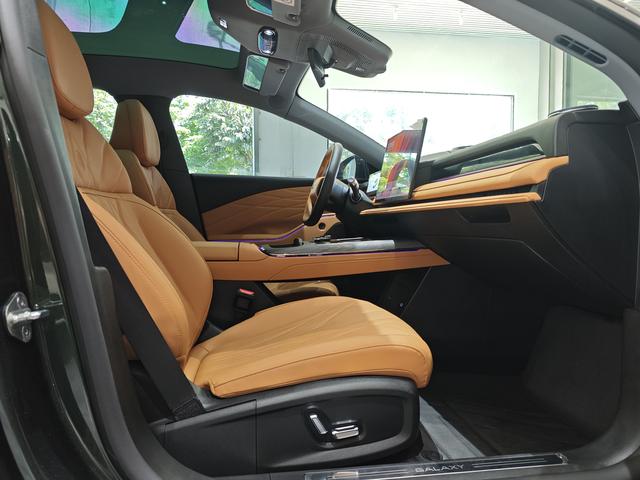
- Highlight 3: Abundant intelligent and comfort features — It carries the Qianli Haohan H5 driving-assistance suite with city/highway NOA, a 15.4-inch floating center screen, and VIP electric executive seats with ventilation, heating and massage. The 5-meter body also delivers confident road presence.
- Caveat 1: Noticeable high-speed wind noise — The frameless doors look great, but some owners report that wind noise control at highway speeds is average; NVH is not class-leading.
- Caveat 2: Seasonal impact on electric range — In winter with heating on, actual pure-electric range drops noticeably — some owners report around 90km in winter, below the rated figure.
- Caveat 3: Infotainment ecosystem still maturing — Some owners note limited app availability in the infotainment system, missing common music/audiobook apps, and occasional voice-assistant disconnects.
2. Model Overview
The Geely Galaxy Xingyao 8 (星耀8) is a mid-to-large plug-in hybrid sedan under Geely’s Galaxy brand, launched in May 2025. In late March 2026, Geely Galaxy introduced the “Yuan Hang Jia” (Far Voyager) series, adding three variants with 225km pure-electric range on top of the existing 130km EM-i Honor Edition. This review covers the flagship “225km EM-i Yuan Hang Jia Xinghe (Starlake) Edition.” Positioned as a “technologically premium mid-to-large hybrid sedan,” it quickly became a sales benchmark in the segment, claiming the annual sales crown among mid-to-large hybrid sedans within 8 months, with cumulative sales surpassing 80,000 units.
Design-wise, it follows Galaxy’s “Ripple Aesthetics” language — a “flying-eave tiger-eye” LED daytime running lamp up front, a low-slung fastback silhouette with frameless doors, and a full-width taillight bar at the rear, all contributing to a 0.25 drag coefficient. Power comes from the Thor EM-i AI hybrid system (1.5L Evo engine + front single motor) with a class-leading 47.26% thermal efficiency engine, managed by the Xingrui AI Cloud Power 2.0 system. Safety features include 160km/h BMXS blowout stability control and 130km/h AES emergency evasion assist.
You can explore the exterior and interior design of this model through the following video:
3. Core Specifications
| Item | Specification |
|---|---|
| Model | Geely Galaxy Xingyao 8 PHEV 2026 225km EM-i Yuan Hang Jia Xinghe Edition |
| Powertrain | Plug-in hybrid (1.5L naturally aspirated + front single motor) |
| Engine | 1.5L, 82kW (112hp), 136N·m, 47.26% thermal efficiency |
| Motor | Permanent-magnet synchronous, 175kW (238hp), 262N·m |
| System Combined Power | 257kW, combined torque 398N·m |
| Pure-Electric Range (CLTC) | 225km |
| Comprehensive Range (CLTC) | 1725km |
| Fast Charging (30%–80%) | 15 minutes |
| Charge-Depletion Fuel Use (CLTC) | 3.32L/100km |
| Electricity Consumption | 15.1kWh/100km |
| Battery | 28.3kWh lithium iron phosphate (Shen Dun golden-brick battery) |
| Dimensions (L×W×H) | 5018×1918×1480mm, wheelbase 2928mm |
| Seats | 5 |
| Top Speed | 190km/h |
| Transmission | 1-speed DHT |
Maintenance & manufacturer service: Vehicle warranty is 4 years or 100,000km, with the first owner eligible for 6 years or 150,000km. New-energy drivetrains typically demand less routine maintenance than conventional combustion cars, with costs concentrated in regular items such as engine oil and filters.
Subsidy policies: EV incentives vary by market. Below is a snapshot across selected markets (source: IEA Global EV Policy Explorer):
| Market | Policy Summary |
|---|---|
| China | Purchase tax relief; NEV plate advantages and charging infrastructure planning in some cities |
| Major EU markets | Purchase subsidies or tax relief encouraging low-emission vehicles |
| United States (select states) | Federal and state purchase tax credits, varying by vehicle and household income |
| Parts of Southeast Asia | Tariff concessions or local assembly incentives to boost NEV uptake |
Please refer to the latest local regulations for specifics.
4. Ownership Cost & Service
- Warranty: Vehicle: 4 years or 100,000km; first owner: 6 years or 150,000km. Battery carries first-owner lifetime warranty (exclusions per official terms).
- Maintenance: First service at 5,000km or 6 months; engine oil and filter every 10,000km; cabin filter, fuel filter and spark plugs every 20,000km; brake fluid and transmission oil every 40,000km. Routine maintenance is manageable, centered on oil and filter changes.
- Charging cost: Using the Global Petrol Prices world-average residential electricity price of about 0.170 USD/kWh: a full charge of the 28.3kWh battery costs roughly 4.8 USD. Based on 15.1kWh/100km, pure-electric driving costs about 2.6 USD per 100km. Add fuel at 3.32L/100km for longer journeys.
Subsidy and policy table (Source: IEA Global EV Policy Explorer). Incentive levels differ significantly across countries — prospective buyers should factor local policy into true ownership cost:
| Country/Region | Subsidy & Policy Summary |
|---|---|
| China | Purchase tax relief; NEV quota priority in some cities |
| Major EU markets | Purchase subsidies or carbon-tax incentives; some tiered by battery capacity |
| United States (select states) | Federal and state purchase tax credits |
| Parts of Southeast Asia | Tariff concessions and localization incentives |
5. Competitor Comparison
In the sub-USD-28,000 mid-to-large plug-in sedan segment, the Xingyao 8 faces the BYD Han DM, Baojun Xiangjing PHEV, and Chery Fengyun A9L. Four key observations:
- Leading pure-electric range: The Xingyao 8’s 225km CLTC range clearly exceeds the Han DM (125km) and Xiangjing (140km), giving it an edge in daily EV-first commuting. The Fengyun A9L leads all four at 260km.
- Different power orientations: The Xingyao 8 uses a 1.5L + 175kW single motor with 257kW combined power; the Han DM offers a higher 272hp motor; the Fengyun A9L peaks at 530N·m for stronger performance; the Xiangjing’s 160kW motor is more conservative.
- Body size and space: The Xingyao 8 measures 5018mm long with a 2928mm wheelbase; the Fengyun A9L stretches to a 3000mm wheelbase for more space; the Han DM sits mid-pack (4995mm/2920mm); the Xiangjing uses a hatchback body (5005mm) for greater cargo flexibility.
- Recharging and efficiency: All four are plug-in hybrids with fast charging. The Xingyao 8’s 3.32L/100km charge-depletion consumption is the lowest here; the Fengyun A9L and Han DM perform well overall; the Xiangjing shows higher electricity consumption (14.9kWh/100km).
| Metric | Galaxy Xingyao 8 PHEV 2026 225km EM-i Xinghe | BYD Han DM 2025 Smart-Drive DM-i 125KM Comfort | Baojun Xiangjing PHEV 2025 140km Special | Chery Fengyun A9L 2027 260 MAX |
|---|---|---|---|---|
| Class | Mid-to-large sedan | Mid-to-large sedan | Mid-to-large sedan | Mid-to-large sedan |
| Powertrain | Plug-in hybrid | Plug-in hybrid | Plug-in hybrid | Plug-in hybrid |
| Engine | 1.5L 112hp L4 | 1.5T 156hp L4 turbo | 1.5T 143hp L4 turbo | 1.5T 156hp L4 turbo |
| Engine max power | 82kW (112hp) | 115kW (156hp) | 105kW (143hp) | 115kW (156hp) |
| Motor max power | 175kW (238hp) | 200kW (272hp) | 160kW (218hp) | 160kW (218hp) |
| System combined power | 257kW | — | — | 275kW |
| Max torque | 398N·m | 315N·m | 310N·m | 530N·m |
| Motor max torque | 262N·m | 315N·m | 310N·m | 310N·m |
| EV range (CLTC) | 225km | 125km | 140km | 260km |
| Comprehensive range (CLTC) | 1725km | 1350km | — | — |
| Charging time | Fast 15min (30%–80%) | Fast 27min | Fast 15min, slow 6.5h | Fast 14.5min |
| Transmission | 1-speed DHT | E-CVT | 1-speed DHT | 1-speed DHT |
| Dimensions (mm) | 5018×1918×1480 | 4995×1910×1495 | 5005×1900×1505 | 5018×1965×1500 |
| Wheelbase (mm) | 2928 | 2920 | 2900 | 3000 |
| Body style | 4-door 5-seat sedan | 4-door 5-seat sedan | 5-door 5-seat hatchback | 4-door 5-seat sedan |
| Seats | 5 | 5 | 5 | 5 |
| Top speed | 190km/h | 200km/h | 190km/h | 180km/h |
| Charge-depletion fuel | 3.32L/100km | 1.06L/100km | 1.2L/100km | 0.52L/100km |
| Electricity consumption | 15.1kWh/100km | 15.0kWh/100km | 14.9kWh/100km | 17kWh/100km |
| Battery capacity | 28.3kWh | approx. 18.3kWh | — | approx. 36.5kWh |
| Curb weight (kg) | 1895 | 1910 | 1840 | 2085 |
| Gross weight (kg) | 2305 | 2285 | 2260 | 2540 |
| Fuel tank (L) | 55.0 | 50.0 | 53.0 | 67.0 |
| Drivetrain | Front-wheel drive | Front-wheel drive | Front-wheel drive | Front-wheel drive |
| Front suspension | MacPherson independent | MacPherson independent | MacPherson independent | MacPherson independent |
| Rear suspension | Multi-link independent | Multi-link independent | Multi-link independent | Multi-link independent |
| Front/rear tires | 245/45 R19 | 245/50 R18 | 225/50 R18 | 245/50 R19 |
| ADAS | Qianli Haohan H5 (city/highway NOA) | Smart-drive (highway pilot etc.) | Basic ADAS | ADAS config |
| 360° camera | Standard | Standard | Standard | Standard |
| Ambient lighting | 256-color | Yes | — | Yes |
| Wireless charging | 50W first row | 50W first row | 50W first row | 50W |
| Sunroof | Panoramic (openable) | Panoramic (openable) | — | Divided fixed panoramic roof |
| Vehicle-to-load | 6kW | 6kW | 3.3kW | 3.3kW |
| Vehicle warranty | 4y/100,000km | 6y/150,000km | 6y/150,000km | 3y/100,000km |
Note: Competitor data sourced from publicly available specifications. Cells marked “—” indicate data not confirmed.
Summary: All four are mid-to-large plug-in sedans with distinct strengths. The Galaxy Xingyao 8 leads on pure-electric range and efficiency, backed by strong comfort and ADAS features — a pragmatic choice for “EV-first in the city, worry-free on long trips.” The BYD Han DM pairs mature performance with brand recognition and overall balance; the Fengyun A9L offers more space and torque for rear-seat comfort and performance; and the Baojun Xiangjing differentiates with a hatchback body and taxi-oriented variant for flexibility and pricing.
6. Expert Test Drive
Pros:
- Outstanding efficiency: Official charge-depletion consumption is 3.32L/100km; media testing recorded about 3.7L/100km and around 13.0kWh/100km in smart mode — the figures essentially hold up.
- Class-above space and comfort: A 5-meter body with a flat rear floor and VIP electric executive seats with ventilation/heating/massage make long trips comfortable.
- Capable ADAS: The Qianli Haohan H5 suite supports city and highway NOA, with smooth on/off-ramp handling and decisive lane changes; braking is progressive and comfortable — rarely seen among joint-venture peers.
Cons:
- Firmer suspension tuning: Impacts over potholes and speed bumps are noticeable; comfort on rough roads is somewhat compromised, though post-impact settling is acceptable.
- Highway wind and road noise: Frameless doors show noticeable wind noise at highway speeds, and road noise is elevated on coarse asphalt.
- Engine engagement: When the battery is depleted, engine intervention remains perceptible — not harsh, but NVH could improve.
Measured Scenarios:
- Smart-mode road test: ~73.3km from Hangzhou to Moganshan (30% urban / 70% highway), recording 13.0kWh/100km electricity and 0.4L fuel, with accurate EV-range readouts (source: Sina Auto test drive).
- Depleted-range extended mode: ~87.3km return leg measured about 3.7L/100km fuel consumption, consistent with the official 3.67L (source: Sina Auto test drive).
7. Real Owner Reviews
Positive Feedback:
- Space and comfort: Owners widely praise the generous interior — flat rear floor, ample leg/headroom, and comfortable seating. “With the front seat set for a 180cm driver, rear passengers get more than two fists of knee room, headroom is not tight, and the nearly flat floor makes full occupancy easy.”
- Efficiency and running costs: EV-first commuting is very economical with low home-charging costs; charge-depletion consumption is acceptable for a large car. “Pure-electric commuting is economical — a few dollars per home charge covers over 100km, monthly costs are just tens of dollars; charge-depletion consumption of 5–6L/100km is satisfying for a big car.”
- Exterior and interior quality: The fastback silhouette, frameless doors and full-width taillight are well received; the soft-touch interior and ventilated/heated seats add real comfort. “The styling is sporty and dynamic — the fastback sedan look with frameless doors is very athletic, and the full-width taillight looks striking when lit.”
Negative Feedback:
- Highway wind noise and panoramic roof: Frameless doors produce noticeable wind noise at highway speeds, and the panoramic roof warms the cabin noticeably in summer sun. “My main complaint is wind-noise control at highway speeds — the frameless doors look great but are noticeably noisy. The panoramic roof raises cabin temperature quickly under summer sun, causing stuffiness on long trips.”
- Infotainment ecosystem and seasonal range drop: Some owners report a limited app ecosystem with occasional disconnects, and notable EV-range loss in winter. “The infotainment is limited with few apps — no common music/audiobook apps — and occasionally the voice assistant disconnects; in winter with heating, actual range is around 90km.”
8. References
- Global Petrol Prices (2025). World Average Electricity Prices, USD / kWh. Retrieved from https://www.globalpetrolprices.com/electricity_prices/
- IEA. Global EV Policy Explorer. Retrieved from https://www.iea.org/data-and-statistics/data-tools/global-ev-policy-explorer
- Geely Galaxy official site (Xingyao 8 model page): https://www.galaxy-geely.com/P171
- Sina Auto test-drive review (Geely Galaxy Xingyao 8 dynamic experience)
- Owner reviews and specification details compiled from publicly available automotive information platforms