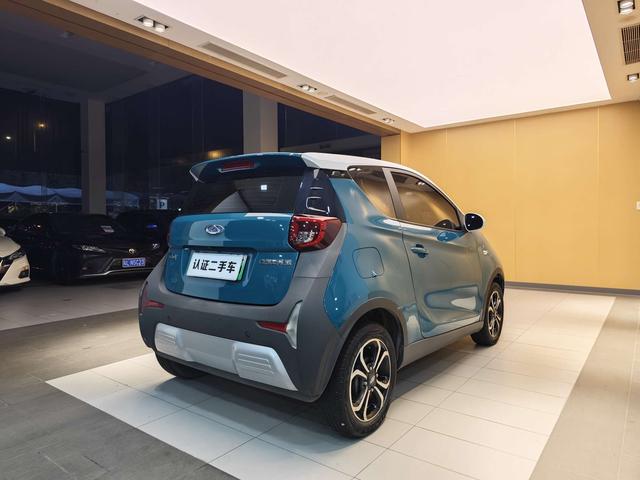
CHERY Dayima (Ant) 2022 CX Cabin Vehicle Profile: RWD Electric Mid-Size SUV with 510km NEDC Range

Model Overview: Market Position & Credibility
The CHERY Dayima is a battery-electric mid-size SUV from CHERY New Energy, part of CHERY's "Ant" series. Its core selling points are the driving quality of its rear-motor RWD layout with independent suspension, generous space, and strong value. The 2022 model is an important upgrade of the model line.
The 2022 Dayima launched in October 2021, offered in CX Cabin, YX Cabin and other trims, all fitted with a 70.1kWh ternary lithium battery pack and a 510km NEDC range. The CX Cabin trim is positioned as a balanced, comfortable mid-level choice. New colors such as Nansha Blue and Yili Purple brought the total to seven body colors.
The Dayima is built on CHERY's purpose-built pure-EV platform with an all-aluminum frame philosophy for good lightness and corrosion resistance, with a curb weight of about 1790kg. As a mid-size SUV, it strikes a strong balance between space, chassis and value, and is an important product in CHERY's push into the pure-EV SUV market.
You can take a full look at the exterior and interior design of this model through the following video:
Core Specifications
|
Item
|
Specification
|
|
Model
|
CHERY Dayima 2022 CX Cabin
|
|
Powertrain
|
Battery electric
|
|
Drivetrain
|
Rear-motor RWD (single motor)
|
|
Max Power
|
130kW (177 hp)
|
|
Peak Torque
|
280N·m
|
|
Range
|
510km (NEDC)
|
|
Battery Capacity
|
70.1kWh (ternary lithium)
|
|
Charging Time
|
Fast ~30 min (to 80%), slow ~13 h
|
|
Consumption
|
~15kWh/100km
|
|
Dimensions (L×W×H)
|
4630×1910×1655mm
|
|
Wheelbase
|
2830mm
|
|
Top Speed
|
170km/h
|
|
Seats
|
5-door, 5-seat
|
|
Cargo Volume
|
386-1250L
|
|
Vehicle Warranty
|
3 years / 120,000km
|
|
Battery Warranty
|
First-owner lifetime
|
Maintenance and service: As a pure EV with a relatively simple structure, routine maintenance mainly covers three-electric checks, cabin filter and brake-fluid replacement, making upkeep more economical than a petrol car. CHERY has a mature nationwide sales and after-sales network.
Purchase incentives: New-energy vehicle purchase subsidies and tax breaks vary by country/region. The following is an overview of representative markets (source: IEA Global EV Policy Explorer):
|
Country/Region
|
Key Subsidy / Incentive
|
|
China
|
NEV purchase tax exemption extended to end of 2025, halved between 2026-2027; some cities offer trade-in subsidies
|
|
EU (selected countries)
|
Purchase subsidies or tax relief for BEVs vary by country
|
|
United States
|
Qualified EVs may receive federal tax credits; states add further incentives
|
Three Highlights & Three Caveats
Highlights
Highlight 1: Solid RWD Chassis with Independent Suspension The Dayima uses a rear-motor, rear-wheel-drive layout with independent suspension front and rear, and a well-tuned, stable chassis. Owners routinely report it "drives really comfortably" and the "chassis is solid, comparable to a Volkswagen Sharan", giving it noticeably better urban driving manners than rivals at a similar price — an easily overlooked strength.
Highlight 2: 510km NEDC Range with a 70.1kWh Ternary Lithium Battery The whole range carries a 70.1kWh ternary lithium battery with a 510km NEDC range. Combined with a low consumption of around 15kWh/100km, it comfortably covers daily commuting and weekend trips, and with very low electricity costs it is highly economical to run over the long term.
Highlight 3: Generous Mid-Size SUV Space and Comfort Features A 4630mm body and 2830mm wheelbase deliver generous rear legroom, with a foldable rear seat (386-1250L cargo). The CX Cabin trim adds leather seats, powered front seats, heated/ventilated/massaging front seats and a panoramic sunroof, offering strong value in its class.
Caveats
Caveat 1: Moderate Fast-Charging Speed Fast charging takes about 30 minutes (to 80%), with slow charging around 13 hours. Compared with 800V rivals (e.g. the Mazda EZ-60 at about 15 minutes), recharging efficiency is lower, so waiting times on long trips can be longer.
Caveat 2: Power Output Is Not Standout With 130kW (177 hp) / 280N·m and a 170km/h top speed, performance is adequate for daily family use but less punchy than some rivals (the Mazda EZ-60 delivers 190kW / 258 hp) when overtaking at speed or climbing under load.
Caveat 3: Conservative Brand and Assistance Tech Launched earlier (2021), the Dayima mainly offers L2 driver assistance (reverse camera, cruise control, lane-departure warning), with no higher-level navigation piloted driving. Its cabin and ADAS feel more conservative than models launched in 2024-2025.
Ownership Costs & Service
Warranty: 3 years / 120,000km vehicle warranty, with first-owner lifetime battery warranty for long-term peace of mind.
Maintenance costs: As a pure EV without an engine or gearbox, maintenance mainly covers the three-electric system, cabin filter and brake fluid. Estimated total maintenance over 60,000km is about CNY 2,877 (approx. USD 400), well below a comparable petrol SUV.
Real ownership cost analysis: With 510km range and around 15kWh/100km consumption, at an average global residential electricity price of about USD 0.17/kWh the cost is about USD 2.55 per 100km; at 20,000km/year that is roughly USD 510 per year, a significant saving on fuel versus a comparable petrol SUV.
Charging costs (based on Global Petrol Prices world average residential price of about USD 0.17/kWh):
-
~USD 2.55 per 100km
-
~USD 510 per year at 20,000km
Subsidies & policy (country comparison, source IEA Global EV Policy Explorer): see the subsidy table above.
Competitors Comparison
The Dayima 2022 CX Cabin's key rivals include the range-extended mid-size SUV Mazda EZ-60, the CHERY Shu Xiang Jia (舒享家) pure-EV SUV, and the earlier AIWAYS U5 pure-EV SUV. All four sit in the mid-size SUV class but differ significantly in refueling/recharging options, power and smart features, compared in detail below:
-
Different refueling approaches: The Mazda EZ-60 is a range-extender that can refuel and recharge with no range anxiety; the other three are pure EVs relying on the charging network.
-
Different performance: The Mazda EZ-60 is strongest overall (190kW / 258 hp), the AIWAYS U5 has the highest torque (310N·m), while the Dayima offers smooth, adequate performance.
-
Different range strategy: The Dayima and Shu Xiang Jia focus on long pure-electric range (510/512km), the Mazda EZ-60 has short pure-EV range (160km) but can extend via its engine, and the AIWAYS U5 has shorter range (405km).
-
Different smart features: The Mazda EZ-60 offers a large 26.45-inch 5K center screen and more advanced intelligent experience; the Dayima and Shu Xiang Jia mainly offer L2 assistance, and the AIWAYS U5 is more basic.
|
Dimension
|
CHERY Dayima 2022 CX Cabin
|
Mazda EZ-60 2025 200 Pro (EREV)
|
CHERY Shu Xiang Jia 2025 512km
|
AIWAYS U5 2021 U5 SE
|
|
Energy Type
|
Battery electric
|
Range-extended (EREV)
|
Battery electric
|
Battery electric
|
|
Drivetrain
|
Rear-motor RWD (single)
|
Rear-motor RWD (single)
|
Rear-motor RWD (single)
|
Rear-motor RWD (single)
|
|
Max Power
|
130kW (177 hp)
|
190kW (258 hp)
|
155kW (211 hp)
|
150kW (204 hp)
|
|
Peak Torque
|
280N·m
|
290N·m
|
285N·m
|
310N·m
|
|
Pure-EV Range
|
510km (NEDC)
|
160km
|
512km (CLTC)
|
405km
|
|
Battery Capacity
|
70.1kWh (ternary Li)
|
31.73kWh (LFP)
|
67.12kWh (LFP)
|
53kWh
|
|
Fast Charge
|
~30 min (to 80%)
|
~15 min (30%-80%)
|
~30 min (30%-80%)
|
~30 min (to 80%)
|
|
Slow Charge
|
~13 h
|
—
|
~8 h
|
~8.5 h
|
|
Consumption
|
~15kWh/100km
|
~17.5kWh/100km
|
~14.8kWh/100km
|
~13.8kWh/100km
|
|
Fuel Tank
|
—
|
45L
|
—
|
—
|
|
Top Speed
|
170km/h
|
185km/h
|
180km/h
|
160km/h
|
|
Dimensions (L×W×H)
|
4630×1910×1655mm
|
4850×1935×1620mm
|
4675×1910×1660mm
|
4680×1865×1700mm
|
|
Wheelbase
|
2830mm
|
2902mm
|
2830mm
|
2800mm
|
|
Cargo Volume
|
386-1250L
|
549-2036L
|
386-1250L
|
432-1555L
|
|
Tires
|
225/60 R18
|
235/55 R19
|
225/60 R18
|
215/65 R17
|
|
Suspension
|
MacPherson + multi-link
|
MacPherson + multi-link
|
MacPherson + multi-link
|
|
|
Center Screen
|
12.3 in
|
26.45 in 5K + sub-screen
|
12.3 in
|
12.3 in
|
|
ADAS
|
L2 (standard)
|
L2 (standard)
|
L2
|
L2
|
|
Vehicle Warranty
|
3y / 120,000km
|
3y / 100,000km
|
4y / 150,000km
|
4y / 150,000km
|
|
Battery Warranty
|
First-owner lifetime
|
8y / 120,000km
|
First-owner lifetime
|
8y / 150,000km
|
All four are mid-size SUVs but differ clearly. The Dayima's strengths are its solid RWD chassis, 510km pure-EV range and spacious interior, ideal for families valuing driving quality and pure-EV economy; the Mazda EZ-60's range-extender removes range anxiety with stronger power and smarter cabin, but has shorter pure-EV range; the Shu Xiang Jia offers the longest range, lighter curb weight and lower consumption; the AIWAYS U5 has strong torque but more basic range and features. Overall, the Dayima is the most balanced in "driving quality + pure-EV range + space value" and is a safe, reliable pick for a family pure-EV SUV.
Expert Test Drive: Pros & Cons
Pros:
-
Solid, comfortable chassis: MacPherson + multi-link independent suspension with rear-motor RWD, stable tuning and good urban driving quality; owners say the "chassis is solid, comparable to a Sharan".
-
Reliable, economical range: 510km NEDC range with about 15kWh/100km; low electricity costs make it very cheap to run.
-
Spacious and well equipped: 2830mm wheelbase gives ample rear space, 386-1250L cargo; CX Cabin adds leather seats, powered adjustment, heated/ventilated/massaging front seats and a panoramic sunroof.
Cons:
-
Slower fast charging: about 30 minutes to 80%, moderate long-distance efficiency.
-
Modest power reserve: 130kW / 280N·m; overtaking response is gentle.
-
Conservative smart features: mainly L2 assistance, no higher-level navigation piloted driving; cockpit tech is traditional.
Test scenarios:
-
City commuting: owners report it drives very comfortably in ECO mode, even "better than an Audi Q3 and VW Sharan" in the city, with economical energy use (source: Sohu Auto owner reviews).
-
Low-temperature environment: the Dayima supports charging above -20°C, with relatively stable winter range, helpful for users facing "winter charging difficulty" (source: official low-temperature range test).
Real Owner Reviews
Positive feedback:
Space — owners generally find rear and cargo space generous, ideal for families.
"The space is really large; the rear row often carries people without feeling cramped."
Chassis & comfort — the solid chassis and comfortable driving feel are among the most praised points.
"The chassis is solid and drives really comfortably; even in ECO mode it feels great."
Cost of ownership — pure-EV driving brings extremely low energy costs.
"Switching from a heavy-fuel car to a pure EV, I save a lot on fuel costs."
Negative feedback:
Front-end design — some owners feel the front face is not attractive.
"What I like least? Nothing yet — maybe the front face isn't perfect!"
Power and brand recognition — power is gentle in some conditions, and as an earlier-launched model its brand recognition in the pure-EV space is limited. This should be judged based on real-world experience.
References
-
Global Petrol Prices (2025). World Average Electricity Prices, USD / kWh. Retrieved from https://www.globalpetrolprices.com/electricity_prices/
-
IEA. Global EV Policy Explorer. Retrieved from https://www.iea.org/data-and-statistics/data-tools/global-ev-policy-explorer
-
CHERY New Energy (Dayima model official specifications and configuration)
-
Sohu Auto (Dayima owner reviews and ratings)
-
Baidu Baike (CHERY Dayima entry)