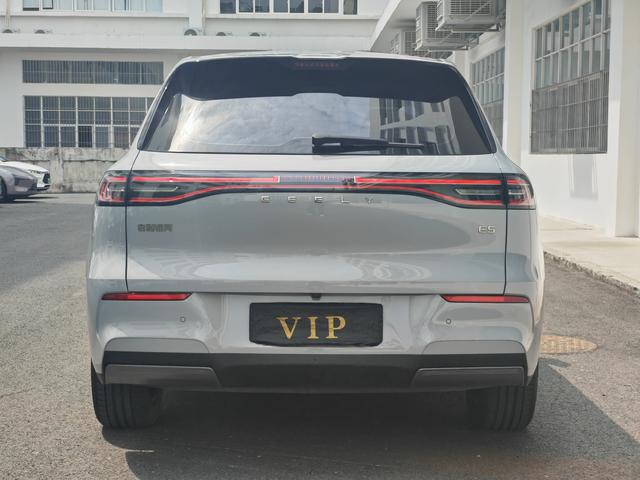
Geely Galaxy E5 2026 Vehicle Profile: 610km Range Electric SUV, 12.3kWh Consumption, 0.269Cd

1. Verdict: Three Highlights & Three Caveats
- Highlight 1: Long range with "more for the same price" — CLTC range reaches 610km, up from 530km at no extra cost for the 2026 model, paired with a 68.39kWh battery. City commuters can realistically go a full week on a single charge while enjoying strong value.
- Highlight 2: Class-above space and flexible storage — With a 2750mm wheelbase and a flat rear floor, rear seating is spacious for a compact SUV; the trunk offers about 461L (expandable to 1877L) plus a hidden underfloor compartment, making it highly practical for families and camping.
- Highlight 3: Low consumption and rich equipment — Real-world consumption is among the best in class (around 10.9–13kWh/100km). A 16-speaker Flyme Sound audio system, 50W wireless charging, heated/ventilated seats, and a smooth Flyme Auto infotainment round out the package.
- Caveat 1: Soft suspension and body float — Thanks to cell-to-body construction, some owners report a soft ride with noticeable body float over bumps; rear passengers may feel carsick, and the handling is not a sporty orientation.
- Caveat 2: Noticeable highway noise — Wind and road noise are more evident at highway speeds; NVH is not class-leading, so noise-sensitive buyers should test drive.
- Caveat 3: Moderate wet-grip from stock tires — Some owners note the factory tires can slip on wet surfaces when pulling away; extra caution is advised in the rain, with aftermarket tires an option.
2. Model Overview
The Geely Galaxy E5 is a compact pure-electric SUV under Geely’s Galaxy brand, launched in August 2024 and positioned as a “global smart pure-electric SUV.” Backed by generous space, low consumption and strong value, it quickly passed 10,000 monthly sales and became a leading player in China’s A-segment EV SUV market.
Design-wise, it follows Galaxy’s “Ripple Aesthetics” language with a “Light Ripple” illuminated front grille and badge and an “Sunrise” full-width taillight; smooth lines help achieve a 0.269Cd drag coefficient that balances looks and efficiency. Power comes from Galaxy’s “11-in-1” intelligent e-drive (front single motor, 160kW/218hp, 320N·m, ~6.9s 0–100km/h), using a Shen Dun short-blade battery and cell-to-body (CTB) construction, with the battery already meeting strict new national standards. The cabin runs the Galaxy Flyme Auto system with a 15.4-inch 2.5K full-screen, 16-speaker Flyme Sound audio, a 540° transparent underbody view and sentinel mode. The 2026 model offers 530km and 610km ranges; the 610km variant adds 8kWh of capacity and supports up to 6kW vehicle-to-load for easy camping power.
You can explore the exterior and interior design of this model through the following video:
3. Core Specifications
| Item | Specification |
|---|---|
| Model | Geely Galaxy E5 2026 610km Exploration Plus |
| Powertrain | Pure electric (front single motor) |
| Motor | Permanent-magnet synchronous, 160kW (218hp), 320N·m |
| Pure-Electric Range (CLTC) | 610km | 530km (lower trim) |
| Fast Charging (30%–80%) | 20 minutes |
| Slow Charging | ~10.4 hours |
| Electricity Consumption (official) | 12.3kWh/100km |
| Battery | 68.39kWh lithium iron phosphate (Shen Dun short-blade battery) |
| Dimensions (L×W×H) | 4615×1901×1670mm, wheelbase 2750mm |
| Seats | 5 |
| Top Speed | 180km/h |
| 0–100km/h | ~6.9s |
| Drivetrain | Front-wheel drive |
| Transmission | Single-speed |
| Curb Weight | 1778kg (gross 2191kg) |
Maintenance & manufacturer service: Vehicle warranty is 4 years or 100,000km, with the first owner eligible for 6 years or 150,000km. As a pure EV, it has no engine/gearbox routine maintenance; upkeep focuses on brakes, cooling, cabin filter and tires, keeping long-term costs low.
Subsidy policies: EV incentives vary by market. Below is a snapshot across selected markets (source: IEA Global EV Policy Explorer):
| Market | Policy Summary |
|---|---|
| China | Purchase tax relief; NEV plate advantages and charging infrastructure planning in some cities |
| Major EU markets | Purchase subsidies or tax relief encouraging low-emission vehicles |
| United States (select states) | Federal and state purchase tax credits, varying by vehicle and household income |
| Parts of Southeast Asia | Tariff concessions or local assembly incentives to boost NEV uptake |
Please refer to the latest local regulations for specifics.
4. Ownership Cost & Service
- Warranty: Vehicle: 4 years or 100,000km; first owner: 6 years or 150,000km. EV batteries typically carry extended warranty (exclusions per official terms).
- Maintenance: As a pure EV, service is limited to routine checks (brakes, coolant, cabin filter, tires) without oil/filter changes, so ongoing maintenance is cheaper and more convenient than combustion equivalents.
- Charging cost: Using the Global Petrol Prices world-average residential electricity price of about 0.170 USD/kWh: a full charge of the 68.39kWh battery costs roughly 11.6 USD. At the official 12.3kWh/100km, pure-electric driving costs about 2.1 USD per 100km — even lower at the real-world figure of about 10.9kWh/100km.
Subsidy and policy table (Source: IEA Global EV Policy Explorer). Incentive levels differ significantly across countries — prospective buyers should factor local policy into true ownership cost:
| Country/Region | Subsidy & Policy Summary |
|---|---|
| China | Purchase tax relief; NEV quota priority in some cities |
| Major EU markets | Purchase subsidies or carbon-tax incentives; some tiered by battery capacity |
| United States (select states) | Federal and state purchase tax credits |
| Parts of Southeast Asia | Tariff concessions and localization incentives |
5. Competitor Comparison
In the compact pure-EV SUV segment, the Galaxy E5 competes primarily with the GAC Aion N60, Aion V Tyrannosaurus, and Great Wall ORA 5 SUV. Four key observations:
- Leading pure-electric range: The E5 (610km) ties the AION N60 (610km), both ahead of the AION V (520km) and ORA 5 (480km) — E5 and N60 edge ahead for long-range needs.
- Different power tuning: The E5 uses a 160kW/320N·m motor with the highest torque and a quick ~6.9s sprint; the N60 has the highest power (165kW); the AION V and ORA 5 each use 150kW for a more balanced feel.
- Body size and space: The E5 measures 4615mm long with a 2750mm wheelbase; the AION V and N60 stretch to 2775mm for more rear space; the ORA 5 is smallest (4471mm/2720mm) and most agile. All are 5-door 5-seat SUVs.
- Recharging and efficiency: All four are pure EVs with fast charging. The E5, AION V and ORA 5 fast-charge in about 20 minutes (30%–80%); the N60 is slightly slower. The E5’s official 12.3kWh/100km is economical, with the AION V slightly higher at 12.8kWh.
| Metric | Galaxy E5 2026 610km Exploration Plus | AION N60 2026 610 LiDAR Ultra | AION V 2026 Tyrannosaurus Family 520 Smart | ORA 5 SUV EV 2026 480km LiDAR |
|---|---|---|---|---|
| Class | Compact SUV | Compact SUV | Compact SUV | Compact SUV |
| Powertrain | Pure electric | Pure electric | Pure electric | Pure electric |
| Motor power | 160kW (218hp) | 165kW (224hp) | 150kW (204hp) | 150kW (204hp) |
| Max torque | 320N·m | 205N·m | 205N·m | 260N·m |
| EV range (CLTC) | 610km | 610km | 520km | 480km |
| Charging time | Fast 20min, slow 10.4h | Fast 23min | Fast 22min | Fast 20min, slow 8.5h |
| Fast-charge band | 30%–80% | 30%–80% | 30%–80% | 30%–80% |
| Transmission | Single-speed | Single-speed | Single-speed | Single-speed |
| Dimensions (mm) | 4615×1901×1670 | 4615×1883×1673 | 4580×1854×1686 | 4471×1844×1641 |
| Wheelbase (mm) | 2750 | 2775 | 2775 | 2720 |
| Body style | 5-door 5-seat SUV | 5-door 5-seat SUV | 5-door 5-seat SUV | 5-door 5-seat SUV |
| Seats | 5 | 5 | 5 | 5 |
| Top speed | 180km/h | 160km/h | 160km/h | 170km/h |
| 0–100km/h | ~6.9s | 8.5s | 7.9s | — |
| Electricity consumption | 12.3kWh/100km | 11.8kWh/100km | 12.8kWh/100km | 11.1kWh/100km |
| Battery capacity | 68.39kWh | 69.7kWh | 62.2kWh | 45.3kWh |
| Curb weight (kg) | 1778 | 1850 | 1780 | 1560 |
| Gross weight (kg) | 2191 | 2305 | 2280 | 1960 |
| Trunk capacity (L) | 461–1877 | 447 | — | 317–1000 |
| Drag coefficient | 0.269 | — | 0.27 | — |
| Drivetrain | Front-wheel drive | Front-wheel drive | Front-wheel drive | Front-wheel drive |
| Front/rear suspension | MacPherson / multi-link independent | MacPherson / multi-link independent | MacPherson / multi-link independent | MacPherson / multi-link independent |
| Front/rear tires | 225/55 R18 | 215/55 R18 | 215/55 R18 | 225/60 R18 |
| Brakes | Vented disc / electronic parking | Vented disc / electronic parking | Vented disc / electronic parking | Vented disc / electronic parking |
| ADAS | L2 driving assist | LiDAR high-level ADAS (Ultra) | L2 driving assist | LiDAR high-level ADAS |
| 360° camera | Standard | Standard | Standard | Standard |
| Adaptive cruise | Standard (full-speed) | Standard (full-speed) | Standard (full-speed) | Standard (full-speed) |
| Auto parking | Standard | Optional | Standard | Standard |
| Memory parking | — | Optional | Optional | Standard |
| Vehicle-to-load | 3.3kW (up to 6kW) | 6kW | 3.3kW | 6kW |
| Sunroof | Panoramic (openable) | Panoramic | Panoramic | Panoramic/fixed roof |
| Seat material | Leatherette | Leatherette | Leather+leatherette | Leatherette |
| Rear seat fold | 40:60 | 40:60 | 40:60 | 40:60 |
| Center screen | 15.4-inch | 15.6-inch | 14.6-inch | 15.6-inch |
| Phone connectivity | Flyme Link, HiCar, CarLink | HiCar, CarLink, CarPlay | CarLink | HiCar, CarLink, CarPlay |
| Vehicle warranty | 4y/100,000km | 4y/150,000km | 4y/150,000km | 4y/150,000km |
Note: Competitor data sourced from publicly available specifications. Cells marked “—” indicate data not confirmed.
Summary: All four are compact pure-EV SUVs with distinct strengths. The Galaxy E5 balances range, space flexibility and efficiency, backed by generous space and equipment — a top pick for “family space + value.” The AION N60 offers the highest power plus LiDAR high-level ADAS (Ultra) for tech-focused buyers; the AION V stretches the wheelbase longest for family comfort; and the ORA 5 is the most compact and lightest (1560kg) with the best consumption (11.1kWh), suiting city commuting. All fast-charge; final choice depends on price, space and ADAS needs.
6. Expert Test Drive
Pros:
- Excellent efficiency: Official consumption is 12.3kWh/100km, with media tests recording as low as ~10.9–11.6kWh/100km — among the best in class and very cheap to run.
- Practical space and storage: Flat rear floor and over-two-fists rear legroom; the trunk easily fits multiple suitcases with a hidden underfloor compartment for family and camping use.
- Solid cabin and intelligence: Flyme Auto is smooth, the 15.4-inch 2.5K screen is crisp, the 16-speaker Flyme Sound audio is impressive, and the 540° transparent view plus sentinel mode add real value.
Cons:
- Soft suspension and body float: Due to cell-to-body construction, the ride is tuned soft with noticeable body float over bumps; rear passengers (especially children/elderly) may feel carsick.
- Average highway NVH: Wind and road noise are more evident at speed; not the quietest in class, so noise-sensitive buyers should test drive.
- Moderate wet-grip tires: The stock tires can slip when pulling away on wet roads; extra caution in the rain, and aftermarket tires are an option.
Measured Scenarios:
- Efficiency test: Media measured about 11.6kWh/100km, with some owners reporting as low as 10.9kWh/100km (source: Sohu Auto preview test, Sina Auto owner reviews compilation).
- Winter low-temperature test: At -25°C, measured range was about 260.9km with 28.6kWh/100km consumption, a ~42.8% achievement rate — winter range drops noticeably (source: Sina Auto winter test).
7. Real Owner Reviews
Positive Feedback:
- Space and storage: Owners widely praise the flat-floor rear and generous space; kids ride comfortably and the trunk loads easily. “What I like most is the space — the flat rear floor fits three adults easily, it’s very practical with the kids, and it loads a lot.”
- Equipment and value: At this price point the kit is rich — 50W wireless charging, sentinel mode, heated/ventilated seats and the 16-speaker audio are welcome. “At this price, 50W wireless charging, sentinel mode and ventilated/heated seats are rare; the 16-speaker sound is impressive and storage is generous.”
- Efficiency and running costs: Owners report consumption mostly between 11–14kWh/100km, making running costs low and ownership satisfying. “After a year of ownership I feel I chose well and don’t regret it; for an A-segment car the rear space is large, family rides comfortably, and consumption is satisfying.”
Negative Feedback:
- Soft suspension and carsickness: Several owners report a soft ride with noticeable body float; rear passengers may feel carsick — the most consistent criticism in owner feedback. “The chassis feels very soft and sways noticeably over speed bumps; my dad says the rear rides like an air mattress and gets uncomfortable.”
- Highway noise and details: Some owners note elevated highway noise and occasional interior rattles or tire issues. “I’m not happy about the highway noise when driving fast; there’s also a slight rattle from the right A-pillar on bumpy roads.”
8. References
- Global Petrol Prices (2025). World Average Electricity Prices, USD / kWh. Retrieved from https://www.globalpetrolprices.com/electricity_prices/
- IEA. Global EV Policy Explorer. Retrieved from https://www.iea.org/data-and-statistics/data-tools/global-ev-policy-explorer
- Geely Galaxy official site (Galaxy E5 model page): https://www.galaxy-geely.com/E5
- Xinhua (launch report on the 2026 Geely Galaxy E5 long-range)
- Sohu Auto, Sina Auto (Galaxy E5 test drive and winter test)
- Owner reviews and specification details compiled from publicly available automotive information platforms