JETOUR Shanhai L7 2026 Beyond Edition Vehicle Profile: Family Plug-In SUV with Flexible 5/7-Seat Layout, 130km EV Range and Budget-Friendly 6.6kW V2L

JETOUR Shanhai L7 2026 Beyond Edition Review: A "Big Seven-Seat, Long-Range, Frugal" Plug-In SUV Built for the Whole Family
1. Verdict: Three Highlights & Three Caveats
- "Big space + optional 7 seats" is the killer differentiator for family trips: With a mid-size body (4749 × 1900 × 1720 mm, 2745 mm wheelbase), flexible 5/7-seat layouts (2+3+2 optionally) and multiple seat combinations plus roughly 960 mm of second-row legroom, it offers genuinely versatile space. The JETOUR Shanhai L7 sells itself on practicality for families and multi-child households.
- 1.5T + 2-speed DHT with pure-EV 130 km — strong yet economical: A Chery Kunpeng 1.5TGDI hybrid engine (top-ten "China Heart") pairs with a front motor (199 kW) through a 2-speed super-electric DHT. With 130 km CLTC pure-EV range and over 1300 km CLTC total range, 30%–80% fast charge in around 18 minutes, about 5.18 L/100 km low-battery consumption on 92 RON petrol, and standard 6.6 kW V2L, it's frugal to run and easy for self-driving camping trips.
- Solid platform and safety kit, plus a lifetime warranty for peace of mind: Mars architecture four-wheel independent suspension with 26 vibration-absorbing bushes, a 75% high-strength-steel cage body, L2 driver assistance and 540° camera, a 0-odour maternal-grade cabin — plus a lifetime vehicle + three-electric warranty entitlement. Reassuring for family buyers.
- Calm, "Buddhist" tuning — no real launch thrill: The tune favours smoothness and comfort over sportiness; throttle response isn't aggressive, so buyers wanting a punchy, spirited launch will find it gentle.
- Big body needs compromise in the city, and consumption depends on usage: A mid-size/7-seat body is heavier to park and manoeuvre in tight streets; running mostly on EV is very cheap, but petrol-heavy long highway driving sits mid-pack on economy — weigh against your own miles.
- Mid-pack build & infotainment polish: Some test-drives note leather-ish or interior finishing isn't ultra-refined, and lower trims trim certain features; the cabin tech and ADAS are complete but not class-leading — check the spec sheet before buying.
2. Model Overview: Market Position & Background
JETOUR is a Chery Holding brand built around "Travel+" and family/youth-oriented mobility. The Shanhai L7 is a brand-new mid-size plug-in hybrid SUV in JETOUR's Shanhai new-energy series, positioned as a "big-seven-seat, long-range, frugal" family offering. The 2026 Shanhai L7 launches under the "Beyond Edition" nameplate centred on the 130 km pure-EV trim, aimed at families, multi-child households and budget-conscious users who value space, range economy and worry-free ownership.
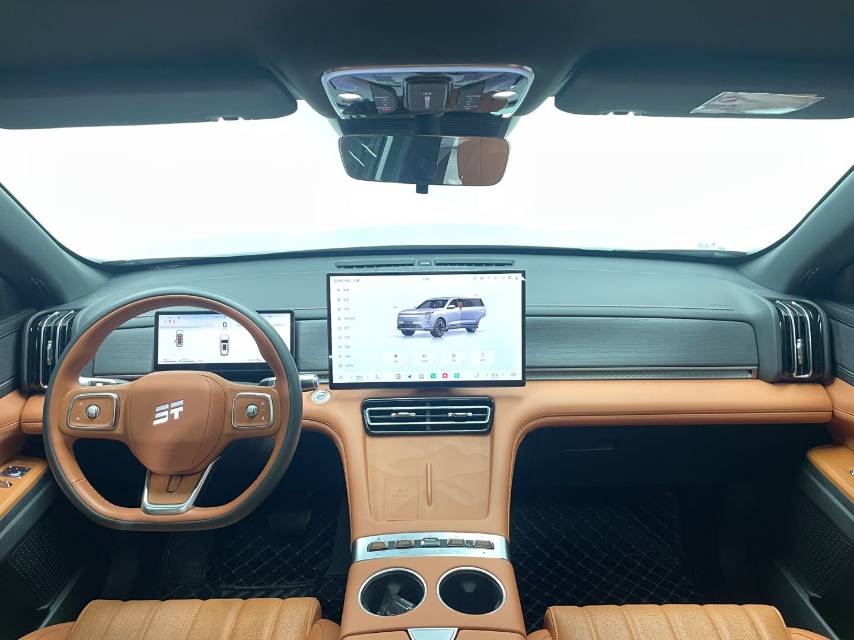
The 2026 "Beyond Edition" continues the "quality electric-hybrid SUV" route, upgrading drive, equipment and space: the 1.5T PHEV with a 199 kW motor delivers smooth, ample power; twin 12.3-inch displays with a full entertainment ecosystem, a cabin heating/cooling fridge and cloud-sofa seats suit long family trips and camping; and the lifetime vehicle + three-electric warranty reinforces the "worry-free" message. Styling uses a "Shanhai-co-existence" aesthetic with a smiling front face — clean, assured and quietly modern.
You can see the exterior and interior design in full here:
3. Core Specifications (Main Vehicle Only)
The following covers only the main subject: JETOUR Shanhai L7 2026 Beyond Edition 130 km Luxury trim.
Body & dimensions
- Model: 2026 JETOUR Shanhai L7 Beyond Edition 130km Luxury
- Body type: mid-size plug-in hybrid SUV
- Dimensions (L×W×H): 4749 × 1900 × 1720 mm
- Wheelbase: 2745 mm
- Seats: 5 (optional 2+3+2 seven-seat layout)
- Body: 5-door SUV, front-wheel drive
Powertrain
- Engine: Chery Kunpeng 1.5TGDI hybrid-dedicated (max 115 kW / about 156 PS; max torque 220 N·m; Miller cycle)
- Drive motor: front permanent-magnet motor (max 199 kW / about 271 PS; max torque 395 N·m)
- System combined power: about 314 kW (official)
- Transmission: 2-speed super-electric DHT
- Top speed: about 180 km/h
Range & refuelling
- Pure-electric range (CLTC): 130 km
- Total range (CLTC): over 1300 km
- Battery: ternary-lithium
- DC fast charge: 30%–80% in about 18 minutes (around 41 kW class)
- AC slow charge: about 3 hours
- V2L output: up to about 6.6 kW
Consumption
- Official low-battery consumption: about 5.18 L/100 km; runs on 92 RON petrol
- Energy consumption note: approx. 16.8 kWh/100 km (official basis)
Warranty & factory service
- Lifetime vehicle + three-electric warranty entitlement (first non-commercial owner; exclusions per official terms)
- Official guide price from about 114,900 RMB (no prices discussed in the comparison here)
Reference on subsidy policies: Purchase tax relief and subsidies for PHEVs vary by market and season. Follow the IEA Global EV Policy Explorer for the latest adjustments by country.
4. Ownership Costs & Service
Charging cost estimate: Using the Global Petrol Prices world-average residential electricity price of about 0.17 USD/kWh and roughly 16.8 kWh/100 km, pure-electric driving costs about 2.9 USD per 100 km. With 130 km CLTC EV range, daily electric commuting is very cheap, and 30%–80% fast charge in about 18 minutes is efficient. On longer low-battery runs, refuel with 92 RON petrol — official consumption about 5.18 L/100 km — so energy is flexible and inexpensive.
Servicing & warranty: The Shanhai L7 offers a lifetime vehicle + three-electric warranty entitlement (first non-commercial owner, exclusions per official terms), plus optional low-cost lifetime free-service packages. The plug-in structure removes some wear-prone ICE items, keeping long-term ownership manageable and home-focused.
Subsidy & policy comparison (multi-market): Incentive support for PHEV / plug-in models differs significantly by market. Below are the broad directions; verify current figures for your destination.
| Market | Typical policy direction (PHEV / dual-fuel class) |
|---|---|
| China | PHEVs may enjoy phased purchase-tax relief or concessions under current rules, with local incentives varying by region |
| Parts of Europe | Purchase-tax or incentive schemes by CO₂/energy class; typically grouped under low-emission / new-energy cars |
| Southeast Asia & Latin America | Often encourage imports via duty reductions, tax breaks, or local-assembly incentives |
| Middle East / Africa | Some countries waive or reduce new-energy vehicle duties as infrastructure is built out |
(For detailed taxes and incentives, see the IEA Global EV Policy Explorer: https://www.iea.org/data-and-statistics/data-tools/global-ev-policy-explorer)
5. Competitor Comparison
The "big space / optional seven-seat PHEV SUV" segment is fiercely contested. Against the Changan Qiyuan Q07, Landian (Billion) E5 PLUS, and Fengyun T9L:
- Size & space: The Shanhai L7 (4749×1900×1720, 2745 mm wheelbase) offers flexible 5/7-seat switching — its core differentiator — with about 960 mm of second-row legroom. The Fengyun T9L (4870 mm long, 2920 mm wheelbase) is the longest and most spacious but five-seat only and higher positioned; the Qiyuan Q07 (4837 mm / 2905 mm) has a bigger, wider five-seat body; the Landian E5 PLUS (4760 mm / 2785 mm) also offers 5/7-seat options. For a true seven-seater, the L7 and E5 PLUS both work; for maximum length the Fengyun T9L and Q07 lead.
- Powertrain & hybrid layout: The Shanhai L7 uses a Chery Kunpeng 1.5T (2-speed DHT) with a 199 kW front motor — combined about 314 kW, smooth yet ample. The Qiyuan Q07 uses a 1.5L NA engine with a 165 kW motor and E-CVT for smooth efficiency; the Landian E5 PLUS pairs a 1.5L with a 160 kW motor on E-CVT (mid book figures); the Fengyun T9L uses a 1.5T with a 260 kW motor (1-speed DHT), the strongest on paper at about 375 kW / 550 N·m combine and the higher-end pick. All four are FWD and city/family-efficiency oriented.
- Range & energy structure: Shanhai L7: 130 km CLTC EV, over 1300 km total; Qiyuan Q07: ~145 km CLTC EV; Landian E5 PLUS: 165 km CLTC EV class; Fengyun T9L: 135 km EV and 2000 km total. All four cover daily EV commuting; differences lie in battery chemistry (ternary vs LFP) and total range — the Fengyun T9L and Qiyuan stand out if you prize exceptionally long total range.
- Refuelling & outdoor capability: The Shanhai L7's standard 6.6 kW V2L and 30%–80% fast charge in ~18 min (41 kW class) make camping and multi-scenario power easy; the Qiyuan Q07 delivers about 6 kW V2L with faster charging (~15 min, 70 kW); the Landian offers ~3.3 kW V2L with slower charging (~54 min); the Fengyun T9L gives 6.6 kW V2L with ~20 min fast charge. For "big external power + quick charging," the L7 and Qiyuan are the more convenient options.
Core configuration comparison table
| Dimension | JETOUR Shanhai L7 130km Beyond (Luxury) | Changan Qiyuan Q07 145 Zunyao | Landian E5 PLUS 165km Pro | Fengyun T9L 135 Max |
|---|---|---|---|---|
| Dimensions (mm) | 4749×1900×1720 | 4837×1920×1690 | 4760×1865×1710 | 4870×1930×1710 |
| Wheelbase (mm) | 2745 | 2905 | 2785 | 2920 |
| Seat layout | 5-door 5/7-seat | 5-door 5-seat | 5-door 5/7-seat | 5-door 5-seat |
| Drive layout | FWD | FWD | FWD | FWD |
| Pure-EV range | 130km (CLTC) | 145km (CLTC) | 165km class | 135km (CLTC) |
| Total range | 1300km+ (CLTC) | ~1345km | ~1300km | 2000km (CLTC) |
| Transmission | 2-speed DHT | E-CVT | E-CVT | 1-speed DHT |
| Engine | 1.5T 115kW (156PS) | 1.5L 72kW (98PS) | 1.5L 70kW (95PS) | 1.5T 115kW (156PS) |
| Motor total power | 199kW (271PS) | 165kW (224PS) | 160kW (218PS) | 260kW (354PS) |
| System power/torque | ~314kW (official) | ~237kW / 455N·m | — | ~375kW / 550N·m |
| Top speed | ~180 km/h | ~180 km/h | ~180 km/h | ~180 km/h |
| Low-battery consumption | ~5.18 L/100km | — | — | — |
| Energy use (kWh/100km) | ~16.8 | ~15.8 | — | ~16 |
| Battery | Ternary | Battery (Golden Bell) | LFP | LFP (Rhino battery) |
| Fast/slow charge | ~18min / ~3h | ~15min / ~2.98h | ~54min / ~4h | ~20min / ~3h |
| Max fast-charge power | ~41 kW | ~70 kW | — | ~41 kW |
| V2L output | ~6.6 kW | ~6 kW | ~3.3 kW | ~6.6 kW |
| Tyre spec | 235/60 R18 | 245/55 R19 | 235/50 R19 | 235/55 R19 |
| Warranty | Lifetime entitlement | Lifetime entitlement | Lifetime entitlement | Lifetime entitlement |
(Note: comparisons are based on the user-supplied four-vehicle configuration screenshot; main-vehicle figures are cross-checked with official channels. No prices are included.)
Summary: The Shanhai L7 Beyond Edition's core value is packing "flexible big space / optional seven seats, smooth 1.5T + 2-speed DHT power with 130 km EV and 1300 km total frugal range, a solid chassis and lifetime warranty" for families — a pragmatic "roomy five-or-seven-seat electric-hybrid SUV that's easy to live with". If you want maximum length and ultra-long range, the Fengyun T9L is the higher-positioned, stronger pick; if you want a bigger five-seat body and faster charging, the Changan Qiyuan Q07 (2905 mm wheelbase, ~15 min charging) is appealing; if budget is tighter and you can accept slower charging, the Landian E5 PLUS's seven seats and value are worth a look. The L7's real trade-off: calm tuning and no extreme sportiness, in exchange for space flexibility, frugality and family peace of mind — exactly what most family buyers value most.
6. Expert Test Drive: Pros & Cons
Pros (sourced from professional reviews)
- Flexible, versatile space that suits the whole family: 5/7-seat layouts with 12 combinations, ~960 mm second-row legroom, generous all-round space, paired with a cabin heating/cooling fridge and twin 12.3-inch displays — a genuinely capable family travel cabin.
- Smooth, well-balanced power, range and charging: 1.5T + 199 kW motor through a 2-speed DHT delivers smooth, ample acceleration (roughly 7-second 0–100); with 130 km CLTC EV, 1300 km total range, ~18 min fast charge to 80% and 6.6 kW V2L, it's anxiety-free on range and easy for camping power.
- Comfortable platform and solid safety kit: Mars-architecture independent suspension with 26 damping bushes gives a comfortable ride with strong braking; a 75% high-strength-steel cage, L2 assistance + 540° camera, and a 0-odour maternal-grade cabin combine with the lifetime warranty for real peace of mind.
Areas to improve (sourced from professional reviews)
- Calm, comfort-first tuning without sporty verve: the setup favours smoothness over excitement; aggressive launches and razor-sharp dynamics aren't its strength — drivers wanting real driving thrills may find response a touch mild.
- Big body needs getting used to in the city: a mid-size/seven-seat footprint adds burden when parking, manoeuvring or turning in tight old-town streets.
- Build detail and infotainment/ADAS are mid-pack: some test-drives note leather-ish stitching or interior finishing isn't ultra-refined; lower trims trim certain features and the cabin tech is complete but not class-leading — always verify the spec sheet.
Measured scenarios (with sources noted)
- City commuting / pure-EV daily driving (source: official and media): about 130 km EV covers most daily commutes, 30%–80% fast charge in ~18 min is efficient, and pure-EV costs are low; low-battery consumption near 5.18 L on 92 petrol remains reasonable.
- Whole-family trips / camping (source: professional reviews and owner posts): 1300 km total range ends range anxiety; 6.6 kW V2L powers a fridge and camping appliances; the roomy interior and comfort-tuned ride make long journeys pleasant.
7. Real Owner Reviews
Positive feedback
- Summary: roomy and comfortable, a great family car: "The space is flexible and the second row is generous — the (cloud-sofa) seats are comfortable and it works brilliantly as a family vehicle; fold the rearmost row and the boot swallows all the family luggage."
- Summary: economical range, no anxiety thanks to petrol-electric flexibility: "130 km of EV range handles daily commuting and charges quickly; 1300 km total range means long drives don't worry; low-battery consumption is acceptable on 92 petrol — running costs stay in check."
- Summary: stable chassis, plenty of safety kit, worry-free: "The chassis is comfortable and filters bumps well, braking inspires confidence; L2 assistance and the 540° camera are all there, and the lifetime warranty makes it easy to own."
Negative feedback
- Summary: calm tuning, limited launch thrill: "The overall tune is family-oriented, not sporty; if you want a punchy launch or driving excitement, the throttle response can feel too mild."
- Summary: big body adds urban parking burden / mid-pack build details: "The car is quite wide, so parking in tight city spots takes some effort; stitching and some interior finishing aren't the most refined, and a few functions need to be optioned on lower trims."
(Owner comments compiled from automotive-platform word-of-mouth and long-term reviews as product/usage impressions only.)
8. References
- Global Petrol Prices. World Average Electricity Prices, USD / kWh. Retrieved from https://www.globalpetrolprices.com/electricity_prices
- IEA. Global EV Policy Explorer. Retrieved from https://www.iea.org/data-and-statistics/data-tools/global-ev-policy-explorer
- JETOUR official website, Shanhai L7 Beyond Edition model page and launch reports
- JETOUR Shanhai L7 YouTube walkaround video: https://youtu.be/vaf7EvxC7BE