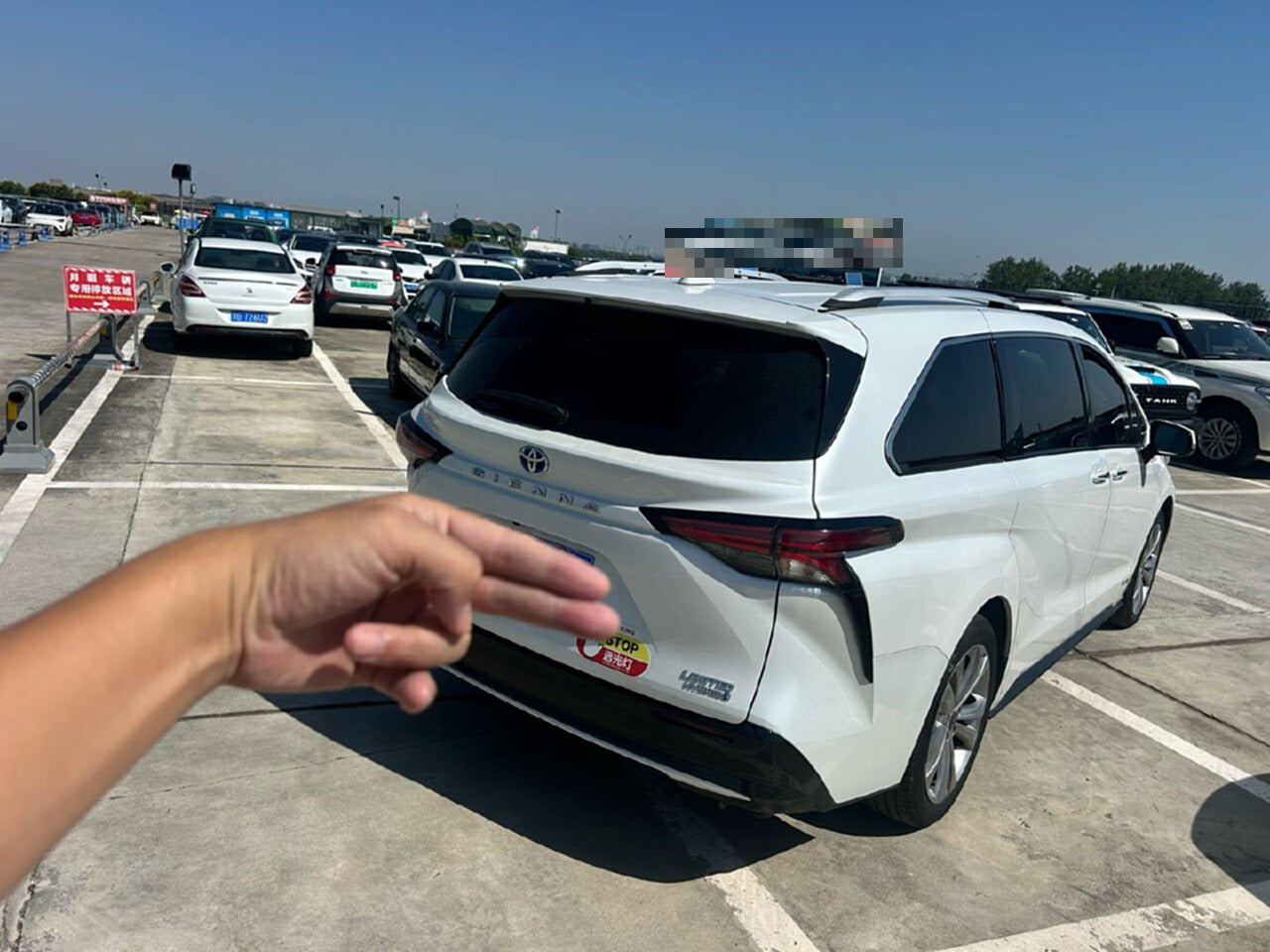
Toyota Sienna 2026 Vehicle Profile: Toyota Hybrid Large MPV with e-AWD, 7 Seats & ~6.13L/100km

1. Bottom Line: Three Highlights & Three Caveats
- Highlight One: Toyota hybrid efficiency—smooth, frugal and worry-free The Sienna pairs a 2.5L naturally aspirated four-cylinder with an electric motor in a Toyota hybrid system that drives without shift-shock. The 2026 2.5L Hybrid AWD Premium adds electronic all-wheel drive (front + rear motors) for more confident traction at low speed and on wet roads. WLTC combined fuel use is about 6.13 L/100km—impressive for a ~5.2-metre, 7-seat large MPV—keeping daily running costs low whether in city stop-go or on expressways.
- Highlight Two: generous, flexible 7-seat space At 5,165 × 1,995 × 1,765 mm with a 3,060 mm wheelbase, the Sienna uses a 2-2-3 seat layout with independent second-row seats and wide shoulder room, so seven adults travel comfortably on long trips. The boot ranges flexibly from 525 L to 2,112 L, with folding seats, covering both family road trips and business/people-moving needs.
- Highlight Three: Toyota quality and strong resale value lower the risk As a Toyota large joint-venture MPV, the Sienna benefits from mature chassis durability and build consistency, and it consistently ranks among the top of its segment for three-year resale value. For export/wholesale buyers wary of "a big purchase that could lose its worth," the Toyota badge means more predictable re-sale and lower ownership risk.
- Caveat One: Frugal and family-oriented, interior finish is modest The Sienna's strengths are usability and low running cost; cabin materials lean pragmatic rather than opulent. If you expect rich leather, abundant soft-touch trim and a lavish ambience, adjust expectations accordingly.
- Caveat Two: Comfort-leaning, not a performance vehicle The 2.5L hybrid is tuned for linear, economical drive; under hard acceleration or full-load hill climbing the response is steady rather than punchy. Buyers wanting sporty thrust should look elsewhere.
- Caveat Three: Know the difference vs "high-roof" tuned variants Many Granvia-family "high-roof / high-custom / traveler" conversions sit above 1,900 mm tall and emphasise executive luxury, whereas this Sienna is a normal-height, home/dual-use factory model. When comparing, separate "factory long-wheelbase family MPV" from "converted high-roof executive van" on body height, parking-garage clearance and after-sales/registration implications.
2. Model Overview: What Kind of Van Is the Toyota Sienna
The Toyota Sienna is Toyota's large MPV for North America and China. GAC Toyota began local production in China in 2021, introducing the 2.5L hybrid system, and the Sienna quickly became a benchmark family/business MPV, competing alongside joint-venture rivals while selling on "frugal hybrid running, a huge flexible cabin, and Toyota reliability."
Its market positioning is high-value practicality rather than ultimate luxury: the core pitch is hybrid efficiency and smoothness, generous and reconfigurable 7-seat space, and strong resale value, serving multi-child households and business shuttle needs alike. It is not the executive-tier Alphard; the Sienna focuses on cost-effectiveness and everyday usefulness, giving it a stable following among upgrading family buyers.
From an overseas standpoint, the Sienna is a well-known, mature Toyota hybrid large MPV (the North American model likewise runs a 2.5L hybrid with optional E-Four electronic AWD). Its ride comfort, the airy openness of the independent second-row seats, and its low day-to-day running costs are what reviewers most often praise. The trim profiled here, the 2026 Hybrid AWD Premium, adds all-wheel drive and a higher feature set—near the top of the locally produced Sienna range.
Design-wise the Sienna uses Toyota's family front face, with a horizontal grille flowing into the headlights; the side profile uses straight window lines and split waist creases for a long, sweeping stance; the rear is clean with a low, wide tailgate that eases loading bulky items. The overall look is modern and presentable rather than flashy, fitting both family and business use.
You can get a full look at the car via this video:
3. Core Specifications (2026 2.5L Hybrid AWD Premium)
- Manufacturer: GAC Toyota (Toyota system)
- Class: Large 5-door 7-seat MPV
- Powertrain: Hybrid (HEV), 2.5L naturally aspirated L4 + electric motor
- Engine: 2.5L / 2,487 mL, L4 NA, DOHC, compression ≈14, multi-point hybrid injection, 92-octane
- Engine output: 189 PS / max 139 kW @6,000 rpm / 236 N·m @4,200–4,700 rpm
- Electric motor: drive motor total 174 kW; front 134 kW + rear 40 kW (electronic AWD)
- Combination: system combined ≈181 kW (roughly 246-PS-class combined)
- Transmission: E-CVT (continuously variable hybrid)
- Drive: front-based all-wheel drive (electronic AWD / twin motors)
- WLTC fuel use: 6.13 L/100km; verified owner average ≈6.5 L/100km
- Top speed: 180 km/h
- Dimensions (L×W×H): 5,165 × 1,995 × 1,765 mm; wheelbase 3,060 mm
- Seats/layout: 7 seats, 2-2-3 independent second-row layout
- Boot: 525–2,112 L (expandable)
- Kerb weight: ≈2,155 kg
- Fuel tank: 68 L
- Tyres: 235/60 R18 front & rear; space-saver spare
- Emissions standard: China VI
- Launched: Sept 2025 (2026 model)
Maintenance & manufacturer service: Whole-vehicle warranty is 3 years / 100,000 km; the nickel-metal-hydride traction battery for non-commercial first owners carries a lifetime/long-term warranty (subject to official waiver clauses). Routine care centres on oil/filter and hybrid-system checks; Toyota hybrids are known for economical maintenance and low fault rates. Some connected-car services follow the manufacturer's policy.
Incentives / subsidies (sketch): The Sienna is a conventional hybrid (HEV), so in most of mainland China it does not qualify for the new-energy purchase-tax halving or BEV/PHEV-specific subsidies; it is taxed on the same basis as a fuel car. Different markets treat HEVs differently:
| Model / energy type | Policy / region | Note |
|---|---|---|
| Sienna 2.5L Hybrid AWD Premium | Mainland China | Handled as hybrid/fuel; no new-energy-specific purchase subsidy |
| Large MPV (HEV, illustrative) | China | Purchase tax at ordinary passenger-car rate |
| Other markets (BEV/PHEV reference) | Europe / SE Asia | Subsidies mostly target BEV/PHEV; varies by country |
This is a simplified overview. Exact amounts and eligibility change with policy, and export purchases should be verified against the target country's current rules and the IEA Global EV Policy Explorer.
4. Ownership Cost & Service
Fuel cost (world-average gasoline as reference): At a world-average gasoline price of ≈1.42 USD/L and WLTC of 6.13 L/100km, each 100 km costs ≈8.7 USD; at a realistic owner-avg 6.5 L/100km it is ≈9.2 USD/100km. Over ~15,000 km a year that is roughly 1,300–1,400 USD annually (varies with local fuel prices and use; urban congestion and heavy loads increase it). Versus a similarly sized conventional petrol MPV, the hybrid's advantage is clear.
Servicing & holding cost: A hybrid's routine service cadence is close to a petrol car's but cheaper: oil/filter, cabin filter, brake and battery/hybrid health checks, with long service intervals and modest per-visit costs. Major repairs within the 3-year/100,000-km whole-vehicle cover keep long-term outlay relatively contained for a large MPV of this class.
Subsidies & policy across markets: HEVs rate as energy-efficient, not zero-emission, vehicles, so most purchase subsidies do not apply. An export view:
| Country/Region | Purchase / tax | Note |
|---|---|---|
| Mainland China (origin) | Purchase tax at ordinary fuel/hybrid rate | Original RMB pricing; long-term battery cover for eligible first owners |
| US / Canada | Low-displacement registration benefits; low purchase tax | Globally mature Sienna; strong resale |
| Selected Europe | Taxed by emissions/fuel use; hybrid's edge is consumption | Varies greatly by country |
Policy is time-sensitive. For export decisions, refer to the destination country's official announcements and the IEA Global EV Policy Explorer.
5. Competitor Comparison: Sienna AWD Premium vs High-Roof Granvia Traveler vs Granvia High-Custom vs Juntian High-Roof 2WD
Within the "large Toyota MPV" segment, the three rivals shown here are converted/high-customised versions of the Toyota Granvia—the Sienna's sibling model on the same platform. All four are large 7-seat MPVs sharing the 2.5L hybrid-oriented powertrain idea, differing mainly in "factory family/daily model" vs "converted high-roof executive model":
Sienna 2026 (2.5L Hybrid AWD Premium) is the factory-produced hybrid large MPV with electronic AWD and modern Toyota design—balanced, frugal and strong on resale, the prudent family pick; High-Roof Granvia · Lorinser Traveler (2026 High-Roof Traveler Edition) goes the high-roof executive route, raising the body to 1,925 mm for a taller, more commanding cabin and business presence; Granvia High-Custom (2026 2.5L High-Custom Edition) keeps a normal 1,765 mm height and focuses on upmarket business re-trim and upgraded appointments; Juntian Granvia (2025 High-Roof 2WD Xingchen Edition) follows a converted high-roof path at 1,920 mm and is front-drive, appealing to large-space customisation buyers.
All four share a "big MPV, many seats, hybrids are frugal" base. The differences come down to drive layout (AWD vs single-motor FWD), body height (high-roof vs normal roof) and whether they carry conversion/luxury-business attributes.
Full configuration comparison (from the supplied screenshots, no prices)
| Spec | Sienna 2026 Hybrid AWD Premium | High-Roof Granvia Lorinser Traveler 2026 | Granvia High-Custom 2026 2.5L | Juntian Granvia 2025 High-Roof 2WD |
|---|---|---|---|---|
| Class | Large MPV | Large MPV | Large MPV | Large MPV |
| Energy | Hybrid (HEV) | Hybrid | Hybrid | Hybrid |
| Body | 5-door 7-seat MPV | 5-door 7-seat MPV | 5-door 7-seat MPV | 5-door 7-seat MPV |
| Dims L×W×H (mm) | 5165×1995×1765 | 5175×1995×1925 | 5175×1995×1765 | 5175×1995×1920 |
| Wheelbase (mm) | 3060 | 3060 | 3060 | 3060 |
| Kerb weight (kg) | 2155 | 2090 | 2090 | 2090 |
| Engine | 2.5L 189hp L4 | 2.5L 189hp L4 | 2.5L 189hp L4 | 2.5L 189hp L4 |
| Engine code | A25D | A25H | A25H | A25H |
| Displacement (mL) | 2487 | 2487 | 2487 | 2487 |
| Induction | Naturally aspirated | Naturally aspirated | Naturally aspirated | Naturally aspirated |
| Max power (PS) | 189 | 189 | 189 | 189 |
| Net power (kW) | 139 | 139 | 139 | 139 |
| Peak torque (N·m) | 236 | 236 | 236 | 236 |
| Motor (PS) | 237 (screenshot readout) | 182 | 182 | 182 |
| Motor total power (kW) | 174 | 134 | 134 | 134 |
| Rear motor | Rear 40kW (twin) | — (single front) | — (single front) | — (single front) |
| System combined power (kW) | 181 | — | — | 181 |
| Transmission | E-CVT | E-CVT | E-CVT | 8AT |
| Drive | Front-based AWD (e-AWD) | Front drive | Front drive | Front drive |
| Drive motors | Twin | Single | Single | Single |
| Fuel tank (L) | 68 | 68 | 68 | 68 |
| WLTC (L/100km) | 6.13 | — | — | 5.71 |
| Boot (L) | 525–2112 | 525–2112 | 525–2112 | — |
| Top speed (km/h) | 180 | 180 | 180 | 180 |
| Whole-vehicle warranty | 3y/100k km | 3y/60k km | 3y/60k km | 3y/100k km |
| Tyres | 235/60 R18 | 235/65 R17 | 235/65 R17 | 215/75 R17 |
| Centre screen | 12.3-inch | 12.3-inch | 12.3-inch | 10.25-inch |
| Seat layout | 2-2-3 | 2-2-3 | 2-2-3 | 2-2-3 |
Note: All figures in this table were compiled (via OCR) from the configuration screenshots provided; no prices appear. Cells not marked in the original images show "—". A few readouts (e.g. motor 237 PS) are quoted as shown and should be re-checked against the official dealer config sheet.
Summary: If you buy mainly for home use and value frugal running, dependable space and strong resale on a factory model, the Sienna hybrid AWD Premium is the steadier choice. If you do heavier business/executive reception and want taller, lounge-like headroom and an upgraded luxury presence, consider the Granvia-family high-roof/high-custom conversions—but remember the extra height affects garage clearance and the warranty/registration structure, so verify compliance and after-sales before buying a converted version.
6. Expert & Owner Test Notes: Pros & Cons
As a hybrid large MPV, insights reflecting professional reviews and owner usage:
Pros
- Big, flexible space: owners commonly report "the space is genuinely huge; seven adults fit fine and six on long trips are very comfortable," with strong boot expansion for family and business use (sources: multiple motoring media & community reviews).
- Frugal and seamless hybrid: the 2.5L hybrid is smooth and linear; at WLTC ≈6.13 L/100km, running cost is notably below a similarly sized petrol MPV (source: official WLTC + owner averages combined).
- Comfortable, stable driving: Toyota chassis tuning is comfort-biased, filtering bumps well; the e-AWD trim adds traction confidence in wet/standing starts (combined from pro tests and owner feedback).
Cons
- Interior finish is pragmatic/plain and lacks premium flair (concentrated owner feedback).
- Power is smooth rather than punchy; under heavy load or hard acceleration response is measured.
- The loaded AWD body is heavy (~2,155 kg); in dense urban traffic or frequent heavy load, real-world fuel use runs above WLTC.
Measured scenarios (sources noted)
- Family long-distance / group travel: with ~6–7 on board, cabin space, long-ride comfort and cargo volume coped well (source: owner long-trip sharing on car communities).
- City high-frequency commuting economy: in stop-go traffic the motor does much of the work; owners report low real-world fuel use and a long range on one 68 L tank (source: owner reviews + media tests).
Note: points above compile open professional tests, motoring media and owner reports; individual figures reflect specific conditions, and actual results vary with traffic, load, driving style and weather. Test-drive before purchase.
7. Real Owner Feedback
Positive feedback
- Space: The overwhelming majority of owners rate the 7-seat space and loading ability highly, saying it comfortably covers multi-generation long trips. "The space is genuinely huge—seven adults is no problem, and six on a long trip should be very comfortable. This is my number-one satisfaction." (paraphrased from owner reviews)
- Fuel economy & smoothness: Low running cost from the hybrid plus smooth drive is repeatedly praised, seen as far cheaper than a similar-size petrol MPV. "The hybrid is very frugal and smooth—in town the motor does a lot and it has no shift-shock, for such a big van." (paraphrased owner comment)
- Comfort & reliability: Owners value the Toyota ride comfort and dependable reputation, seeing them as the reason to choose it. "The ride is very comfortable and well damped; I pick Toyota precisely because it's dependable and easy to live with." (paraphrased owner comment)
Negative feedback
- Interior quality: Many owners say the cabin materials lean hard-plastic/practical and lack upmarket feel. "What I'm least happy about is the interior—it looks a bit plain, not really matching the price tag." (paraphrased owner quote)
- Noise & some details: Some owners mention noticeable tyre/road noise and that certain details (ambience/audio richness) aren't the fullest at the price. "Tyre noise is a bit noticeable; highway soundproofing could still be better." (paraphrased owner quote)
Owner feedback above is drawn from public community and review platforms and focuses only on the vehicle itself (chassis, space, fuel use, interior, noise), for reference only.
8. References
- Global Petrol Prices. World Average Gasoline Prices, USD/Liter. Retrieved from https://www.globalpetrolprices.com/gasoline_prices/
- IEA. Global EV Policy Explorer. Retrieved from https://www.iea.org/data-and-statistics/data-tools/global-ev-policy-explorer
- GAC Toyota official website — Sienna model & configuration pages
- YouTube: The 2026 Toyota Sienna Is Not Just a Minivan Anymore (RZN Auto)
- Test-drive and owner insights compiled from public automotive media and owner communities for reference only; they do not constitute purchase advice.