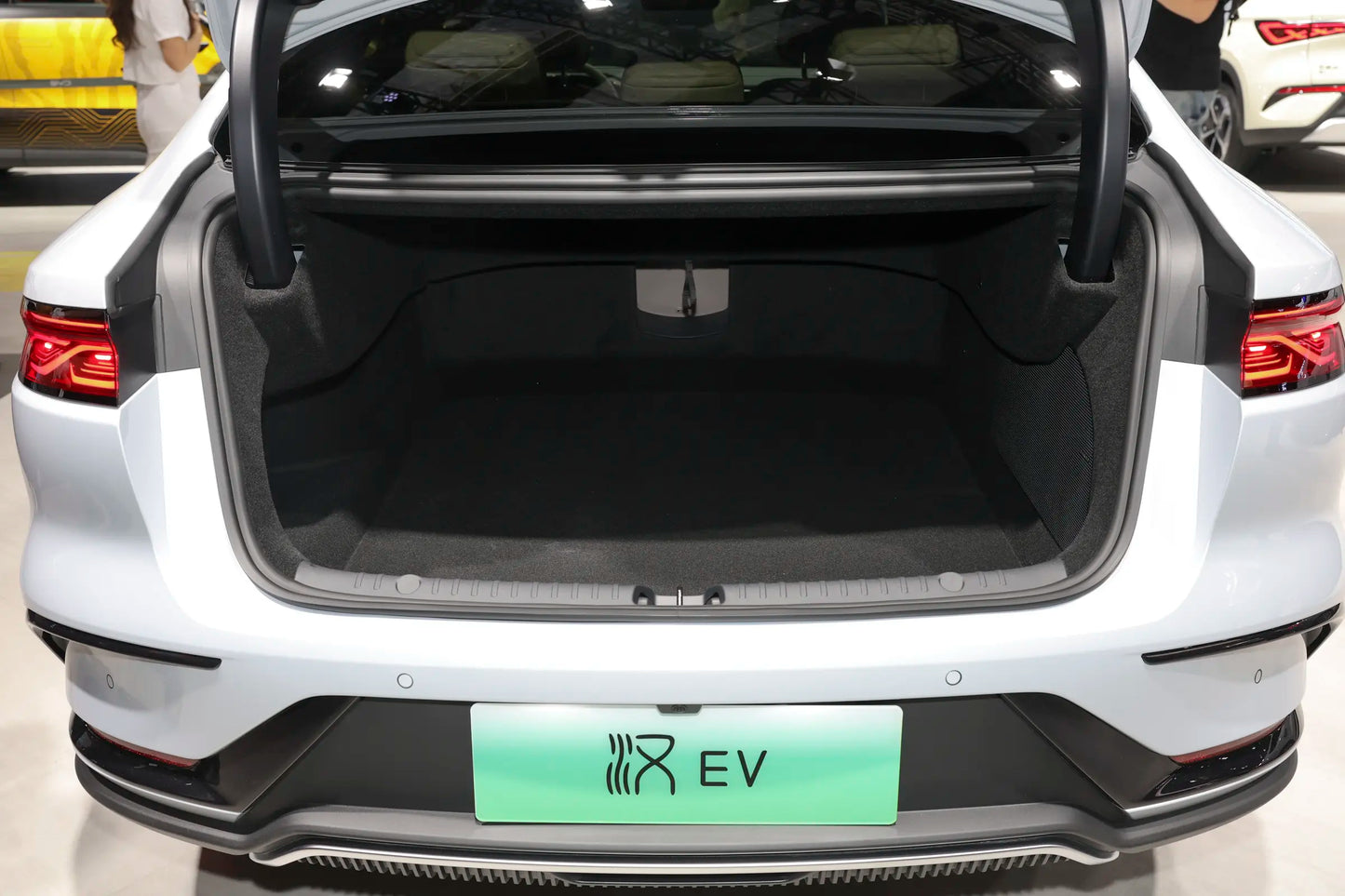
Vehicle Model Profile: BYD Han EV

Vehicle Highlights
-
With a driving range of 506 km and an energy consumption of just 13.2 kWh/100 km, the Han EV delivers longer range and lower operating costs for both daily commuting and weekend trips. Its high-efficiency electric drive system maintains stable output across various driving scenarios, showcasing BYD’s maturity in battery, motor, and energy-management technologies.
-
The five-link suspension, combined with Yunnian-C / FSD damping calibration, significantly enhances ride comfort, cabin quietness, and overall driving stability. Both front and rear seating positions feel natural, and the cabin offers excellent sound insulation, providing a premium and composed ride experience for family travel and long-distance highway journeys.
-
Equipped with a 15.6-inch rotating display, 360° panoramic imaging, and a comprehensive suite of intelligent driver-assistance features, the system offers smooth interaction and clear logic with full functionality coverage. Whether for new drivers or experienced users, it is easy to operate—representing a well-balanced combination of luxury and technology.
Please Note
-
The base model offers more basic configurations in areas such as seat materials, infotainment chip performance, audio quality, and intelligent driving capability. Many advanced functions require the LiDAR-equipped versions. Therefore, buyers need to choose based on their budget and actual usage needs.
-
Some users report that the brake pedal feel is on the softer side. The high-performance versions require some adaptation to the braking rhythm under strong power output. Compared with models tuned for a sportier driving style, the Han EV lacks a more direct braking response.
-
In certain scenarios, the system may experience brief stutters or delayed responses. Although OTA updates can gradually improve this, multitasking under complex usage conditions may still affect the overall experience.
Overview
The BYD Han EV is one of BYD's flagship mid-to-large pure electric sedans under the e-Platform 3.0 technology architecture. Since its launch, the model has consistently ranked among the top sellers in the mid-to-large EV sedan segment. Between 2024 and 2025, the Han EV maintained steady monthly sales of 10,000–18,000 units and frequently claimed the sales champion title in the 200,000–300,000 RMB new-energy sedan category, demonstrating strong market recognition and stable delivery capacity.
The 2025 BYD Han EV offers three range options—506 km, 605 km, and 701 km—catering to different driving needs. Its official price ranges from USD 25,685 to USD 30,828 (approximately RMB 179,800 to 235,800). The model primarily targets family users seeking luxury, comfort, and strong value for money, as well as mainstream EV consumers who prioritize long range, safety, and reliable build quality.
You can explore the vehicle’s exterior and interior design in detail via:
Basic Information
Configuration
Driving Range (km) (CLTC): 506
Driving Range (km) (WLTP): 415 (Reference: EV Range Converter)
Charging Time (hours): Fast charging 0.42 h / Slow charging 8.6 h
100km Power Consumption (kWh/100km): 13.2
Battery Capacity (kWh): 60.48
Maximum Speed (km/h): 185
Vehicle Dimensions (mm): 4995 × 1910 × 1495
Maintenance Costs and Manufacturer Services
Charging Cost Based on the global average residential electricity price of USD 0.17 per kWh (Global Petrol Prices, 2025), the BYD Han EV consumes approximately 13.2 kWh per 100 km, resulting in a charging cost of about USD 2.24 per 100 km.
Maintenance Cost The average annual maintenance cost of an electric vehicle is approximately 30%–40% of that of a gasoline vehicle.
Manufacturer Services The vehicle comes with a 6-year or 150,000-km comprehensive warranty (DCAR, 2025).
Subsidies and Policies
| Examples | |
| Germany | Motor tax exemption for EVs with less than 50g CO2/km emissions or at least 60km range (80km from 2025) until 2030. Privileges for electric cars on German roads, e.g. car parking and bus lane use. (Government of Germany, 2012) |
| Switzerland | Legislative revision including support for recharging stations, an extension of tax exemptions for electric and hydrogen trucks until 2030. (Swiss Federal Government, 2023) |
| Thailand | Tax reductions and exemptions for EVs to promote their deployment (Government of Thailand, 2022) |
| United Kingdom | ZEV mandate: 80% of new cars and 70% of new vans sold in Great Britain will be zero emission by 2030, increasing to 100% by 2035. Around 300 000 public chargers expected as a minimum by 2030 (Government of the United Kingdom, 2023) |
| United States | Alternative Fuel Vehicle Refueling Property Credit offers tax credits up to 30% (up to USD 1 000 for residences or up to USD 100 000 for business) for the installation of alternative fuelling equipment in low-income communities or non-urban areas (Government of the United States, 2023) |
| Mexico | Signatory to COP26 ZEV Declaration to work towards all sales of new cars and vans being zero emission globally by 2040. (Government of Mexico, 2022) |
| United Arab Emirates | Increase EV charging stations to 10 000 in 2030 and 30 000 by 2050. (Government of Dubai, 2023) |
| Brazil | National Green Mobility and Innovation Program ("MOVER") (Government of Brazil, 2024) |
For more, please refer to Global EV Policy Explorer to check the EV policies in your location (Global EV Policy Explorer, 2025)
Competitive Comparison
We selected three pure electric models with a starting price within USD 500 of the 2025 BYD Han EV Intelligent Driving Edition (506 km, USD 25,685 equivalent) and compared them using officially released specifications. The analysis shows that the Han EV stands out in energy efficiency, NVH performance, and lateral cabin comfort, making it a well-rounded and high–value option among mid-to-large electric sedans.
-
Range & Energy EfficiencyThe BYD Han EV delivers 506 km of range with a low consumption of 13.2 kWh/100 km, giving it a "high-efficiency, low-energy" advantage in its segment. Compared with the Hongqi EH7 (600 km range but higher 13.9 kWh/100 km consumption), the Han EV offers lower real-world operating costs and better long-term value. While the XPeng P7 Ultra leads the segment with 702 km of range, it comes at a higher price; the Avatar 06 EV offers only around 230 km CLTC, making it less comparable. Therefore, when considering range, energy consumption, and cost together, the Han EV remains the most balanced and cost-effective choice.
-
Charging PerformanceThe Han EV and the Hongqi EH7 both support 0.42-hour fast charging (30–80%), placing them at the same level. The XPeng P7 Ultra shows a significant advantage with 0.20 hours, and the Avatar 06 achieves 0.25 hours thanks to its high-voltage platform. Although the P7 Ultra and Avatar 06 offer faster replenishment under high-voltage architectures, the Han EV and EH7 still provide stable and reliable fast-charging speeds that remain mainstream in this price segment.
-
Power PerformanceThe BYD Han EV uses a 150 kW motor, prioritizing daily comfort-oriented driving. The Hongqi EH7 and XPeng P7 Ultra deliver 253 kW and 270 kW, respectively, offering stronger acceleration and high-speed performance. The Avatar 06 provides 231 kW, landing in the upper-middle range. Therefore, the Han EV's power delivery focuses on smoothness and comfort rather than sporty performance.
-
Space & PracticalityWith dimensions of 4995 × 1910 × 1495 mm, the Han EV offers balanced space. Although its height is lower than the wide-body XPeng P7, the trunk capacity remains competitive. Its cargo expansion surpasses the Avatar 06 (461–1285 L) but trails the longer-wheelbase EH7 (480–1450 L). Overall, practicality is well-rounded.
-
Technology & Driver AssistanceThe Han EV features BYD’s rotating central display, 360° panoramic imaging, and a comprehensive intelligent driving suite. Its level of functionality is more complete than the Avatar 06 (some features require higher trims) and comparable to the Hongqi EH7. In terms of usability and system stability, the Han EV performs more consistently.
-
Comfort Features:The BYD Han EV delivers excellent NVH performance, offering balanced comfort for both front and rear passengers, with sound insulation and damping tuned more toward comfort. The Hongqi EH7 provides stronger seat support and a heavier, more solid chassis feel. The XPeng P7 adopts a sportier overall tuning with firmer suspension and seating posture, making its long-distance comfort inferior to the Han EV. The Avatr 06 also uses a sport-oriented suspension setup, with vibration filtering that is slightly less refined compared to the Han EV's more composed and stable style.
Summary
The BYD Han EV delivers strong competitiveness in energy efficiency, comfort, NVH, overall space, and pricing. Although its performance and advanced driver-assistance features fall short of the XPeng P7, and it is less aggressive than the LiDAR-equipped Avatar 06 in intelligent driving hardware, the Han EV remains the "stable, all-round performer" in the USD 17k–20k mid-to-large electric sedan segment.
Supported by consistent range performance, balanced features, BYD's proven Blade Battery safety, and superior overall value, it stands out as a dependable and high-value choice for mainstream EV buyers.
| Model / Parameter | Han EV 2025 Smart Driving Edition 506KM Premium | Hongqi EH7 2025 600 Smart Select Edition | Xpeng P7 2025 702 Long Range Ultra | Avatr 06 2025 Pro Extended-Range Edition |
| Basic Infomation | ||||
| Driving Range (km)(CLTC) | 506 | 600 | 702 | 230 (BEV) / 1190 (Combined) |
| Charging Time (hours) | Fast charge 0.42 hours | Fast charge 0.42 hours | Fast charge 0.2 hours | Fast charge 0.25 hours |
| Maximum Power (kW) | 150 | 253 | 270 | 231 |
| Maximum Torque (N·m) | 310 | 450 | 465 | 367 |
| Maximum Speed (km/h) | 185 | 190 | 230 | 190 |
| Body | ||||
| Vehicle Dimensions (mm) | 4995×1910×1495 | 4980×1915×1490 | 5017×1970×1427 | 4855×1960×1467 |
| Number of Seats (units) | 5 | 5 | 5 | 5 |
| Trunk Capacity (L) | 400 | - | 575-1929 | 416-1266 |
| Battery | ||||
| 100km Power Consumption (kWh/100km) | 13.2 | 13.9 | 12 | 17.2 |
| Battery Capacity (kWh) | 60.48 | 75 | 74.9 | 31.7 |
| Additional Features | ||||
| Auto Hold | Standard Equipped | Standard Equipped | Standard Equipped | Standard Equipped |
| Driver Assistance Camera | ● Reverse Camera ● 360° Surround View | ● Reverse Camera ● Blind Spot Camera + 360° Surround View | ● Reverse Camera ● Blind Spot Camera ● 360° Surround View ● Transparent View | ● Reverse Camera ● Blind Spot Camera ● 360° Surround View ● Transparent View |
| Sunroof Type | Openable Panoramic Sunroof | Fixed Panoramic Sunroof | Fixed Panoramic Sunroof | Fixed Panoramic Sunroof |
| Power Seats | Driver and Passenger Seats | Driver and Passenger Seats | Driver and Passenger Seats | Driver and Passenger Seats |
| Drive Mode Selection | ● Sport ● Snow ● ECO ● Comfort | ● Sport ● Snow ● Custom ● ECO ● Comfort | ● Sport ● Snow ● Custom ● ECO ● Comfort ● Launch Mode | ● Sport ● Custom ● ECO ● Comfort |
| Power Windows | Front and Rear | Front and Rear | Front and Rear | Front and Rear |
| Number of USB/Type-C Ports | 4 (Front) and 2 (Rear) | 2 (Front) and 2 (Rear) | 2 (Front) and 2 (Rear) | 2 (Front) and 1 (Rear) |
Data Source: (DCAR, 2025)
Real-world Review
Advantages:
-
Well-rounded overall product strength. The exterior design is mature, the interior offers a notable upgrade in luxury, and the chassis has been upgraded from a three-link to a five-link setup with Yunnian-C/FSD damping. Together, these enhancements give the vehicle a ride quality close to that of a premium executive sedan.
-
Leading performance and intelligent features. It supports an 800V high-voltage platform and delivers strong overall performance.
Areas for Improvement:
-
Significant feature gaps in lower trims. The base model shows noticeable shortcomings in comfort, luxury, and intelligent features, while the advanced intelligent-driving functions are available only on the LiDAR-equipped versions.
-
Average braking performance. Some high-performance variants offer strong acceleration but adopt braking calibration geared more toward household comfort. The braking force transition feels moderate, requiring some adaptation from the driver.
Test review from internal and third-party testing:
-
Smooth and quiet at low speeds with stable, user-friendly intelligent assistance, making it very suitable for daily commuting.
-
Strong power for highway overtaking, a stable chassis, and excellent NVH deliver comfortable long-distance travel; the plug-in hybrid version offers clear fuel-consumption advantages with low range anxiety.
Real User Reviews
In 2025, we conducted a structured questionnaire survey among BYD Han EV owners on the highly influential DCAR automotive forum. A total of 421 valid responses were collected. Through qualitative analysis of the feedback, we summarized 15 distinct positive feedback dimensions (with 15 specific statements) and 13 negative feedback dimensions (with 13 specific statements) (DCAR, 2025).
Positive Feedback
Excellent cabin quietness
Summary: Car owners generally believe that the Han EV has outstanding quietness. The cabin has excellent sound insulation and gentle shock absorption, providing an overall quiet and comfortable riding experience. After closing the window, it forms a clear isolation from the outside world, creating a rare sense of high-end tranquility in its class.
Strong power performance
Summary: Abundant power, quick response in ECO mode, and effortless overtaking.
Negative Feedback
The storage space is relatively small
Summary: Insufficient storage space, difficult to meet family travel needs.
The car's infotainment system is lagging
Summary: Infotainment lag and rearview mirror reset issues
References
DCAR (2025). DCAR. Retrieved from https://www.dongchedi.com/auto/series/20041
EV Range converter (2025). EV Range converter. Retrieved from https://ev-range-standard-converter.web.app/
Global EV Policy Explorer (2025). Explore key policies and measures for EV deployment. Retrieved from https://www.iea.org/data-and-statistics/data-tools/global-ev-policy-explorer?utm_source=chatgpt.com
Global Petrol Prices (2025). World Average Electricity Prices, USD / kWh. Retrieved from https://www.globalpetrolprices.com/electricity_prices/