BMW X3 2022 xDrive25i M Sport Vehicle Profile: German Handling Benchmark?

Model Overview: Market Position & Credibility
The BMW X3 is one of BMW's best-selling mid-size SUVs, forming the "iron triangle" of premium German mid-size SUVs alongside the Mercedes-Benz GLC and Audi Q5L. The 2022 model is the mid-cycle refresh of this generation (G08 platform), launched in August 2021. Produced locally in China by BMW Brilliance, it arrived earlier than many rivals and benefits from mature localized manufacturing and after-sales support.
The X3 lineup has undergone several iterations since localization; the 2021 refresh upgraded the front fascia, interior, and infotainment system, boosting both luxury feel and technology. As a sport-oriented luxury SUV, its positioning emphasizes "driving pleasure first," differentiating it from the space-focused Q5L and luxury-focused GLC.
In terms of design, the M Sport package gives it a more aggressive front bumper, sport wheels, and blacked-out details, complemented by the double-kidney grille and sharp headlights for a clean, athletic look. The 2.0L turbocharged four-cylinder paired with a ZF 8AT and full-time xDrive all-wheel drive balances everyday smoothness with occasional spirited driving.
In terms of sales, the premium mid-size SUV segment has always been a hot category in China's high-end market. The X3 consistently ranks among the top sellers in this segment, with strong volumes and good resale value.
You can get a complete look at the vehicle's exterior and interior design through the following video:
Core Specifications
Model: BMW X3 2022 xDrive25i M Sport Powertrain type: Gasoline Engine: 2.0T 204 hp L4 (B48B20C) Max power: 150 kW (204 hp) Peak torque: 300 N·m Transmission: 8-speed automatic Top speed: 210 km/h Official 0-100 km/h: 8.9 seconds WLTC combined fuel consumption: 8.3 L/100km Fuel grade: 95 RON Fuel tank capacity: 65 L Dimensions (L×W×H): 4,737 × 1,891 × 1,689 mm Wheelbase: 2,864 mm Seating: 5 seats Body type: 5-door 5-seat SUV Drivetrain: Front-engine, AWD (xDrive full-time) Front suspension: Strut-type independent Rear suspension: Multi-link independent Curb weight: approx. 1,855 kg
Maintenance costs & manufacturer service: Full vehicle warranty is 3 years or 100,000 km (whichever comes first). Total maintenance cost over 60,000 km is estimated at about USD 2,317. BMW's service network has wide coverage in China, and routine maintenance (oil, filters, etc.) cycles and pricing are relatively transparent. However, compared with some Japanese or domestic rivals, the maintenance and parts costs for a premium brand run higher.
Subsidy policy: As a conventional petrol vehicle, the BMW X3 does not qualify for China's NEV purchase tax exemption or new-energy subsidies. In overseas markets, some countries and regions impose purchase or environmental taxes on petrol vehicles (such as vehicle tax in parts of Europe or the UK's Vehicle Excise Duty), with amounts varying by emissions and region. Consult the IEA Global EV Policy Explorer for the differing policies applied to petrol vehicles across countries.
Three Highlights & Three Caveats
Highlight 1: Class-leading driving dynamics Powered by a 2.0L turbocharged inline-4 engine paired with an 8-speed automatic transmission and full-time xDrive all-wheel drive, with strut-type front and multi-link rear independent suspension, this mid-size SUV drives closer to a sports sedan. Precise steering and strong cornering composure make it a key draw for driving enthusiasts.
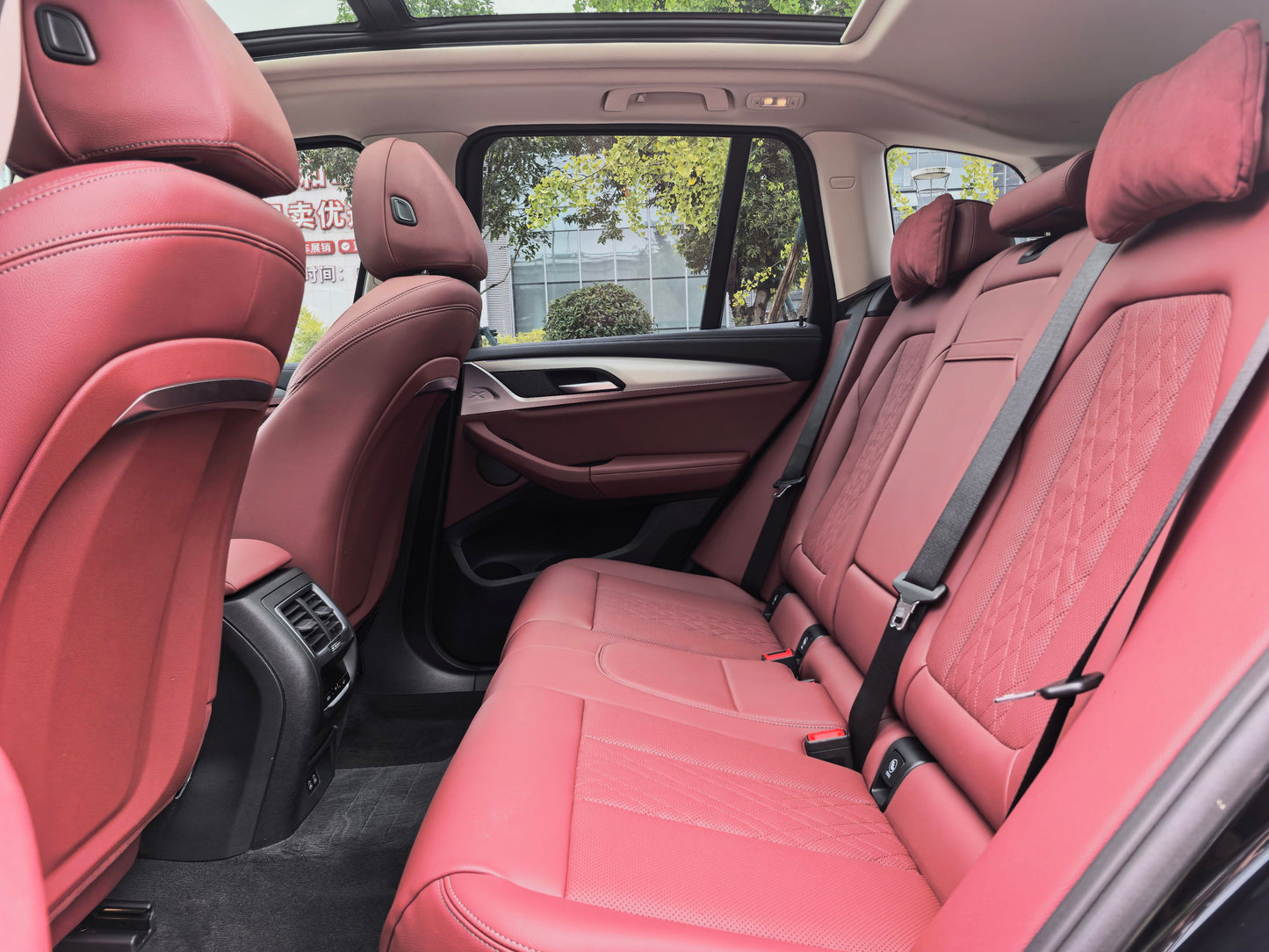
Highlight 2: Premium badge and build quality Built by BMW Brilliance, this model carries strong brand recognition. The interior features extensive soft-touch materials and solid build quality, while the M Sport package adds aggressive visual styling. A 12.3-inch fully digital instrument cluster, panoramic sunroof, and heated front seats round out everyday comfort.
Highlight 3: Balanced power and fuel economy The 204-hp low-output tune is far from weak, reaching 100 km/h in 8.9 seconds—enough for most scenarios. Official WLTC combined fuel consumption of 8.3 L/100km, mated to a well-sorted 8AT, makes it relatively economical among luxury mid-size SUVs.
Caveat 1: Rear space is on the compact side At 4,737mm long with a 2,864mm wheelbase, rear legroom and overall spaciousness trail stretched rivals like the Audi Q5L. Families who routinely carry passengers should test it in person.
Caveat 2: Config compromises at the entry level As the entry-level 25i powertrain, some comfort and driver-assist features (such as keyless entry and certain driver aids) are optional rather than standard, leaving a gap in technology content compared with higher trims.
Caveat 3: Real-world city fuel economy runs high Official figures are optimistic; real owners report city driving in congestion can exceed 11 L/100km, dropping to around 7.5 L/100km on the highway. City commuters should factor these costs into their budget.
Ownership Costs & Service
Warranty policy: Full vehicle warranty is 3 years or 100,000 km; unlimited-mileage warranty schemes are standard among premium brands. BMW offers free first service and official maintenance packages (e.g., maintenance plans/extended warranty options) that can help lock in some costs in advance.
Maintenance costs: Total maintenance cost over 60,000 km is estimated at about USD 2,317, covering oil, filters, air filters, brake fluid, spark plugs, and other routine items. BMW's official maintenance system offers transparent pricing and standardized items, but labor and parts costs exceed mainstream brands. Follow the official maintenance schedule to avoid over-servicing.
Real ownership cost analysis: As a conventional petrol luxury SUV, ownership costs mainly include three parts: fuel, maintenance, and insurance. Based on official WLTC fuel consumption of 8.3 L/100km and 20,000 km per year, roughly 1,660 L of fuel is consumed annually. Combined with higher-than-average city-cycle real-world consumption, annual fuel spend is meaningful. Premium-brand insurance premiums and later-stage maintenance costs also run higher than ordinary joint-venture brands.
Fuel cost estimate (based on global average prices): Using the global average petrol price published by Global Petrol Prices (approx. USD 1.4/L), a year of 20,000 km at 8.3 L/100km yields an annual fuel cost of about USD 2,324. Using China's domestic 95 RON gasoline price (about USD 1.0/L), annual fuel cost is about USD 1,660. Under city congestion, real-world consumption can reach 11 L/100km, pushing fuel spend higher.
Fuel prices are based on Global Petrol Prices global data for rough estimation only; actual costs vary by region and driving habits.
Competitors Comparison
In the premium mid-size SUV market, the BMW X3's most direct rivals are the Mercedes-Benz GLB, Audi Q5L, and Cadillac XT5. The four models share a similar positioning but different priorities. The following points help you quickly grasp the differences:
-
Powertrain orientation: The BMW X3 (204 hp) and Audi Q5L (190 hp) are close on paper, while the Cadillac XT5 offers the strongest figures with 237 hp plus a 48V mild-hybrid; the Mercedes-Benz GLB 220 delivers 190 hp with a balanced tune.
-
Size and space: The Cadillac XT5 (4,813mm) and Audi Q5L (4,770mm) are longer, and the Q5L's 2,907mm wheelbase leads in rear space; the BMW X3 (4,737mm) and GLB (4,638mm, but offering 7 seats) each make their own trade-offs.
-
Drivetrain and handling: The BMW X3 uses full-time all-wheel drive, while the GLB, Q5L, and XT5 use on-demand AWD; BMW's handling tuning leans more toward the driver.
-
Fuel economy: The Audi Q5L (7.86 L/100km WLTC) and Cadillac XT5 (7.97 L/100km) are relatively more efficient, while the BMW X3 (8.3 L/100km) and Mercedes GLB (8.35 L/100km) run slightly higher.
|
Comparison Item
|
BMW X3 2022 xDrive25i M Sport
|
Mercedes-Benz GLB 2022 GLB 220 4MATIC
|
Audi Q5L 2022 40 TFSI Fashion
|
Cadillac XT5 2022 2.0T AWD Premium
|
|
Class
|
Mid-size SUV
|
Compact SUV
|
Mid-size SUV
|
Mid-size SUV
|
|
Powertrain
|
Gasoline
|
Gasoline
|
Gasoline
|
Gasoline (48V mild hybrid)
|
|
Engine
|
2.0T 204 hp L4
|
2.0T 190 hp L4
|
2.0T 190 hp L4
|
2.0T 237 hp L4 48V
|
|
Max power (kW)
|
150
|
140
|
140
|
174
|
|
Peak torque (N·m)
|
300
|
300
|
320
|
350
|
|
Transmission
|
8-speed automatic
|
8-speed wet dual-clutch
|
7-speed dual-clutch
|
9-speed automatic
|
|
Dimensions (L×W×H, mm)
|
4,737×1,891×1,689
|
4,638×1,834×1,700
|
4,770×1,893×1,667
|
4,813×1,903×1,686
|
|
Wheelbase (mm)
|
2,864
|
2,829
|
2,907
|
2,857
|
|
Body type
|
5-door 5-seat SUV
|
5-door 7-seat SUV
|
5-door 5-seat SUV
|
5-door 5-seat SUV
|
|
Top speed (km/h)
|
210
|
205
|
211
|
210
|
|
Official 0-100 km/h (s)
|
8.9
|
8.7
|
9.0
|
8.3
|
|
WLTC combined fuel (L/100km)
|
8.3
|
8.35
|
7.86
|
7.97
|
|
Fuel tank capacity (L)
|
65
|
60
|
73
|
82
|
|
Cargo volume (L)
|
—
|
—
|
550
|
584-1,634
|
|
Drivetrain
|
Front-engine AWD (full-time)
|
Front-engine AWD (on-demand)
|
Front-engine AWD (on-demand)
|
Front-engine AWD (on-demand)
|
|
Front suspension
|
Strut-type independent
|
MacPherson independent
|
Multi-link independent
|
MacPherson independent
|
|
Rear suspension
|
Multi-link independent
|
Multi-link independent
|
Multi-link independent
|
Multi-link independent
|
|
Front/Rear brakes
|
Ventilated disc/Ventilated disc
|
Ventilated disc/Solid disc
|
Ventilated disc/Ventilated disc
|
Ventilated disc/Ventilated disc
|
|
Tire size
|
245/50 R19
|
235/50 R19
|
235/55 R19
|
235/55 R19
|
|
Sunroof
|
Panoramic, opening
|
Segmented opening
|
Panoramic, opening
|
Panoramic, opening
|
|
Digital instrument cluster
|
12.3-inch fully digital
|
10.25-inch fully digital
|
Fully digital
|
Fully digital
|
|
Front seat heating
|
Standard
|
Optional
|
Optional
|
Standard
|
|
Keyless start
|
Standard
|
Standard
|
Standard
|
Standard
|
|
Active braking
|
Standard
|
Standard
|
Standard
|
Standard
|
|
Adaptive cruise control
|
Optional
|
Optional
|
Standard (adaptive)
|
Standard
|
Summary: The choice among these four is actually quite clear. If "fun to drive" is your top priority, the X3's full-time AWD, precise steering, and sport-tuned chassis are its biggest strengths—but you must accept relatively compact rear space and slightly higher fuel consumption. The Audi Q5L is the balanced pick for space and comfort, with the longest wheelbase, the roomiest rear, and the lowest consumption.
The Cadillac XT5 offers the strongest on-paper power with 237 hp plus a 48V mild hybrid, the largest dimensions, and richer features, making it the value-oriented choice. The Mercedes-Benz GLB stands out through its 7-seat layout for multi-occupant family scenarios, though as a compact SUV its third row is better suited to occasional use. Each model has its strengths; the final decision comes down to how you weigh driving, space, brand, and features.
Expert Test Drive — Pros & Cons
Pros:
-
Responsive and smooth powertrain: The 2.0T engine and 8AT work maturely together, delivering brisk launches and effortless highway overtaking, with smooth shifts for a composed daily drive.
-
Benchmark handling: The chassis is taut with excellent cornering body control and high-speed stability, precise steering, and the characteristic BMW sportiness.
-
Solid interior materials and build: Extensive soft-touch covering, solid workmanship, and the expected premium-brand feel, with comfortable seats.
Could be improved:
-
Relatively compact rear space: Compared with stretched rivals, rear legroom feels a bit tight and affects comfort on full long trips.
-
Noticeable highway noise: Tire and wind noise are evident at highway speeds, and cabin insulation is only middling.
-
Average infotainment and smart features: The infotainment has a learning curve, some low-trim driver-assist features are optional, and the smart experience lags new-energy rivals at a similar price.
Test scenarios:
-
Highway cruising and overtaking: At 120 km/h the body is stable with sufficient mid-range response for confident overtaking (Source: professional media test; WLTC combined 8.3 L/100km).
-
City congestion: Low-speed starts are smooth and easy to follow traffic, but real owners report city congestion consumption above 11 L/100km, showing a clear drop in fuel economy under stop-and-go traffic (Source: owner combined fuel consumption crowd data).
Real Owner Reviews
Positive feedback:
Exterior & presence: Owners generally praise the X3's exterior design; the M Sport styling and front-end presence are key highlights.
"The exterior is truly striking and premium-looking, like a car full of fighting power. The front-end identity is very high, the lines are smooth and elegant."
Power & handling: Powertrain response, chassis solidity, and driving feel are what owners like most—brisk launches, light steering, and agile handling.
"Starting is very easy and fast, the engine is reliable, the steering wheel is very light, and the throttle and brake are well tuned and responsive, making it very confident to drive."
Interior & materials: Soft-touch coverage, solid build, premium feel, and comfort earn owner approval; seats are wide and soft.
"Everything you touch is soft-touch material, the build quality is solid, the seats are wide and long, very soft, and the cabin is quiet."
Negative feedback:
Small rear space: Rear space is a common complaint, feeling cramped especially when full or for space-sensitive users.
"Space is average at best; the rear is mediocre, and even people under 175 cm find legroom a bit tight."
Noise & fuel consumption: Highway noise and higher city fuel consumption are the most frequently reported issues.
"Tire and wind noise are quite noticeable at highway speeds and sound insulation is only average; in city traffic consumption can exceed 11 L/100km, making fuel costs higher than expected."
References
-
Global Petrol Prices (2025). World Average Gasoline Prices, USD / Liter. Retrieved from https://www.globalpetrolprices.com/gasoline_prices/
-
IEA. Global EV Policy Explorer. Retrieved from https://www.iea.org/data-and-statistics/data-tools/global-ev-policy-explorer
-
BMW (BMW Brilliance). BMW X3 Specifications. Retrieved from https://www.bmw.com.cn/
-
Trading Economics. Gasoline Prices - Countries - List. Retrieved from https://tradingeconomics.com/country-list/gasoline-prices