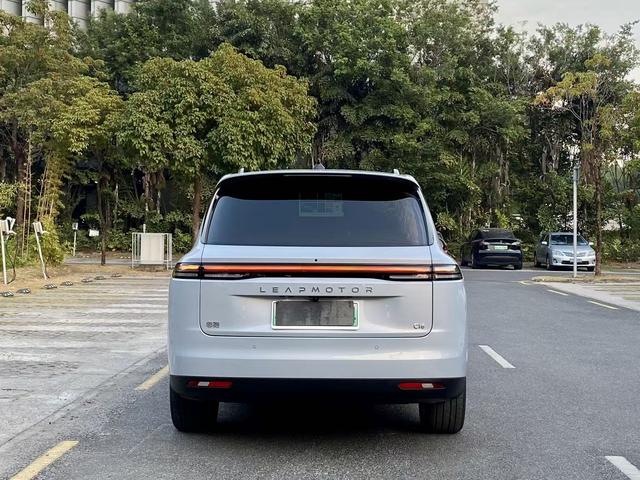
Leapmotor C16 2027 EREV LiDAR Vehicle Profile: 280km EV Range, Standard 128-Line LiDAR Large SUV

1. Conclusion: Three Highlights and Three Caveats
- Highlight 1: 280 km CLTC electric range — mostly pure-electric city driving — The 2027 EREV version uses a larger LFP battery and delivers a CLTC pure-electric range of 280 km, so a week of city commuting can run almost entirely on electricity; on a full tank plus full charge the combined range exceeds 1000 km, keeping long trips anxiety-free.
- Highlight 2: LiDAR + Qualcomm Snapdragon 8650 — class-above driving-assist hardware — The Premium (Zhizun) trim comes standard with a 128-line LiDAR (AT128), three millimetre-wave radars and Qualcomm Snapdragon 8650-class compute, paired with the Leapmotor Pilot system for highway navigation and all-scenario smart parking — rare at this end of the large-SUV segment.
- Highlight 3: Practical space and rich features in a large 5-seat SUV — At 4925×1908×1770 mm with a 2825 mm wheelbase, the C16 is positioned as a large SUV with a roomy 5-seat cabin and generous boot; a near-2.1-tonne stable platform plus a well-equipped smart cockpit makes it balanced for family use.
- Caveat 1: High depleted-battery fuel consumption — charge it regularly — The range extender starts early, and measured depleted-battery consumption is about 7.3–8.0 L/100km — higher than most comparable EREV/PHEVs. If it is run as a petrol car without charging, the cost advantage drops sharply, so keeping some battery is advisable.
- Caveat 2: Driving assist can occasionally misjudge; stay attentive — Some owners report that advanced driving assistance occasionally hesitates or misjudges in complex traffic, requiring manual takeover. As an L2 system, keep continuous attention on the road.
- Caveat 3: Brand service network is still expanding — Leapmotor is a newer NEV brand, and its sales/service network in overseas and some regions is still being built out. The whole-vehicle warranty is 4 years / 120,000 km (with a lifetime EV-system warranty), and after-sales coverage is more limited than established mainstream brands.
2. Model Overview
The Leapmotor C16 is Leapmotor’s large SUV, positioned around “big space + strong equipment + outstanding value for money,” aimed at family users and tech-oriented buyers. Since launch the C16 has delivered steadily, sharing the platform with the C10. Its combination of space, dual powertrains (pure EV/EREV), available LiDAR across trims and flagship cockpit equipment has carved out a niche in the RMB 150k–250k large-SUV segment.
The 2027 model is a refreshed version launched in mid-2026. Compared with earlier versions, it upgrades pure-electric range (to 280 km), battery capacity and all-trim driving-assist hardware (LiDAR + Snapdragon 8650), and offers both 5-seat and 6-seat layouts to suit different family structures.
Design-wise, the C16 keeps Leapmotor’s clean, rounded family language: a full-width front light bar with a closed grille, clean side lines with hidden door handles and rear privacy glass. The minimalist cabin features hidden electric vents and waterfall ambient lighting, with a standard 10.25-inch digital cluster and a 14.6-inch floating central screen, plus several exterior and interior colour options.
You can get a full look at the exterior and interior design through the video below:
3. Core Specifications
| Item | Specification |
|---|---|
| Model | Leapmotor C16 2027 EREV 280 LiDAR Premium (Zhizun) 5-Seat |
| Powertrain | Extended-Range Electric Vehicle (EREV) |
| Engine | 1.5L four-cylinder naturally aspirated range extender |
| Drivetrain | Single rear motor (RWD) |
| Pure-Electric Range (CLTC) | 280 km |
| Combined Range | over 1000 km (full tank + full charge) |
| Battery | LFP, approx. 38.9 kWh |
| Battery Fast-Charge Time | approx. 0.27 h (30%–80%) |
| Motor Max Power | 200 kW |
| Motor Max Torque | 360 N·m |
| 0–100 km/h | 8.3 s |
| Top Speed | 180 km/h |
| WLTC Combined Fuel Consumption | 0.56 L/100km (depleted approx. 6.29 L/100km) |
| Dimensions (L×W×H) | 4925 × 1908 × 1770 mm |
| Wheelbase | 2825 mm |
| Seats | 5 |
| Curb Weight | approx. 2120 kg |
| Whole-Vehicle Warranty | 4 years / 120,000 km |
| EV/Battery System Warranty | Lifetime (first non-commercial owner, subject to manufacturer terms) |
| Smart Driving | Leapmotor Pilot, 128-line LiDAR (AT128) + Snapdragon 8650-class compute, 3 mmWave radars |
| Comfort Features | Panoramic sunroof, hidden electric vents, waterfall ambient lighting, 10.25” cluster + 14.6” central screen, multi-zone voice control |
Subsidies and Policies (varies widely by region; refer to the latest local policy):
| Country / Region | Main Policy Type | Notes |
|---|---|---|
| China | Purchase-tax reduction + local subsidies | EREV/PHEVs enjoy certain tax benefits and, in some cities, exemption from plate restrictions |
| EU | Purchase incentives + tax benefits | Many countries offer subsidies or tax relief for EREVs/PHEVs/EVs; amounts differ by country |
| US | Federal tax credit + state incentives | Depends on battery sourcing and price thresholds |
| Southeast Asia | Import-duty relief & incentives | Several countries are promoting local NEV production and lower import tariffs |
Source: IEA Global EV Policy Explorer. Policies are subject to the latest local rules.
4. Ownership Costs & Service
- Warranty: The car carries a 4-year / 120,000 km whole-vehicle warranty, with a lifetime warranty on the EV/battery system for the first non-commercial owner (subject to manufacturer terms).
- Maintenance Costs: As an extended-range vehicle, the structure is relatively simple — the engine only acts as a generator in depleted-battery mode, so servicing focuses on routine checks (oil, electronics, cooling) and costs less than a conventional petrol car. When used mostly on pure electric, engine runtime is low and maintenance needs are minimal.
- Charging Costs: Using the Global Petrol Prices world-average residential electricity price of about USD 0.176/kWh, even at a generous consumption of roughly 14 kWh/100km, charging costs about USD 2.5 per 100 km of pure-electric driving. Comparable petrol SUVs typically consume 8–10+ L/100km, so the fuel-versus-electric gap gives a clear cost advantage.
5. Competitor Comparison
Against the Nissan NX8 EREV, iCAR V27 and eTT008 — all large extended-range SUVs — the Leapmotor C16 differentiates on four key points:
- Balanced EV range and combined range: The C16’s 280 km CLTC pure-electric range ties the Nissan NX8 (280 km) and beats the iCAR V27 (210 km) and eTT008 (202 km); combined range exceeds 1000 km for long trips.
- Stronger driving-assist hardware: The C16 Premium trim comes standard with a 128-line LiDAR plus Snapdragon 8650-class compute and three millimetre-wave radars; several comparables rely on a monocular camera or fewer radars, so the C16’s sensor redundancy and capability differ.
- Different size/space focus: All four are large SUVs. The C16’s 1770 mm height is comparable, its 2825 mm wheelbase and 5-seat layout give a roomy cabin; the eTT008 is the longest but space utilization depends on layout.
- Different performance profiles: The C16 delivers 200 kW / 360 N·m and 8.3 s 0–100 km/h; the NX8 makes 195 kW / 310 N·m / 8.8 s, the iCAR V27 185 kW / 300 N·m / 8.4 s, and the eTT008 200 kW / 340 N·m / 8.8 s — the C16 is balanced overall.
| Spec | Leapmotor C16 2027 EREV 280 LiDAR Premium 5-Seat | Nissan NX8 2026 EREV 260 Pro | iCAR V27 2026 210KM 2WD Falcon 500 | eTT008 2026 5-Seat EREV Ultra-Wide |
|---|---|---|---|---|
| Class | Large SUV | Large SUV | Large SUV | Large SUV |
| Powertrain | EREV | EREV | EREV | EREV |
| CLTC Electric Range (km) | 280 | 280 | 210 | 202 |
| Battery Fast-Charge Time (h) | 0.27 | 0.26 | 0.28 | 0.25 |
| Fast-Charge SOC Window | 30%–80% | 20%–80% | 30%–80% | 30%–80% |
| System Max Power (kW) | 200 | 195 | 185 | 200 |
| System Max Torque (N·m) | 360 | 310 | 300 | 340 |
| 0–100 km/h (s) | 8.3 | 8.8 | 8.4 | 8.8 |
| Top Speed (km/h) | 180 | 180 | 180 | 180 |
| WLTC Combined Fuel Consumption (L/100km) | 0.56 | 0.70 | 1.83 | 0.79 |
| Dimensions (L×W×H, mm) | 4925×1908×1770 | 4870×1920×1680 | 5055×1976×1894 | 6002×1972×1732 |
| Seats | 5-seat SUV | 5-seat SUV | 5-seat SUV | 5-seat SUV |
| ADAS Compute Chip | Qualcomm Snapdragon 8650 | Horizon Journey 6M | — | — |
| Front Perception Camera | 8 MP | Monocular / 8 MP | Monocular | Monocular |
| Millimetre-Wave Radars | 3 | 3 | 1 | 2 |
| LiDAR | AT128 (128-line) | — | — | — |
| Whole-Vehicle Warranty | 4 yr / 120,000 km | 6 yr / 150,000 km | 5 yr / 120,000 km | 4 yr / 100,000 km |
Note: “—” indicates a value not clearly shown in the provided screenshots; verify competitor figures against official final specifications.
Summary: All four are large extended-range SUVs; the real differentiators are EV range and driving-assist hardware. The Leapmotor C16 wins on a balanced 280 km electric range and — rare at this price — a standard 128-line LiDAR plus Snapdragon 8650 driving-assist package, making it most attractive to buyers wanting “low-cost pure-electric commuting plus advanced smart driving.” The Nissan NX8 and iCAR V27 each emphasize brand/service and body size; the eTT008 differentiates with a longer body and warranty.
6. Expert Test Drive: Pros, Cons and Real-World Scenarios
Pros:
- Extended-range plus long EV range covers both city electric and long trips; 280 km CLTC pure-electric range keeps daily commuting cheap, and combined range exceeds 1000 km.
- Generous driving-assist hardware — 128-line LiDAR, multi-sensor fusion and Snapdragon 8650-class compute, so highway navigation and all-scenario smart parking lead this price segment.
- Balanced space and equipment — the large-SUV wheelbase and 5-seat layout give a spacious cabin, with a smart cockpit and rich comfort features covering family needs.
Areas to Improve:
- Higher depleted-battery fuel consumption: the range extender starts early; measured depleted use is about 7.3–8.0 L/100km (winter test up to 7.96 L/100km), so long-distance fuel mode is less economical than comparable PHEVs.
- Noticeable highway wind noise; NVH at speed is only average and could be better.
- Driving assist can occasionally misjudge and needs human takeover in complex scenarios; as an L2 system, keep attention on the road.
Real-World Scenarios:
- Highway battery-hold fuel economy: Under the XCX-Test PHEV standard, a battery-hold (50%) highway test measured about 7.3 L/100km, close to the displayed figure (source: XCX professional test, 2024).
- Depleted-battery consumption: A winter test measured about 7.96 L/100km — among the highest in that test group, indicating it is best to keep the battery charged day-to-day (source: winter professional test, compiled via Sohu Auto / related organizations).
7. Real Owner Reviews
Positive Feedback:
- Space and value-for-money: Most owners describe it as “spacious and comfortable to ride” and “great value at this price — equipment is stacked,” with the big cabin and rich smart/comfort features making it popular with families and value-seeking buyers.
- Solid pure-electric range and low daily cost: Owners report city consumption of about 11–14 kWh/100km, with the 280 km CLTC range achieving a high real-world ratio in urban commuting; day-to-day they rarely need petrol, giving a clear cost advantage.
- Rich smart-driving and cockpit equipment: With standard LiDAR and high-compute chip plus a smooth infotainment system (Snapdragon 8295/8650 series), owners generally recognize the sincerity of its intelligent configuration.
Negative Feedback:
- High depleted-battery consumption — not thrifty when uncharged: “The range extender starts too early; depleted city driving can hit around 8 L/100km, about the same as a petrol SUV. You really need to keep charging for it to pay off.”
- Noticeable highway wind noise; average NVH: “Wind noise is quite obvious on the highway; the cabin isn’t as quiet as expected — sound insulation could be better.”
- Driving assist occasionally misjudges: “Driving assist sometimes hesitates or misjudges on ring roads and in work zones, needing manual takeover — you have to keep watching it.”
(Reviews compiled from automotive-platform owner feedback; for reference only, not representative of all owners.)
8. References
- Global Petrol Prices (2026). World Average Electricity Prices, USD / kWh. Retrieved from https://www.globalpetrolprices.com/electricity_prices/
- IEA. Global EV Policy Explorer. Retrieved from https://www.iea.org/data-and-statistics/data-tools/global-ev-policy-explorer
- Leapmotor Official Website. Leapmotor C16. Retrieved from https://www.leapmotor.com/
- Owner reviews and professional evaluation data compiled from automotive platforms (August 2026)